




New Delhi: The ongoing war between Iran and Israel/the United States has entirely changed the geopolitical landscape of West Asia. Several countries in the region play a significant role for India on multiple fronts: from being a crucial source for energy security to sea lane security and being a second home to millions of Indian workers. While there are no signs of an immediate truce between the conflicting parties, it is becoming increasingly difficult for India to continue with its balancing act policy.
To address these geopolitical dynamics and India’s strategy during the war, the International Dialogue and Diplomacy Foundation (IDDF) organized a symposium on “India’s West Asia Relations after the Iran–Israel/US War” on May 18, 2026, at the Constitution Club of India, New Delhi. This event provided an opportunity for analyzing such a dynamic scenario and understanding its ramifications for India.
The symposium, chaired by Ambassador K.P. Fabian, focused on crisis management, strategic opportunity, and Indian policy in the war and post-war period. It addressed critical issues and achieved strategic objectives in policy formulation, strategic balancing, diaspora and humanitarian security, energy and economic security, and global leadership transitions.
Ambassador Fabian said that India’s post-war policy towards West Asia inevitably depends on how it conducted itself during the war. Drawing attention to the tense world situation, he cited Donald Trump who said, “The clock is ticking for Iran,” while reminding the US that the clock is ticking for the President as well.
Dr. Sreeram Chaulia, Dean of Jindal School of International Affairs, O. P. Jindal University, Sonipat, said the war did not happen in a vacuum but rather in connection to the attacks on October 7, 2023. He emphasized the significance of West Asia for India in terms of energy, diaspora, remittances, and commerce, and how India faces the challenge of being a partner to both sides of the conflict while ensuring its commercial interests via the Strait of Hormuz. Dr. Chaulia dismissed Pakistan’s US-driven mediation role as untenable for Israel. “India’s presence in global forums makes it a far superior peace broker, leveraging international diplomacy to project itself as a rising power through proactive but cautious engagement,” he said.
While answering a question, Dr. Chaulia clarified that an attempt from India to make overseas bases will not be considered military adventurism since, in the current geopolitical scenario and global rivalries, it is important for India to also assert itself.
Lt. Gen. Arvinder Singh Lamba emphasized the need for effective military diplomacy as a sustainable approach to conflict resolution and deterrence. He described the existing scenario as a delicate contactless war marked by asymmetry, drones, and denial of airspace. Emphasizing that any political overreach in military matters leads to catastrophic results for world energy security, he highlighted the involvement of major players such as Russia and China. Crucially, he noted how Houthi maritime aggression near the Strait of Hormuz, including targeted strikes on India-bound commercial shipping vessels, complicates broader regional security and India’s bilateral dynamics.
Ambassador Dr. Ausaf Sayeed, who has served as India’s Ambassador to Saudi Arabia and Yemen, said that changes in regional dynamics, such as the Saudi-Iran rapprochement mediated by China in March 2023 and regional attention to Vision 2030, have led to a loss of the traditional strategic credibility of the US to the advantage of China. He pointed out that India is one of the casualties of the “double blockade” imposed by the conflict around the Strait of Hormuz, facing huge economic challenges related to the import of agricultural fertilizer, $50 billion worth of remittances from the Indian diaspora, and connectivity projects such as Chabahar and IMEC. He also spoke about how India has made a “midway course correction” during the war. At the beginning of the war, India appeared to be standing with Israel, while in the later phase, it engaged with all the parties. He also said that on the question of Palestine, India is back to its position of supporting a two-state solution based on pre-1967 borders.
Colonel Rajeev Agarwal said that the conflict is an unnecessary war with severe global ramifications. He spoke about the asymmetric “war of percentages” strategy of observation, endurance, dispersion, and diversion. “While the aim of the war was to attack Iran’s nuclear and missile programs to bring about a regime change, it has gravely undermined the US credibility and opened up critical vulnerabilities within the supply chain,” he said.
INDIA NEWS STREAM
India criticises record-keeping of negotiations for UNSC reforms
United Nations: India has criticised the record-keeping of the negotiations for Security Council reforms, pointing out that the document from the last meeting obfuscated the extent of support for expansion...
MEA lists six major outcomes of PM Modi’s historic and successful Sweden visit
Gothengburg: As Prime Minister Narendra Modi concluded his third leg of his successful Sweden visit during the five-nation tour, the Ministry of External Affairs (MEA) has listed six significant outcomes...
Lack of understanding: India rebuts questions on press freedom, minority rights during PM’s Netherlands visit
The Hague: India strongly pushed back against questions relating to “press freedom” and “minority rights” during Prime Minister Narendra Modi’s visit to the Netherlands, as senior diplomat Sibi George delivered...
In Netherlands, PM Modi highlights India’s diverse culture and development trajectory since 2014
The Hague: Lauding the Indian community's vibrancy, enthusiasm and spirit of celebrating life which always remains alive, Prime Minister Narendra Modi on Saturday said while history has witnessed numerous civilizations...
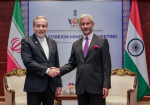
EAM Jaishankar meets Iranian FM Araghchi, reviews West Asia situation
New Delhi: External Affairs Minister (EAM) S Jaishankar on Friday met his Iranian counterpart Seyed Abbas Araghchi in New Delhi, where the two leaders exchanged views on the evolving situation...
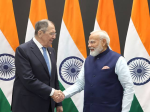
Russian FM calls on PM Modi, discusses situation in Ukraine and West Asia
New Delhi: Russian Foreign Minister Sergei Lavrov called on Prime Minister Narendra Modi in New Delhi on Thursday, discussing the various regional and global issues of mutual interest, including the...
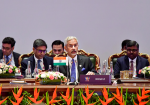
EAM Jaishankar flags fragile West Asia situation, says safe waterways vital for global economic well-being
New Delhi: Highlighting the fragile security environment in West Asia, External Affairs Minister (EAM) S. Jaishankar on Thursday said that persistent tensions in the region, along with threats to shipping...
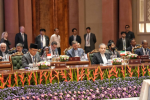
Iran victim of illegal expansionism, warmongering, says Araghchi at BRICS meet
New Delhi: Iranian Foreign Minister Abbas Araghchi on Thursday urged the global community to condemn "violations of international law" by the United States and Israel and take action against "warmongering",...
India urges Bangladesh to expedite nationality verification for ‘smooth repatriation’ of illegal immigrants
New Delhi : India on Thursday said that repatriation of illegal Bangladeshi nationals hinges on cooperation from Dhaka, noting that over 2860 cases of nationality verification remain pending with Bangladesh,...
India, Vietnam elevate ties to enhanced comprehensive strategic partnership: PM Modi
New Delhi: Prime Minister Narendra Modi on Wednesday announced that ties between India and Vietnam have been elevated to Enhanced Comprehensive Strategic Partnership. While addressing a joint press meet...
‘Targeting civilians unacceptable’: PM Modi condemns attack on UAE that injured 3 Indians
New Delhi: Prime Minister Narendra Modi on Tuesday condemned the attack on the UAE's Fujairah that resulted in injuries to three Indian nationals and termed the targeting of civilians and...

EAM Jaishankar, Iranian FM have ‘detailed conversation’ on West Asia conflict
New Delhi: External Affairs Minister (EAM) S Jaishankar on Wednesday received a phone call from Iranian counterpart Seyed Abbas Araghchi during which both ministers held a "detailed conversation" on the...


