



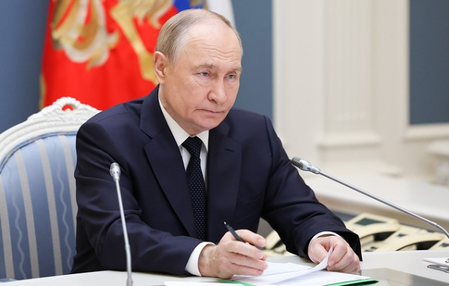
New Delhi: Russian President Vladimir Putin’s two-day state visit to India, on December 4
and 5, for the 23 rd annual India Russia summit, will be a closely observed event
not just in New Delhi and Moscow, but in several capitals worldwide,
particularly Washington, Beijing, Kyiv, Riyadh and even Islamabad.
While the visit will certainly provide an opportunity for President Putin to
review the progress of the India – Russia relationship with Prime Minister
Narendra Modi, and chart the course to navigate and bolster the bilateral
‘Special and Privileged Strategic Partnership,’ the outcomes will be closely
monitored in major western and eastern capital cities.
Of particular interest will be the outcomes on defence collaboration and energy
cooperation, especially whether India will continue to primarily rely on Russia
for the bulk of its defence and crude petroleum supplies. According to industry
reports in November, indications are that Indian petroleum refiners have been
turning to non-sanctioned Russian petroleum companies to source their crude
supplies.
US President Donald Trump has repeatedly stated in recent months, since the
appointment of his aide Sergio Gor as US envoy to India, that he has been
assured that India will wind down its purchase of Russian crude by the year end.
President Trump, apparently frustrated by India's continued Russian oil imports
and its participation as a founder member of BRICS, lashed out at India and
imposed a 50% tariff on Indian exports to the USA effective from 27 August
2025, hitting Indian manufacturing and exports hard.
Trump has now said that India and the US are “close” to finalising a “very
good” trade deal, dependent on India’s non-purchase of Russian crude. India
has a very narrow path to negotiate while ensuring its national interests and
staring down at prohibitive tariffs. This ‘zero sum’ and transactional US attitude
has forced a rethink in trade policies globally, and is even hurting the domestic
US market. Also, Trump is desperate to appear like a statesman and end the
Russia – Ukraine conflict in time to earn a Nobel Peace prize nomination by the
end of January 2026. Ukraine is under a lot of pressure to agree to his terms
because his leverage over Russia is limited given how effectively Putin has kept
the war effort funded through heavily discounted petroleum sales to countries
like India and China.
Defence hardware procurement, specifically the S-400 ‘Triumf’ air defence
systems and a range of missiles to replenish its stocks depleted during
‘Operation Sindoor,’is likely to be another key focus area of discussions
between Putin and Modi.
Speaking at a public forum recently, India’s Defence Secretary RK Singh
specified that while the focus of the upcoming Russia-India Summit will be
"broader elements of cooperation on defence", including the strategic S-400 air
defence systems, actual orders will take more time to finalise. By all accounts,
the S-400 air defence systems were extremely effective in targeting Pakistani
fighter planes during Op Sindoor in May.
Russia’s war with Ukraine is also likely to be discussed, with Putin outlining his
terms for ending the hostilities. At an earlier summit, PM Modi had cautioned
President Putin that “this is not an era of war,” and he will try to urge an early
cessation of hostilities with Ukraine even as they try to infuse a momentum into
their bilateral relations, particularly the trade partnership.
After Putin’s visit was announced, the Kremlin, in its official statement, said,
“This visit is of great importance, as it provides an opportunity to discuss the
entire extensive scope of Russia-India special and privileged strategic
partnership in politics, trade and economy, science and technology, as well as
cultural and humanitarian affairs, in addition to addressing current international
and regional issues.”
A comprehensive joint statement is likely to be adopted after the summit level
talks and a wide range of bilateral interdepartmental and business agreements
are scheduled to be signed.
Officials have been working on the details of the outcome documents and joint
statement since External Affairs Minister Subrahmanyam Jaishankar visited
Russia in August to co-chair the 26th Session of the India-Russia Inter-
Governmental Commission on Trade, Economic, Scientific, Technological and
Cultural Cooperation (IRIGC-TEC). With his counterpart Sergey Lavrov, EAM
Jaishankar comprehensibly reviewed of the entire gamut of India–Russia
bilateral relations, including sectors like trade and economic cooperation,
various connectivity initiatives, political, defence and military-technical
cooperation and fast-tracking the opening of new Indian Consulates in Kazan
and Yekaterinburg. On global and multilateral cooperation, both reaffirmed
their shared commitment to reform of global governance, and collaboration in
G20, BRICS and the SCO.
Regional developments such as those in Ukraine, Middle East, West Asia and
Afghanistan were discussed. Jaishankar reiterated India’s approach to
emphasize dialogue and diplomacy as essential to resolving differences. He also
raised the issue of Indians serving in the Russian Army and hoped for an
expeditious resolution of the pending cases.
India’s multi-dimensional and very wide-ranging relationship with Russia has
been one of the critical pillars of its foreign policy, one it will try to ensure
remains vibrant and mutually beneficial and supportive during President Putin’s
visit, despite pressures from various quarters. Jaishankar briefly captured the
essence of the India – Russia relationship when he said, “Russia has never hurt
our interests…. our relationship with Moscow today is based on this
experience.
INDIA NEWS STREAM
India, UK agree to address contemporary challenges, advance Indo-Pacific security
London: Chief of Defence Staff (CDS) General Anil Chauhan held a meeting with his UK counterpart, Air Chief Marshal Sir Richard Knighton, on Wednesday, during which India and UK reaffirmed...
Rajnath Singh invites German defence industry to co-create under Aatmanirbhar Bharat
New Delhi: Defence Minister Rajnath Singh has stressed that India, under the visionary leadership of Prime Minister Narendra Modi, is witnessing an unprecedented transformation in the defence sector, and increased...
PM Modi leads strategic reset with South Korea with focus on tech, trade and growth
New Delhi: India and South Korea have taken a major step toward strengthening their bilateral relationship, with Prime Minister Narendra Modi and South Korean President Lee Jae Myung announcing a...
India monitoring West Asia developments, in touch with Iran for safe passage of ships: MEA
New Delhi: The Ministry of External Affairs (MEA) said on Tuesday that India continues to follow developments in the West Asia region and remains in touch with countries of the...
South Korea voices deep regret over Japan PM’s offering, lawmakers’ visit to war shrine
Seoul: South Korea expressed deep regret on Tuesday after Japanese Prime Minister Sanae Takaichi sent a ritual offering to a war shrine seen as symbolising, if not whitewashing, Japan's militaristic...
SEBI slashes minimum investment in social impact funds to Rs 1,000
Mumbai: The Securities and Exchange Board of India (SEBI) has drastically slashed the minimum investment requirement for individual investors in social impact funds to Rs 1,000 in order to lower...
India, South Korea will continue to contribute towards peaceful and inclusive Indo-Pacific: PM Modi
New Delhi: Prime Minister Narendra Modi said on Monday that India and South Korea share a common outlook for the Indo-Pacific and will continue to contribute towards a peaceful, progressive,...
Bengal polls: Mamata Banerjee accuses PM Modi of misusing government machinery
Kolkata: Claiming that Bharatiya Janata Party's (BJP) downfall has started, West Bengal Chief Minister Mamata Banerjee on Sunday accused Prime Minister Narendra Modi of misusing government machinery for political campaigns....
Nepal govt’s move to control purchases from bordering Indian towns draws flak
Kathmandu: The Nepal government’s decision to levy customs duty on goods valued above NPR 100 brought from bordering Indian towns has drawn criticism from stakeholders in Nepal’s border areas, where...
India voices concern over Hormuz shipping attacks, takes neutral stance on UNSC resolution veto
United Nations: While expressing concern over the attacks on commercial shipping in the Hormuz Strait, India has taken a neutral stance on the veto by Russia and China of a...

India, Austria to strengthen partnership in defence, semiconductors and quantum: PM Modi
New Delhi: Prime Minister Narendra Modi on Thursday announced that India and Austria will strengthen their partnership in defence, semiconductors, quantum, and biotechnology. Addressing a joint press meet with...
India opposes two-tier UNSC permanent membership, agrees with G4 proposal for 15-year deferral
United Nations: While opposing a discriminatory, two-tier permanent membership level in the Security Council, India has agreed to a G4 proposal that would defer veto powers for 15 years in...


