


July 29, 2020
New Delhi: Extension of right to education to cover all children between three and 18 years of age, and mother tongue or the regional/local language to be medium of instruction up to Class 5 in all schools are some of the key highlights of the New Education Policy(NEP) approved by the Government on Wednesday.
The NEP 2020 provides that Sanskrit will be offered at all levels and foreign languages from the secondary school level, but it also says “no language will be imposed on any student”.
The key highlights of the New Education Policy is use of technology in teaching, learning and assessment, a single regulator for higher education, graded autonomy for colleges, and phasing out of the affiliation system in 15 years. It also includes formation of the National Research Foundation, internationalisation of education and multiple entry and exit for students and an academic bank of credit.
The NEP proposes to do away with exams being held every year. Instead, school students will sit only for three – at Classes 3, 5 and 8. Assessment in other years will shift to a “regular and formative” style that is more “competency-based, promotes learning and development and tests higher-order skills, such as analysis, critical thinking and conceptual clarity”.
Classes 10 and 12 will continue to have boar exams but even these will be re-designed with “holistic development” as the aim. Standards for this will be established by a new national assessment
The NEP 2020 proposes a four-year undergraduate programme with multiple exit options to give students flexibility. A multi-disciplinary bachelor’s degree will be awarded after completing four years of study. Students exiting after two years will get a diploma and those leaving after 12 months will be have studied a vocational/professional course. MPhil (Master of Philosophy) courses are to be discontinued.
A Higher Education Council of India (HECI) will be set up to regulate higher education; the focus will be on institutions that have 3,000 or more students. Among the council’s goals is to increase gross enrolment ratio from 26.3 per cent (2018) to 50 per cent by 2035. The HECI will not, however, have jurisdiction over legal and medical colleges.
The HECI will have four independent verticals – National Higher Education Regulatory Council for regulation, General Education Council to set standards, Higher Education Grants Council for funding and National Accreditation Council for accreditation.
Outcomes of the National Education Policy will be universalisation of education from primary to secondary by 2030, attaining foundational learning and numeracy skills by 2025, 100 per cent gross enrolment ratio by 2030, and two crore school children joining back. It will also include preparation of teachers for assessment reforms by 2023, an inclusive education system by 2030, board exams only to test core concepts, and instilling at least one vocational skill in every child. (With IANS inputs)
Long-pending Kishau Dam Project deal inked; Centre, six states sign MoU
New Delhi: A Memorandum of Understanding (MoU) for the long-pending Kishau Project was signed on Tuesday between the Centre and six states -- Uttarakhand, Himachal Pradesh, Haryana, Rajasthan, Uttar Pradesh...
Vijay govt scraps Parandur airport project, to identify alternative site
Chennai: Tamil Nadu Chief Minister C. Joseph Vijay on Monday announced that the state government would abandon the proposed greenfield airport project at Parandur and identify an alternative site that...
Karnataka to submit Mekedatu DPR by Aug 15, TN can’t stop project: Minister Reddy
Bengaluru: Karnataka Water Resources Minister Ramalinga Reddy on Wednesday asserted that Tamil Nadu has no authority to prevent Karnataka from constructing the proposed Mekedatu Balancing Reservoir, saying that the project...
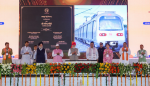
PM Modi lays foundation stone for Rs 13,037-crore Jaipur Metro Phase-2 project
Jaipur: Prime Minister Narendra Modi on Saturday virtually laid the foundation stone for the Jaipur Metro Rail Project Phase-2 during the inauguration ceremony of the Rajasthan Refinery at Pachpadra in...
Continuous improvement has changed India’s economic DNA: PM Modi
New Delhi: Prime Minister Narendra Modi said on Thursday that India has been transforming its economic DNA over the past 12 years by following the philosophy of 'Kaizen' -- the...
PM Modi launches Rs 4,000 crore projects in Sikkim, says Northeast is India’s ‘Ashtalakshmi’
Gangtok: Prime Minister Narendra Modi on Tuesday inaugurated and laid the foundation stones for multiple development projects worth around Rs 4,000 crore in Sikkim, asserting that the Northeast region is...
PM Modi inaugurates Delhi-Dehradun Economic Corridor; highway to enhance connectivity
Dehradun: Prime Minister Narendra Modi inaugurated the Delhi-Dehradun Expressway on Tuesday, which will significantly reduce travel time and enhance connectivity with the national capital. The 210-km highway, built for Rs...
Ilyas Husain appointed as Jamia’s Pro Vice-Chancellor
Jan 1, 2020 New Delhi: Jamia Millia Islamia Vice-Chancellor Najma Akhtar on Wednesday appointed professor Ilyas Husain as the Pro Vice-Chancellor (PVC) of the institute. Husain holds an expertise in...
AMU winter vacations extended for indefinite period, students condemn the VC move
Jan 1, 2020 Aligarh: With the discontent over the CAA-NRC refusing to subside and anger among students simmering over the recent police action, the Aligarh Muslin University(AMU) authorities on Wednesday...
CBSE mandates 75% attendance for 10th, 12th exams
Jan 2, 2019 New Delhi: Students should have a minimum 75 per cent attendance to be able to appear for the 10th and 12th examinations to be conducted by the...
Delhi Metro launches free Wi-Fi on Airport Express Line
Jan 2, 2020 New Delhi: Delhi Metro Rail Corporation (DMRC), on Thursday, launched free Wi-Fi facility at all the six metro stations of the Airport Express Line. Passengers on this...
New Parliament House to be ready for session from 2022: Om Birla
Lok Sabha Speaker Om Birla addressing the 25th conference of the Presiding Officers and the Chairman of Parliaments of Commonwealth on Wednesday at Ottawa in Canada on Wednesday. Jan 9,...