




New Delhi: Nearly five decades after the Emergency was declared in India, the National Council of Educational Research and Training (NCERT) has incorporated the subject into a Class 9 Social Science textbook for the first time.
The newly introduced textbook, ‘Understanding Society: India and Beyond’, presents the Emergency period as a significant challenge faced by India’s democratic system.
The topic has been included in a chapter examining both the achievements and challenges of democracy in the country. According to NCERT officials, this marks the first instance of the Emergency being covered in a Class 9 textbook.
The inclusion coincides with the completion of 50 years since the Emergency was imposed in 1975. The chapter outlines the political and social circumstances that preceded the decision and discusses its impact on democratic institutions and civil liberties.
According to the textbook, public discontent with the government had been growing in the early 1970s due to factors such as rising unemployment, high inflation and concerns over governance. These issues contributed to widespread protests and political unrest in several parts of the country.
The text explains that a National Emergency was declared in June 1975 on the grounds of internal disturbance. During the 21-month period that followed, several constitutional freedoms were curtailed, press censorship was enforced, and many opposition leaders and activists were detained. The chapter notes that democratic institutions came under considerable pressure and that citizens experienced restrictions on their rights and freedoms.
The textbook also discusses the contribution of veteran leader and social reformer Jayaprakash Narayan, popularly known as Lok Nayak, in mobilising opposition to the Emergency. It highlights how movements led by him brought together students, youth groups and citizens, particularly in Bihar and Gujarat, creating a broad-based campaign for democratic reforms.
The chapter further explains that the Emergency was withdrawn in 1977, following which general elections were held. It notes that the outcomes of those elections demonstrated the resilience of India’s democratic framework, as voters were able to express their views through the electoral process and bring about political change.
Beyond the Emergency, the revised textbook examines several contemporary challenges confronting democracy. These include misinformation, fake news, poverty, regional divisions, social discrimination and gender inequality. The objective is to help students understand the complexities of democratic governance in modern society.
A new section titled “Democracy and You” has also been added to encourage students to engage with democratic values and understand their responsibilities as active citizens.
The textbook also focuses on India’s democratic institutions, the role of media as the “fourth pillar of democracy”, voter participation, polling systems and grassroots democracy through examples of panchayats. It also includes sections on women’s voting rights and reservations in local bodies.
IANS

NTA releases final answer keys for Joint CSIR-UGC NET June 2026 exam
New Delhi: The National Testing Agency has released the final answer keys for all five subjects of the Joint CSIR-UGC NET June 2026 examination on its official website, an official...
Dialogue with youth should not be limited to political discussions: Devendra Nath Mahto
Ranchi: In a message to political parties, Jharkhand student leader Devendra Nath Mahto said on Sunday that holding dialogues with youth "should not be limited to political discussions". After leading...

CJP seeks accountability over Rajasthan schools, denies political motive
Jaipur: CJP spokesperson Ashutosh Ranka on Saturday said the organisation would continue visiting schools across India to highlight their poor condition and seek accountability from all government, asserting that its...
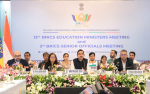
BRICS Education Ministers adopt declaration, set five key priorities
Bhubaneswar: Union Education Minister Pralhad Joshi said on Friday that the 13th BRICS Education Ministers' Meeting in Odisha's state capital Bhubaneswar, unanimously adopted the BRICS Education Ministers' Declaration, marking an...
Delhi Cabinet approves Bill to allow private universities
New Delhi: The Delhi Cabinet, led by Chief Minister Rekha Gupta, on Friday approved the "Delhi Private Universities Bill, 2026" that is expected to attract investment in higher education and...
Expert panel to audit NEET-PG admission system, Centre informs SC
New Delhi:The Centre on Tuesday informed the Supreme Court that it has constituted an expert committee headed by the Director General of Health Services (DGHS) to examine issues arising out...
Nandan Nilekani panel formed to ‘fix’ PM Modi’s ‘image’: Congress
New Delhi: The Congress on Sunday dismissed the constitution of a task force on exam reforms, headed by Nandan Nilekani, as an exercise aimed to “fix” Prime Minister Narendra Modi’s...
Priyanka slams use of force against protesting students, seeks debate on Education Policy
New Delhi: Congress MP Priyanka Gandhi Vadra on Monday criticised the government for what she called a reluctance to discuss “flaws in the Education Policy”. Speaking to reporters outside...
NTA cracks down on fake OMR sheets; students warned against submitting AI-generated documents
New Delhi: In a stern warning amid rising concerns over manipulated documents, the National Testing Agency (NTA) has issued a strong advisory to students and parents regarding the submission of...
Acharya Prashant urges Sonam Wangchuk to break his fast, says on NEET crisis a system can’t be honest if its builders are dishonest within
Panaji: Philosopher and author Acharya Prashant, speaking at length on the NEET paper leak, the student suicides and the protests that have followed, has said the crisis is not merely...
NEET UG 2026: NTA says window to challenge OMR responses closes tomorrow
New Delhi: After releasing the scanned images of OMR sheets of candidates who appeared in the NEET UG 2026 re-exam on June 21, the National Testing Agency (NTA) reminded that...
Karnataka to set up India’s first govt-driven AI University: CM Shivakumar
Bengaluru: Chief Minister D.K. Shivakumar on Tuesday announced that Karnataka will establish India's first government-driven Artificial Intelligence University, reaffirming the state's ambition to emerge as a global hub for responsible...


