
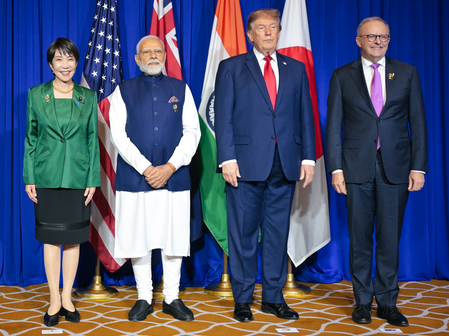
New Delhi: That the four leaders of the QUAD (quadrilateral of democracies) nations finally met for a summit in Manila, albeit for less than an hour, and chose to
jointly release a statement indicates the urgency that all four leaders felt to declare to the world that their group of four exists and is working.
It was interesting that the leaders of Australia, India, Japan and the United States, the four countries which make up the Quad, met in Manila where each had come for individual summits with leaders of the Association of South East Asian Nations (ASEAN), which the Philippines chairs this year, and the East Asia Summit.
While the Quad has taken pains to state that it is not directed against China (which has even called the group the ‘Asian NATO’), the fact that this summit was held in the Philippines, a frontline ASEAN state on the South China Sea facing regular aggressive Chinese posturing, indicates a willingness among the four leaders to openly recognize the threat to maritime security and assert the need for freedom of movement along international trade routes.
Clearly articulating their concerns, “the four leaders aligned their strategic perspectives on the situation in the Indo-Pacific region, including in the East China Sea and the South China Sea”, against coercive attempts to hinder maritime commerce.
Although China was not named, the joint statement issued after their meeting was clearly indicative in stating, “we — President Donald J. Trump of the United States, Prime Minister Anthony Albanese of Australia, Prime Minister Narendra Modi of India, and Prime Minister Takaichi Sanae of Japan — strongly oppose any destabilizing or unilateral actions that seek to change the status quo, including by force or coercion, which escalate tensions and undermine regional peace and stability.”
Meeting for the first time after September 2024, the Quad leaders reiterated the breason they came together; “This year marks the tenth anniversary of the vision of a Free and Open Indo-Pacific, first articulated by the late Prime Minister Abe Shinzo of Japan in 2016. A decade on, that vision is stronger than ever.Together, we have shown that the Quad is a force for good and a partnership of action, committed to peace, stability, and prosperity.”
Although Quad has a clearly stated mandate to closely coordinate and collaborate in disaster management and ensuring freedom of commerce along trade routes of the Indo-Pacific, it has never been projected as a military alliance. This time the leaders significantly outlined their plans to hold joint exercises with maritime patrol aircraft of all four countries.
Welcoming “the Indo-Pacific Maritime Surveillance Collaboration, a new initiative to enhance information sharing and maritime domain awareness. In 2027, our respective P-8 and P-3C patrol aircraft are scheduled to fly in a maritime exercise for the first time in a Quad context, making our seas safer,” the joint statement said.
While these exercises in the Quad context are deemed necessary for disaster management, critical in this era of rapid and severe climate-related events, the
Manila Joint statement also states that the group intends to “ensure open, safe, and resilient maritime transit corridors in the Indo-Pacific”.
Other than maritime surveillance exercises, a Quad Business Leaders’ Forum is scheduled to be inaugurated in early 2027, even as the leaders spoke of a
strengthened Partnership for Cable Connectivity and Resilience, which has expanded access to secure and trusted communications infrastructure across the
Indo-Pacific and the AI Accelerator, intended to coordinate and fund efforts to support trusted AI access, deployment, and technical assistance across the Indo-Pacific.
For India, most of the collaborative activities under the aegis of Quad are worked out in a bilateral context, with each of the other three member nations, with which it has established the 2+2 framework, of annual meetings between the foreign and defence ministers of the countries. In fact, the India – Japan 2+2 meeting was held in Tokyo on November 19, two days after the Manila Quad leaders’ summit, in which the ministers agreed to operationalize the bilateral August 2026 maritime security arrangement through enhanced domain awareness, information sharing, joint naval design, and disaster relief.
Expressing satisfaction with the grouping, Prime Minister Modi said the Quad was a force for global good and, as is usual with him, expanded the acronym
QUAD to be ‘Quick, Unified Assistance Delivery’. At a time when the world is witnessing numerous tensions and conflicts, the Prime Minister said the coming
together of the four Quad partners, with democratic values, is important for humanity. The Quad was here to stay, he said, to assist, to partner, and to
complement the efforts of countries in the Indo-Pacific region.
Nilova Roy Chaudhury
INDIA NEWS STREAM