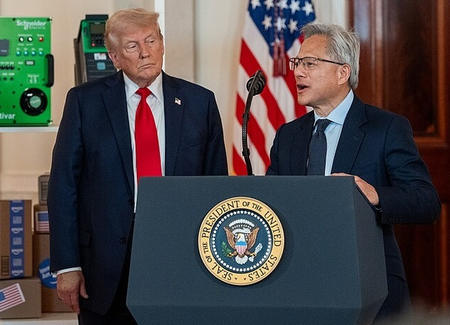

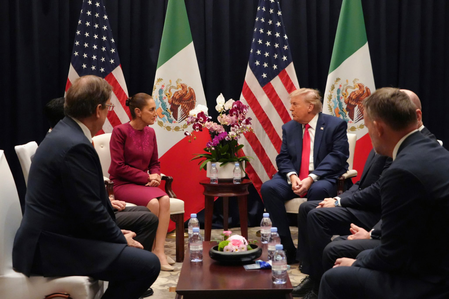
Washington: US President Donald Trump said that Washington was close to a trade deal with Mexico after his meeting with President Claudia Sheinbaum in China. He took a harder line with Canada, saying he wanted an end to what he put at an $80 billion US trade deficit with its northern neighbour.
Trump met Sheinbaum and Canadian Prime Minister Mark Carney in Shenzhen, where leaders had gathered for the Asia-Pacific Economic Cooperation summit. At a White House news conference on his return, he said both conversations had turned on how much more the two countries sell to the United States than they buy from it.
“In my meeting with President Claudia Sheinbaum of Mexico, we are getting close to a deal,” Trump said. He gave no timetable or details of concessions by either side. Recounting what he told her about Mexico’s trade surplus, he said, “I said, Claudia, we can’t have you have a surplus. We’re not going to let that happen.”
Trump said he and Sheinbaum were also working together on the drug cartels. He said he had told her he believed the cartels were running Mexico. He gave no account of her response and announced no new security measure as part of the trade discussions.
With Canada, the conversation turned to oil. Trump said Carney wanted to build the Keystone pipeline and that he welcomed the idea. He gave no details of the proposed route or how the project would proceed. A pipeline alone, he made clear, would fall short of what he wanted from Ottawa.
“We have about an $80 billion deficit with Canada,” Trump said. “I said, when it’s — when it’s down to zero, come over and let’s start talking.”
Trump did not specify the period behind the $80 billion figure or whether it covered goods alone or included services. Despite his demand for balanced trade, he said the two governments were still working towards what he would consider a fair agreement.
Cars, energy and lumber were among the products Trump singled out. He argued that the United States could manufacture its own vehicles and meet more of its needs from domestic energy and timber. Earlier in the news conference, he named Canada and Mexico among the countries he blamed for drawing car production away from the United States. He credited tariffs with persuading manufacturers to build American plants.
Secretary of State Marco Rubio said the shared border gave Washington security issues to work through with Mexico alongside the commercial disputes. He described the meeting with Carney as a step towards a final agreement and said the administration would judge the outcome by what it delivered for American workers.
The United States, Mexico and Canada already trade under the US-Mexico-Canada Agreement, which took effect in July 2020 during Trump’s first term. It replaced the North American Free Trade Agreement and retained duty-free treatment for many goods that meet the pact’s rules on where and how they are made.
IANS