


New Delhi: Many prominent citizens from both India and Pakistan have reportedly come together to appeal to Prime Ministers Narendra Modi and Shehbaz Sharif to end decades of hostility between the two nations which, despite being the ideal option otherwise, remains an uphill task in this case, with ground realities in Islamabad complicating prospects of meaningful talks.
The appeal, signed by intellectuals, activists, and public figures, calls for a new chapter in South Asian relations — one built on dialogue, cooperation, and mutual respect rather than suspicion and confrontation.
It is indeed appropriate and timely, but Pakistan’s multiple power centres make talks a difficult path to tread.
The letter emphasises the shared cultural, historical, and human ties between India and Pakistan. It highlights how ordinary citizens on both sides suffer from the fallout of strained relations: restricted trade, limited cultural exchange, and the constant shadow of conflict.
The signatories argue that peace is not just a lofty ideal but a practical necessity for economic growth, regional stability, and the well-being of millions.
While the appeal is directed at Prime Minister Shehbaz Sharif as one party, the reality is that Pakistan’s political authority is fragmented.
Unlike India, where the Prime Minister wields clear constitutional power, Pakistan operates under a system where multiple power centres compete for influence.
Pakistan’s Army remains the most dominant institution in the country. Army Chief General Asim Munir has been steadily consolidating his authority, shaping both domestic politics and foreign policy.
Historically, the military has dictated the contours of Pakistan’s foreign policy, including India ties, often sidelining civilian governments.
Any peace initiative with New Delhi would require Pakistan military’s explicit backing, making Sharif’s role secondary at best.
Another destabilising factor is the presence of terrorist groups that operate with alarming freedom. Their influence was once again starkly visible during the funeral of former cricketer Shoaib Akhtar’s brother, where photographs showed armed militants mingling openly with mourners.
Such images underscore the challenge, where even if civilian leaders or the military were inclined toward peace, extremist groups can derail progress through violence and intimidation.
Prime Minister Shehbaz Sharif, despite holding office, often finds himself constrained. His Defence Minister, Khawaja Muhammad Asif’s frequent off-the-cuff remarks — sometimes provocative, sometimes contradictory — reflect the lack of coherence within the civilian leadership. These statements not only confuse Pakistan’s official stance but also weaken its credibility in international diplomacy.
In India, Prime Minister Narendra Modi commands a strong mandate and centralised authority. His government has consistently emphasised national security, particularly after incidents like the Pulwama attack and the subsequent Balakot strikes.
The 2025 Pahalgam attack was a tragic incident where 26 Indian tourists were shot down by terrorist targeting Hindu victims near Pahalgam in Kashmir.
Such attacks happened despite Prime Minister Modi’s occasional gestures of peace and goodwill. During his swearing-in ceremony of May 2014, PM Modi invited all Heads of state from the South Asian Association for Regional Cooperation (SAARC), including Pakistan’s then Prime Minister Nawaz Sharif.
Sharif accepted, and attended the ceremony in New Delhi, marking the first time a Pakistani leader had participated in such an event.
The invitation was widely interpreted as Prime Minister Modi’s attempt to “turn over a new leaf” in India-Pakistan relations, signaling openness to dialogue despite earlier attacks.
But within Pakistan, Sharif faced criticism, with the powerful military establishment reportedly viewing the gesture with caution, reflecting the broader pattern of civilian initiatives being undermined by security concerns.
But Prime Minister Modi did not give up. He made a surprise visit to Pakistan on his way back from Kabul on December 25, 2015, to wish Nawaz Sharif on his 66th birthday.
It marked the first visit by a Prime Minister of India to Pakistan in more than a decade, since the 2008 Mumbai attacks. Such acts are now remembered as moments of goodwill gestures overshadowed by violence and mistrust.
Relations deteriorated after the January 2016 Pathankot terror attack and subsequent militant strikes, forcing India to harden its stance, demanding Pakistan take concrete action against terror groups before any dialogue.
These demonstrate how Pakistan’s multiple power centres — including the military and militants — can undermine civilian-led peace efforts.
For India, the lesson was clear; symbolic gestures are insufficient without structural changes in Pakistan’s governance and security environment.
IANS
PM Modi meets top Secretaries to discuss next-generation reforms, ease of doing business and living
New Delhi: Prime Minister Narendra Modi chaired a high-level meeting with Secretaries of all Central government ministries and departments at the Seva Teerth on Tuesday, with a focus on a...
India views mobility as important pillar of international cooperation: EAM Jaishankar
New Delhi: External Affairs Minister (EAM) S Jaishankar said on Tuesday that India considers mobility as a very important pillar of international cooperation, stressing that these partnerships are based on...
Strengthening ties with India ‘extremely important’, affirms Japan ahead of Takaichi’s New Delhi visit
Tokyo/New Delhi: Sanae Takaichi, Prime Minister of Japan, will visit India from July 1 to 3 and hold a Japan-India summit meeting with her Indian counterpart, Prime Minister Narendra Modi,...
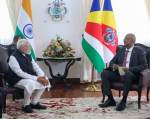
India, Seychelles sign pacts to strengthen trade, digital payments, farm ties
New Delhi: India and Seychelles on Sunday signed agreements to strengthen bilateral ties across trade, digital technology and agriculture following talks between Prime Minister Narendra Modi and Seychelles President Patrick...
Security in Indian Ocean remains central to India-Seychelles relationship: Seychelles President Herminie
Victoria: Seychelles President Patrick Herminie said on Sunday that security in the Indian Ocean remains central to the relationship between his country and India and announced that both nations have...
Passage of 50 years has not changed our commitment to one another: PM Modi in Seychelles’ parliament
Victoria: Prime Minister Narendra Modi on Sunday said that the passage of 50 years of diplomatic relations has not changed the mutual commitment between India and Seychelles. "This year offers...
Rubio sees bigger US role in India’s energy
Washington: US Secretary of State Marco Rubio has said the United States wants to play a bigger role in meeting India's growing energy needs, backing New Delhi's strategy of diversifying...
Rubio eyes Trump’s India visit next year
Washington: US Secretary of State Marco Rubio has said the Trump administration is working towards President Donald Trump's visit to India in the early part of next year, underscoring the...

Despite positive developments, India advises citizens to avoid non-essential travel to Iran
Tehran: India on Wednesday issued a revised advisory for its nationals, urging them to continue avoiding non-essential travel to Iran despite recent improvements in the security situation in the Gulf...
South Africa eyes stronger economic relations with India as US ties sour
New Delhi: South Africa is looking at strengthening economic ties with India amid the rough patch that Pretoria has hit in its relations with the US, according to an article...
Trump unveils Iran deal, eyes wider Middle East pact
Evian (France): US President Donald Trump on Wednesday unveiled the details of a new agreement with Iran that, he said, would prevent Tehran from obtaining a nuclear weapon, reopen the...