



BY ARUL LOUIS
United Nations, Feb 17 (IANS) UN Secretary General Antonio Guterres said that the Security Council resolutions on Kashmir have to be implemented e and although he did not make a reference to it, the main resolution requires Pakistan to withdraw from the areas it occupies.
Guterres, who is on a visit to Pakistan, said at a news conference in Islamabad on Sunday according to a transcript released here, that: “It is clear that we have taken a position about the need for Security Council resolutions to be implemented and for effective de-escalation and dialogue linked to that, with another very important condition, which is full respect for human rights and (fundamental) freedoms in Jammu and Kashmir.”
Security Council Resolution 47 adopted on April 21, 1948, requires the Pakistani government “to secure the withdrawal from the State of Jammu and Kashmir of tribesmen and Pakistani nationals not normally resident therein who have entered the State for the purpose of fighting, and to prevent any intrusion into the State of such elements and any furnishing of material aid to those fighting in the State”.
Although Pakistanis and their supporters elsewhere cite the Security Council asking for a plebiscite to be held in Kashmir, they ignore the precondition of Pakistan’s withdrawal from the occupied areas.
Guterres began a three-day visit to Pakistan, his first as Secretary General, on Sunday to participate in an international conference of 40 years of Pakistan hosting Afghan refugees.
During the trip, he is scheduled to visit Gurdwara Darbar Sahib in Kartapur, which gives direct access to pilgrims from India through a special corridor inaugurated last year.
Replying to a journalist’s question about UN’s role in Kashmir, Guterres said that while he as offered his good offices, he “can only work when accepted by both sides”.
He said that the UN Human Rights High Commissioner Michelle Bachelet made an “important contribution to clarifying what has happened” in Kashmir through her report.
In a report released in July, her office criticised both India and Pakistan for not taking any concrete steps to address the numerous concerns it had raised in an earlier report.
While criticising India for what it said was the lack of accountability for actions by security forces and human rights violations, it also said that there were reports that two terror groups were recruiting children on the Indian side of the Line of Control (LOC) and carrying out attacks on civilians.
Bachelet has since criticised India over the restrictions and human rights violations after Kashmir was put under President’s rule and the subsequent change in its special status under the Constitution’s Article 370.
Guterres said that the UN Military Observer Group in India and Pakistan (UNMOGIP) should have full freedom of movement on the Indian side of the LOC as it has in the area under Pakistani control and that its equipment would be reinforced.
“We believe that UNMOGIP should have full freedom of movement; it has on the Pakistani side e we hope that this will also be achieved on the other side, and we will be strengthening its equipment capacity in order to better be able to implement its mandates,” he said replying to the question that mentioned 287 alleged ceasefire this year.
In his introductory remarks, Guterres said that he was grateful for the UNMOGIP’s work and that it “will continue to monitor the ceasefire at the Line of Control in accordance with its mandate”.
India maintains that the UNMOGIP has no useful role in Kashmir because under the Simla Agreement of 1972 between the two countries, it is a bilateral issue.
India withdrew the government accommodation given to it in New Delhi.
Guterres earlier inaugurated a new UNMOGIP headquarters building in Pakistan.
Guterres said that he had discussed the situation in South Asia with Pakistan Foreign Minister Shah Mehood Qureshi, and he was “deeply concerned about the increase in tensions that we have witnessed last year”.
“I have repeatedly stressed the importance of exercising maximum restraint and taking steps to de-escalate, both militarily and verbally, while reiterating my offer to exercise my good offices, should both sides ask.”
He added: “Diplomacy and dialogue remain the only tools that guarantee peace and stability, with solutions in accordance with the Charter of the United Nations and the resolutions of the Security Council.”
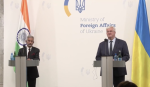
India ready to help with Russia-Ukraine conflict: EAM Jaishankar in Kyiv
Kyiv: Spotlighting Prime Minister Narendra Modi's recent call that endless war must now give way to the end of war, External Affairs Minister (EAM) S Jaishankar on Thursday stated that...
UN chief to visit India for BRICS summit: Spokesperson
United Nations: Secretary-General Antonio Guterres will be visiting India next week for the BRICS Summit, where he will meet with leaders of emerging economies around the world, according to his...
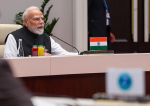
‘Terrorism can’t be strategic asset for anyone’: PM Modi at SCO Summit
Bishkek: Prime Minister Narendra Modi delivered a strong message against terrorism at the 26th Shanghai Cooperation Organisation (SCO) Summit in Bishkek on Tuesday, calling for dismantling the entire ecosystem of...
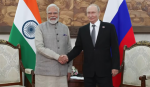
Must move from endless war to end of war: PM Modi during meeting with Russian President Putin
Bishkek: Reiterating that India continues to back all efforts towards achieving peace in Ukraine, Prime Minister Narendra Modi on Monday asserted during a meeting with Russian President Vladimir Putin that...
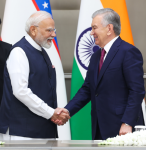
India, Uzbekistan elevate ties to comprehensive strategic partnership, deepen critical minerals cooperation
Tashkent: India and Uzbekistan on Sunday elevated their bilateral ties to a Comprehensive Strategic Partnership, with Prime Minister Narendra Modi and Uzbek President Shavkat Mirziyoyev placing a strong focus on...
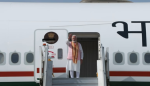
‘Strengthening strategic ties’: PM Modi embarks on four-day visit to Uzbekistan, Kyrgyzstan
New Delhi: Prime Minister Narendra Modi emplaned for his two-nation tour to Uzbekistan and Kyrgyzstan on Saturday, and expressed confidence that this visit will strengthen India's strategic partnerships in Central...
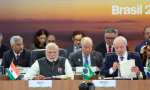
India to host two-day BRICS Summit in Delhi from September 12
New Delhi: India will host the 18th BRICS Summit at Bharat Mandapam in New Delhi on September 12-13, bringing together leaders of BRICS members and partner countries as well as...
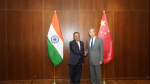
India, China for early, substantial outcome of boundary talks
New Delhi: A month ahead of likely visit by Chinese President Xi Jinping to India for the BRICS summit, the two countries significantly seem pushing for "Early and Substantial...
‘Politically motivated, highly malicious’: India denounces UN racial discrimination committee remarks
New Delhi:India on Wednesday rejected the United Nations Committee on the Elimination of Racial Discrimination's remarks about the country, terming them "politically motivated" and "highly malicious". In a statement, the...
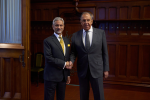
EAM Jaishankar holds wide-ranging talks with Russian FM Lavrov on bilateral, global issues
Moscow: External Affairs Minister S Jaishankar held a wide-ranging conversation with Russian Foreign Minister Sergey Lavrov, with the two leaders discussing bilateral cooperation, regional hotspots, global challenges and multilateral issues....
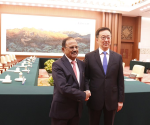
NSA Doval meets Chinese V-P; discusses ways to strengthen peace at border
Beijing: National Security Advisor (NSA) Ajit Doval met Chinese Vice President Han Zheng on Tuesday and discussed ways to strengthen peace and tranquillity in the border areas and bilateral cooperation...
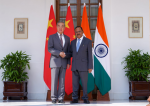
India and China will continue in-depth communication on border issue: Beijing
Beijing: India and China will continue the "in-depth communication" on the border issue in accordance with the spirit of the consensus reached by the leaders of the two countries, Chinese...


