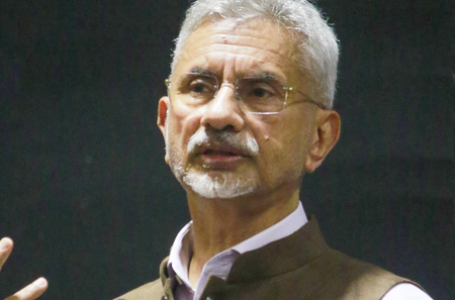


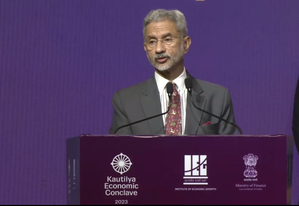
New Delhi: External Affairs Minister S Jaishankar on Sunday said that any expectation that conflicts and terrorism can be contained in their impact is no longer tenable and a unipolar world is now distant history.
Addressing an event, Jaishankar said that the ripple impact of what is taking place right now in the Middle East is still not entirely clear.
He said that the consequences of various conflicts in a globalised world spread far beyond immediate geographies while citing the impact of the Russia-Ukraine war.
He said that in different regions, there are smaller happenings whose impact is not inconsequential.
Addressing the issue of various forms of violence, the Foreign Minister said, “There is also the less formal version that is very pervasive. I am speaking about terrorism which has long been honed and practised as a tool of statecraft.”
“The basic takeaway for all of us is that given the seamlessness of our existence, any expectation that conflicts and terrorism can be contained in their impact is no longer tenable,” Jaishankar said.
He said that a big part of this is clearly economic, but do not underestimate the danger of metastasis when it comes to radicalism and extremism.
Jaishankar said that the unipolar world is distant history.
“The bipolar world was even more distant in the bipolarity of US-Soviet Union. And I don’t think US China will really end up bipolar. I think there are too many, as I said, too many next-run powers with sufficient clout and autonomous activity and regions of their own dominance and privacy…If you look today at what is happening in the Middle East, a lot of it is actually, in a sense, the activities are intrinsic to the Middle East… So the key regional players on regional situations are actually today going to be so dominant compared to the past that they’re not going to leave that much space for global players or external players to come in. And I think you can see that happening in Africa as well,” he said.
He said that another change which should be recognised is in the dispersal of power and the reordering of the global hierarchy.
He said that the most powerful nations are comparatively not as powerful as they used to be in the past.
“Middle powers have started to come into their own. We have seen this clearly in the Gulf and are now seeing it in the Middle East,” he said.
He said that a second contributor to volatility is conflict in a globalised world where consequences spread far beyond the immediate geography.
“We have already experienced this with respect to Ukraine. The ripple impact of what is taking place right now in the Middle East is still not entirely clear,” he said.
He said that in different regions, there are smaller happenings whose impact is not inconsequential.
“There is also the less formal version that is very pervasive, terrorism which has long been honed and practised as a tool of statecraft. Any expectation that conflicts and terrorism can be contained in their impact is no longer tenable,” he said.
He said that a big part of this is clearly economic, but do not underestimate the danger of metastasis when it comes to radicalism and extremism, saying that no danger is too distant anymore.
Referring to the impact of climate changes on global economy, the foreign minister said: “It is necessary to also look at the directly disruptive impact of climate events on the international economy… As weather patterns shift, they can affect the loads of production as well as the supply chains that emanate from them.”
He said that given the increasing frequency of such weather happenings, this is now a risk that we need to build into our calculations.
He said that the working of the global economy has itself added to the concerning side of the ledger.
“The last few years have witnessed rising debt often resulting from a combination of imprudent choices unbiased borrowings and opaque projects,” he said.
He said that the market volatility has been difficult for smaller economies with a narrow trade basket to handle.
“Those highly exposed to tourism or remittances have experienced the consequences of slowdowns very strongly,” he said.
He said that the international financial institutions have not been able to respond adequately, whether due to paucity of resources or lack of priority.
IANS
Politics now ‘trumps’ economics; govt pushing trade pacts, ‘Make in India’: EAM Jaishankar
Kolkata: External Affairs Minister (EAM) S. Jaishankar on Saturday said that in the present era, "politics increasingly trumps economics". He made the remarks after being conferred an Honorary Doctorate...
Grand Alliance meeting: Tejashwi elected legislative party leader; Oppn charts strategy for assembly session
Patna: A meeting of the Grand Alliance was held in Patna on Saturday, where Tejashwi Yadav was unanimously elected as the leader of the Grand Alliance Legislative Party. Leaders...
Putin to visit India next week for 23rd India-Russia Annual Summit, MEA confirms
New Delhi: Russian President Vladimir Putin will travel to India on December 4–5 for the 23rd India-Russia Annual Summit, the Ministry of External Affairs (MEA) said on Friday. The...
Calcutta HC seeks CAG explanation for delay in report on alleged Rs 1,000 crore flood-relief irregularities
Kolkata; The Calcutta High Court has sought an explanation from the Comptroller and Auditor General of India (CAG) over the delay in filing its final probe report on alleged irregularities...
Trump calls attack on National Guard an ‘act of terror’, orders 500 more troops
Washington:Hours after two National Guardsmen were shot in downtown Washington, US President Donald Trump called the attack an "act of terror". "This heinous assault was an act of evil...
No place for any double standards in fight against terrorism, says PM Modi at IBSA meet
Johannesburg: Prime Minister Narendra Modi on Sunday emphasised the need for close coordination between India, South Africa and Brazil in the fight against terrorism and said that there is no...
PM Modi calls for rethinking on global development parameters, proposes path-breaking initiatives at G20 Summit
Johannesburg: Delivering an impactful address at the opening session of the G20 Leaders' Summit in Johannesburg, Prime Minister Narendra Modi on Saturday proposed a series of path-breaking new initiatives and...
EAM Jaishankar, Afghanistan Minister discuss strengthening trade and connectivity
New Delhi: External Affairs Minister (EAM) S Jaishankar and Afghanistan's Industry and Commerce Minister Alhaj Nooruddin Azizi held a meeting in New Delhi on Thursday, discussing ways to strengthen trade,...
Bangladesh advisor calls on NSA Doval, discusses key bilateral issues
New Delhi: Bangladesh’s National Security Advisor (NSA) Khalilur Rahman called on his Indian counterpart Ajit Doval as both held an extensive meeting in New Delhi on Wednesday, the media in...
Committed to best interests of people of Bangladesh, says India after Hasina ICT verdict
New Delhi: India on Monday said that it has noted the verdict announced by the so-called 'International Crimes Tribunal of Bangladesh' concerning former Prime Minister Sheikh Hasina and remains committed...
India criticises Pakistan heading UNSC committee on sanctions against Taliban
United Nations: India has criticised Pakistan heading the Security Council’s committee on sanctions against the Taliban and co-chairing the counter-terrorism panel, citing conflicts of interest. Council members must be prevented...

J&K Police raid 13 locations in Kashmir in connection with Delhi blast
Srinagar: The Counter-Intelligence Wing, Kashmir (CIK) of J&K Police on Thursday raided 13 locations across the Valley in connection with the Delhi terror blast. Officials said that simultaneous raids are...