




At a time in Indian history when the judiciary is under increasing pressure from the polity the untold story of the first Indian judge of the Allahabad High Court acquires a special significance.
A recently published work by two young researchers from the Aligarh Muslim University serves as a reminder not just to the judiciary but to the community at large that dissent and courage are the very back bone of any robust justice delivery system in any part of the world, at any period of history in the modern world.
Justice Syed Mahmood the first Indian judge of the Allahabad high Court had directly confronted the British chief justice of the Allahabad high court justice over contentious legal issues. This story stands out when one reviews the course of dissenting judges within the Indian judicial system — the honouarable members of the higher judiciary
stood up against the establishment and confronted the polity even at the cost of their professional future and personal safety. Justice Mahmood was not just the first Indian judge of the Allahabad High Court but as highlighted in the recent book “Syed Mahmood: Colonial India’s Dissenting Judge”, he was the first North Indian to be appointed as a High Court judge in any part of the country. He was the first member of the Indian judiciary who had mastered both Hindu and Muslim law and always pressed the higher Judiciary to take cognizance of local traditions .
(Nearly eighty years after Justice Syed Mahmood was virtually pushed out of the Allahabad High Court by the colonial masters, a couple of Indian judges had the gumption to take on the then Prime Minister Indira Gandhi at a time when she reigned supreme in the country and was a proponent of “committed judiciary”. Justice Jagannath Sinha of the Allahabad High Court, in June 1975, delivered the historic judgement indicting the then Prime Minister Indira Gandhi for corrupt electoral practices. It was a judgement which altered the course of Indian history. Prior to this a couple of other judges of the Supreme Court of India had also stood up against the government of the day by delivering land mark judgments.
A number of judges in independent India have on occasions displayed similar fortitude while standing up for judicial independence despite pressures by the government of the day. Most of these esteemed judges, including Justice Hegde, came in the lime light after they repeatedly stood up against the Indira Gandhi government in a number of cases in the early 1970s.)
In the above book, quoting rare archival material, Mohammad Nasir, an Assistant Professor in the Department of Law, AMU, and another young researcher, at the department of law Samreen Ahmad highlight the fact that Justice Mahmood’s direct confrontation with the government of the day took place at a time when the hold of the British government on India’s judicial system was supreme and unchallenged. For an Indian judge, to take up cudgels against a British chief justice was nothing short but an act of apostasy. At a time when even the thought of challenging the authority of a British chief justice of a high court was like committing hara-kiri, Justice Mahmood took up cudgels against the Chief Justice of the Allahabad High Court, Sir John Edge.
The authors have quoted the late Advocate General of Uttar Pradesh, Dr Kanhaiya Lal Mishra, who while delivering a lecture at the Allahabad High Court on November 20, 1966, paid rare tributes to Justice Mahmood saying:
“My Lord! The greatness of this court, the glory of this court, are in large measure due to Mahmood…….if I had to select a delegate, this High Court, nay the courts of our country in an international assemblage of judges, past and present, I would unhesitatingly chosen Mahmood”.
The book also quotes the former Chief Justice of India, M Hidayatullah, who encapsulated Syed Mahmood’s standing as a judge in the following words:
“Anyone who wishes to name six greatest judges of all time must find it difficult to omit the name of Syed Mahmood from his list”.
The authors have underlined the singular fact that it was not just that an Indian judge had the temerity to question the authority of British Chief Justice, but it may be kept in mind that Justice Syed Mahmood also happened to be the son of Sir Syed Ahmad Khan, who was amongst those handful of persons whom the British government had honoured by making the members of the Viceroy’s Council. In fact, when Syed Mahmood had been appointed as the judge of Allahabad High Court in the year 1887, it was on the recommendation of Lord Ripon, the then Viceroy of India. In other words, Justice Mahmood had not compromised his honour and his conscience despite the fact that both he and his honourable father had always been considered very close to Her Majesty’s government.
According to the authors, there were a number of factors which prompted Justice Mahmood to take up a confrontation with Her Majesty’s government while refusing to compromise his conscience. The main reason was that gifted with a brilliant mind, Justice Mahmood was a just and humane person and he never hesitated to give dissenting judgments even if he was in an absolute minority on the bench.
On the other hand, Sir John Edge had a huge ego and did not merit any encroachment “on the administrative matters which he considered his exclusive domain”. The tipping point came when the Chief Justice removed the Moharram holidays without conferring with other judges regarding the possible fall out of this step. Justice Mahmood is reported to have said, “if he (the Chief Justice) had only allowed himself enough time to understand the Indian laws and the facts of Indian lives before assuming the position of ‘veni, vidi, vici’ he might have made even a better chief justice.
The authors have not hesitated to point out that the chief justice, while responding to Justice Mahmood’s barbs, had not failed to target Justice Mahmood for his “intemperate behaviour” which imputed his penchant for smoking and love for alcohol. Thus, when Justice Mahmood challenged the Chief Justice on grounds of fair play in the British justice delivery system, the chief justices raised a bogey of persistent neglect of duty by Syed Mahmood..…………being in a condition of intoxication.
Justice Mahmood’s resignation from the judgeship of the High Court in 1892 was a dark chapter not just in his life but also a very painful period for his father Sir Syed Ahmad Khan who had always lauded the British for their justice and fair play.
Syed Mahmood’s resignation deeply wounded Sir Syed and in the last stages of his life it certainly dampened Sir Syed Ahmad Khan’s unalloyed confidence in the British system of justice and fair play.
Justice Mahmood’s unfortunate resignation from the judgeship was just the beginning of a tragic course of events in his life. He had earlier played a very vital role in helping his father in the establishment of the Mohammedan Anglo Oriental College, which grew into a university a few years after the death of both father and the son. He had in fact played a major role in helping his father in the establishment of the MAO College. The authors have underlined the fact that when Mahmood was only 23, it was he who in fact designed the blueprint for the establishment of the MAO College.
Sir Syed Ahmad Khan’s command over English was indeed very limited and it was the young Mahmood who personally drafted all the documents and correspondence pertaining to the establishment of the institution.
After Sir Syed’s death in 1898, Syed Mahmood became the Secretary of the MAO College but here too his innings was cut short barely in a year after he assumed charge. The agony of his inglorious exit from the Allahabad High Court had dealt a lethal blow to the mind and the heart of this great humanist. He would never recover. His alcoholism intensified leading to a virtual breakdown in almost all his personal relationship, including that with his father and his wife. Barely five years after the death of Sir Syed, his son, Syed Mahmood passed away in Sitapur, near Lucknow, a lonely, tragic and forlorn figure. The authors make no attempt to cover up Mahmood’s love for wine and the spirits but with great skill they showcase how the colonial masters succeeded on putting him out in the cold when they perceived that he was challenging them on their own turf . This was certainly sacrilege in their eyes .
Syed Mahmood had paid a heavy price for challenging the majesty of the British Empire. This work, however, succeeds in restoring Syed Mahmood’s due place in the history of modern India. It is a fitting tribute to a man who was not only just and humane, but always kept in mind the rights of the poorest, the loneliest while serving in the post of highest echelons in India’s justice delivery system. For anyone who wishes to understand the birth and the growth of India’s modern justice delivery system, this book is a must read. – INDIA NEWS STREAM

Congress announces nationwide movement to resist changes in MGNREGA
New Delhi: Framing the MGNREGA changes as an ideological battle over equity, federalism, and Gandhian values, Congress leader Rahul Gandhi and AICC President Mallikarjun Kharge on Saturday announced a nationwide...

Trump to meet Zelensky tomorrow amid push for Ukraine peace deal
Washington: US President Donald Trump is set to meet Ukrainian President Volodymyr Zelensky in Florida on Sunday, as Kyiv presses ahead with a new 20-point peace plan aimed at ending...

Venezuelan president Maduro expresses willingness to hold dialogue with US
Caracas: Venezuelan President Nicolas Maduro has expressed willingness to hold dialogue with the United States on the basis of mutual respect, provided that the United States gives up interference in...
Unremitting hostility against minorities in Bangladesh matter of grave concern: MEA
New Delhi: Voicing its grave concern over the persistent incidents of violence targetting religious minorities - including Hindus, Christians, and Buddhists - in its neighbourhood, India on Friday asserted that...
India supports free, fair and inclusive elections in Myanmar: MEA
New Delhi: India on Friday expressed support for democratic transition and free, fair as well as inclusive elections in Myanmar. Ministry of External Affairs (MEA) spokesperson Randhir Jaiswal stated...
VV Rajesh scripts history as BJP’s first Mayor in Kerala
Thiruvananthapuram: Forty-nine-year-old V. V. Rajesh on Friday entered record books as the first Bharatiya Janata Party (BJP) leader to become Mayor of the Thiruvananthapuram Corporation, marking a watershed moment in...
Environment Minister Bhupender Yadav, Jairam Ramesh clash over FSI’s internal report on Aravallis
New Delhi: In a fresh attempt to keep the Aravalli definition issue alive, the Congress on Thursday accused Environment Minister Bhupender Yadav of “suppressing” an internal assessment by the Forest...

Navi Mumbai International Airport commences operations
Mumbai: Navi Mumbai International Airport (NMIA) -- India’s newest Greenfield airport -- began commercial operations on Thursday (Christmas Day). During the initial launch period, passengers will benefit from services operated...

20 US States warn Trump’s $100K H-1B fee threatens schools, hospitals
Washington: More than 20 US states on Tuesday moved to block the Trump administration’s new $100,000 fee on H-1B visas, warning that the measure would disrupt schools and hospitals nationwide...
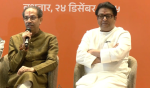
Uddhav, Raj Thackeray join hands for BMC polls, pledge Marathi Mayor
Mumbai: Shiv Sena (Uddhav Balasaheb Thackeray) chief Uddhav Thackeray and Maharashtra Navnirman Sena (MNS) founder Raj Thackeray on Wednesday formally announced an alliance for the upcoming elections to the Brihanmumbai...

ISRO successfully launches BlueBird Block-2 satellite into orbit
New Delhi: In yet another historic feat, the Indian Space Research Organisation (ISRO) on Wednesday successfully launched LVM3-M6 rocket, carrying United States' new generation BlueBird Block-2 communication satellite. “Mission Success....

Bangladesh: ICT formally charges former PM Hasina, 16 others
Dhaka: Bangladesh’s International Crimes Tribunal (ICT) on Tuesday formally charged 17 individuals, including former Prime Minister Sheikh Hasina, in a crimes against humanity case linked to allegations of enforced disappearances...


