

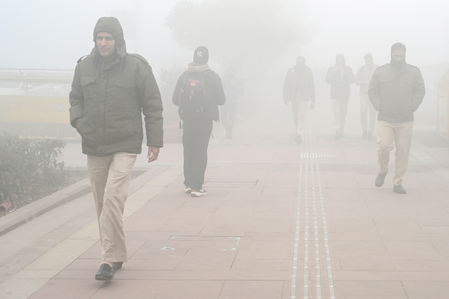
New Delhi: Every winter, Delhi finds itself confronting a familiar crisis. A thick blanket of smog settles over the national capital, visibility deteriorates, health advisories intensify, and millions of residents are forced to reconsider something as basic as stepping outdoors. Yet, beyond the immediate health concerns, another question deserves greater attention: what is the economic cost of breathing polluted air?
As November progresses, Delhi’s air quality has once again reached alarming levels. On November 17, the city’s Air Quality Index (AQI) stood at 246 in the morning, with several monitoring stations recording readings above 300, classified as very poor. Authorities have maintained Stage III restrictions under the Graded Response Action Plan, limiting certain construction activities and vehicle movements.
While these measures are necessary to reduce pollution, they also highlight a larger challenge. Delhi’s air pollution is no longer merely an environmental concern. It is increasingly becoming an economic liability, affecting businesses, household finances, productivity, and investment.
The Invisible Cost to India’s Economy
The financial implications of air pollution are substantial. A recent report by the Federation of Indian Chambers of Commerce and Industry (FICCI) and EY estimates that pollution-related economic losses could amount to 9–9.5% of India’s GDP, based on 2022 estimates.
The report estimates annual business losses at $95 billion from lower productivity, absenteeism, and operational inefficiencies. This highlights air pollutions often overlooked financial cost, even when it is absent from company balance sheets.
Separately, Dalberg Advisors and the Clean Air Fund estimate that pollution cost India about $260 billion in 2024, or 6% of GDP. Despite differing methods, both studies show the substantial economic burden of worsening air quality.
The effects go beyond sick leave. Employees with respiratory discomfort, fatigue, or other pollution-related symptoms may work below capacity. Across India’s large workforce, even small productivity declines can cause significant economic losses.
Businesses and Households Under Pressure
The effects are particularly visible in sectors dependent on outdoor activity and consumer movement. Construction restrictions can delay projects and increase operational costs, while nreduced footfall affects retailers, restaurants and hospitality businesses.
For households, the financial burden is equally concerning. Medical consultations, medication, air purifiers, and protective equipment add to expenses, particularly for families already managing rising living costs.
The World Bank has previously highlighted how pollution-related illnesses increase healthcare expenditure for households and employers while reducing labor productivity. Its assessment of India’s 2019 economic losses attributed $36.8 billion in lost output to premature deaths and illnesses associated with air pollution.
These costs are not distributed equally. Higher-income households may be able to invest in air filtration systems or work remotely, while lower-income workers, particularly those in construction, transportation and delivery services, often have limited alternatives to prolonged outdoor exposure.
Why the Financial Sector Should Pay Attention
For India’s financial sector, worsening air quality raises questions extending beyond immediate economic disruption.
Banks and lenders financing construction, real estate, transportation and small businesses may need to consider how recurring pollution-related restrictions affect project timelines, operating costs and borrower’s repayment capacity.
Insurance providers could also face changing patterns of healthcare demand as respiratory and cardiovascular illnesses place additional pressure on medical services. However, the precise financial impact will depend on insurance coverage, claims experience and the
duration of exposure.
More broadly, investors increasingly evaluate environmental risks when assessing long-term business resilience. Persistent pollution could influence operating costs, workforce availability and the attractiveness of major urban centers as investment destinations.
This does not suggest that Delhi’s pollution crisis will trigger immediate financial instability. Rather, it demonstrates why air quality deserves recognition as a material economic risk requiring greater attention from policymakers, businesses and financial institutions.
Clean Air Is an Economic Investment
Addressing the crisis requires moving beyond emergency winter restrictions towards sustained, coordinated action.
In June 2026, the World Bank highlighted financing programs supporting cleaner air in Uttar Pradesh and Haryana, expected to benefit approximately 270 million people. Such initiatives reinforce the importance of regional cooperation, given that pollution does not respect administrative boundaries.
For India, investing in cleaner transportation, industrial emissions control, sustainable infrastructure and stronger monitoring systems should be viewed not simply as environmental expenditure, but as investment in economic productivity and public wellbeing.
Delhi’s annual pollution crisis serves as a reminder that economic growth cannot be measured solely through rising investment, expanding infrastructure, or GDP figures. The health of the workforce and the quality of the environment supporting that growth are equally important.
As India advances its long-term economic ambitions, clean air must become part of the financial and development conversation.
After all, the true cost of pollution is not limited to what people breathe. It is also reflected in what the economy loses.
Yasa Iqbal Ahmad
INDIA NEWS STREAM
