



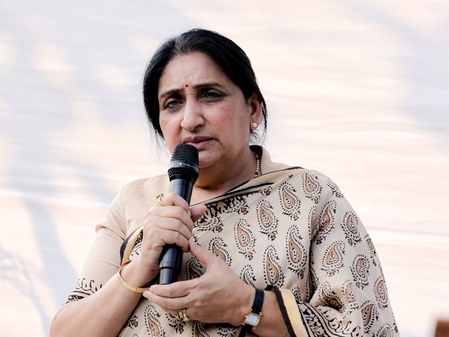
Mumbai: In a significant political transition, Sunetra Pawar was officially elected as the National President of the Nationalist Congress Party (NCP) at the party’s national executive meeting held here.
Party Working President Praful Patel proposed Sunetra Pawar’s name and announced her unanimous election as the national president. Maharashtra unit President Sunil Tatkare seconded her name and hailed her elevation to the post.
Members of the national executive raised their hands to express their faith and confidence in Sunetra Pawar’s leadership.
Both Patel and Tatkare paid tribute to former NCP national president and ex-Maharashtra Deputy Chief Minister Ajit Pawar, who died in a plane crash in Baramati on January 28, 2026.
She succeeds her late husband, Ajit Pawar, who held the position until his tragic passing in the plane crash. Sunetra Pawar assumed office on February 26 following a unanimous decision by party MLAs and senior leaders.
She was sworn in as Deputy Chief Minister on January 31, becoming the first woman to hold the office in the state’s history. Before her swearing-in, she was unanimously elected as the leader of the NCP Legislative Party following the sudden leadership vacuum in the party.
In addition to her party leadership responsibilities, Sunetra Pawar serves in the Maharashtra Cabinet under Chief Minister Devendra Fadnavis, holding key portfolios including State Excise, Sports and Youth Welfare, and Minority Development and Waqf.
This rapid political ascent marks a major shift for Sunetra Pawar, who transitioned from a Rajya Sabha MP to the highest levels of state and party leadership within a matter of weeks, reflecting the party’s confidence in her leadership abilities.
The ascent of Sunetra Pawar to the national presidency of the NCP marks a dramatic shift from a largely behind-the-scenes role into the centre of active political leadership.
For decades, Sunetra Pawar was primarily known as a stabilising force behind Ajit Pawar. While he handled the high-intensity world of Maharashtra politics, she focused on social work in Baramati, managing the Vidya Pratishthan educational institutions and supporting environmental initiatives such as the Environmental Forum of India.
She was regarded as a quiet but influential presence, deeply connected to grassroots workers but rarely serving as the public face of the party.
That changed in mid-2024 when she entered active electoral politics by contesting the Baramati Lok Sabha seat. Though she initially faced a setback there, she was later elected to the Rajya Sabha, signalling the party’s intent to elevate her role within the organisation and national political framework.
IANS

Farmers are India’s foundation: LoP Gandhi flags trade deal at Kannur meet
Wayanad: Leader of Opposition (LoP) in the Lok Sabha, Rahul Gandhi on Thursday positioned farmers at the centre of India’s economic and political debate, alleging that the Union government was...

Sasikala to unveil new party name, confirms plan to contest TN polls
Chennai: V.K. Sasikala, former close aide of late Chief Minister J. Jayalalithaa and a prominent figure in Tamil Nadu politics, on Thursday announced that the name of her new political...
BJP chief blasts Nehru-Gandhi family, labels LoP Rahul ‘poster boy of negative politics’
Patna: BJP National President Nitin Nabin on Wednesday launched a scathing attack on the Congress party, alleging that the Nehru-Gandhi family has historically carried out “compromised missions” that prioritised their...
Congress seeks over 30 seats in DMK-led alliance ahead of TN Assembly polls
Chennai: With the Tamil Nadu Assembly election schedule likely to be announced soon, political activity in the state has intensified, particularly around seat-sharing negotiations within major alliances. In the DMK-led...

Hope that PM Modi mentions genocide of thousands in Gaza during his Israel visit: Priyanka Gandhi
New Delhi: Congress MP Priyanka Gandhi Vadra on Wednesday expressed hope that Prime Minister Narendra Modi would raise the issue of the "genocide of thousands of innocent men, women, and...
Raising issues through protest not a crime: Opposition after Youth Congress President’s arrest
New Delhi: With a Delhi court sending Youth Congress (IYC) National President Uday Bhanu Chib to four days of police custody following his arrest in connection with the shirtless protest...
Raising issues through protest not a crime: Opposition after Youth Congress President’s arrest
New Delhi: With a Delhi court sending Youth Congress (IYC) National President Uday Bhanu Chib to four days of police custody following his arrest in connection with the shirtless protest...
Rajya Sabha poll buzz intensifies in Bihar; Jitan Ram Manjhi reminds NDA of seat promise
Patna: Political activity in Bihar has intensified ahead of the elections for five Rajya Sabha seats, which are being seen as significant in the context of the polls to the...

Will show power of Marathi Manoos if probe is superficial: Rohit Pawar on Ajit Pawar death case
Mumbai: Sharad Pawar-led NCP legislator Rohit Pawar on Monday stated that if a superficial investigation was conducted in the death of Late Deputy Chief Minister Ajit Pawar, the 'Marathi Manoos...

‘ABVP creates atmosphere of impunity on campus’: NSUI National President on JNU student clash
New Delhi: In the wake of the alleged attack on ABVP students at Jawaharlal Nehru University (JNU), NSUI National President Vinod Jakhar on Monday claimed that the RSS-affiliated student wing...

Failed to secure appointment with Gandhi family in 7 months: Bhupen Borah
Guwahati: Newly inducted Bharatiya Janata Party (BJP) leader Bhupen Borah on Monday launched a sharp attack on the Congress leadership, citing personal experiences to highlight what he described as the...

PM Modi bashes Cong over shirtless protest, thanks INDIA bloc allies for criticising the act
Meerut: Prime Minister Narendra Modi on Sunday came down heavily on Congress over its youth wing's recent shirtless protest at the India-AI Impact Summit 2026 and said that the demonstration...


