


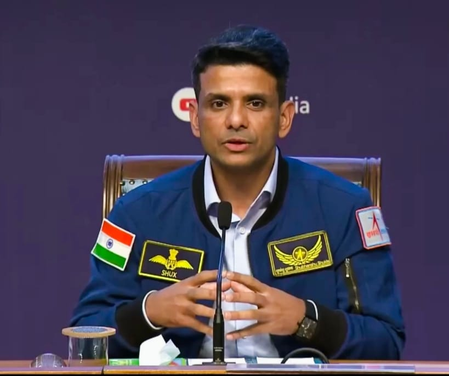
Space mission achieved all technical objectives, results encouraging: Shubhanshu Shukla

New Delhi: IAF Group Captain Shubhanshu Shukla on Thursday said that his mission to the International Space Station (ISS) — a first ever by an Indian — has achieved all technical objectives, and the results are very encouraging.

On June 26, Shukla became the first from the country to reach the orbiting lab. His 18-day stay aboard the ISS was packed with several experiments led by ISRO and other activities on the orbital lab.

Speaking at a press briefing in the national capital, Shukla called it the “mission of an entire nation”.

“We have been able to achieve all our technical objectives,” Shukla said.

“We had seven different experiments, ranging from stem cell research to growing sprouts on the space station. Some of them started showing results while we were there. The results were very encouraging,” he said.

However, he noted that the data needs to be analysed carefully “to not jump to any conclusions”.

For this purpose, “all the experiments done on the space station were preserved and then frozen and have been brought back to Earth,” Shukla said.

Shukla, who piloted the Axiom Space- Mission 4, to and fro along with NASA’s Peggy Whitson, described the feeling as “unbelievable”.

“Despite all the training, when you sit on that rocket and when that engine ignites, when they catch fire, it is a very different feeling. From that point of time till the time we splashed down, the experience has been unbelievable. It has been so exciting and so amazing that I really have been struggling to find words of how do I convey to you so that you live that through my words,” Shukla said.

Sharing his key takeaways from the mission, Shukla said: “Witnessing and executing a human spaceflight mission like this gives you a lot of knowledge, a lot of information. And these are intangibles; you cannot measure them. You cannot just put everything on paper and write it down. The experience goes much beyond and much deeper than what you are documenting or putting in books”.

IANS


Engineers design ‘wearable AC’ that works without power

Jan 8, 2020 New York: Wearable air conditioning is in the offing as engineers from University of Missouri-Columbia have designed an on-skin device that include numerous human health care apps...

Machine can keep human livers alive for a week outside body

Jan 14, 2020 London: Researchers have developed a machine that repairs injured human livers and keeps them alive outside the human body for about one week. It could help save...

New T-cells killed all cancers without touching healthy cells

Jan 21, 2020 London: Researchers at Cardiff University have discovered a new type of killer T-cell that offers hope of a "one-size-fits-all" cancer therapy. These T-cells were shown, in the...

Large amounts of oxygen detected in ancient star’s atmosphere

Jan 24, 2020 San Francisco: An international team of astronomers has detected large amounts of oxygen in the atmosphere of one of the oldest and most elementally depleted stars ever...

Budget proposes Rs 8,000 crore boost for quantum tech

Feb 1, 2020 New Delhi: Giving a huge boost to adoption of emerging technologies, Finance Minister Nirmala Sitharaman on Saturday proposed to provide an outlay of Rs 8,000 crore for...

IIT-Madras builds AI tech to convert brain signals into language

Feb 3, 2020 Chennai: Researchers at the Indian Institute of Technology Madras (IIT-Madras) have developed an Artificial Intelligence (AI) technology to convert brain signals of speech impaired humans into language,...

Carmakers gear up for EV future in India

By Md Waquar haider Feb 5, 2020 Greater Noida: With the world's leading carmakers showcasing their latest electric vehicles (EVs) at the Auto Expo 2020, industry leaders have stressed on...

Reactor side problem, one unit at Kudankulam shut down

By Venkatachari Jagannathan Feb 14, 2020 Chennai: The first 1,000 MW nuclear power plant at Kudankulam has stopped generation due to reactor problem, taking the total of the atomic power...

Indian scientists develop edible coating materials to improve fruit shelf life

By Sunderarajan Padmanabhan Feb 15, 2020 New Delhi: Indian scientists have developed developed non-toxic and edible composite coatings for fruits to save them from perishing fast. Fruits are a highly...

Intel showcases 1st cryogenic quantum computing chip

Feb 19, 2020 San Francisco: Intel Labs, in collaboration with QuTech which is an advanced research centre for quantum computing and quantum internet, has unveiled details about its first cryogenic...

Scientists spot 4G bug that can help hackers impersonate you

Feb 23, 2020 Berlin: Researchers have found a serious vulnerability in LTE/4G mobile communication standard that can help hackers impersonate other phone users, take a streaming service subscription at your...

This large exoplanet could have right conditions for life

Feb 27, 2020 London: Research led by an Indian-origin astronomer has found an exoplanet more than twice the size of Earth that could have the right conditions to sustain alien...

Read Previous

DGCA issued 4 show-cause notices to Air India over 29 violations: Minister

Read Next

Asia buys Asia: India and China lead in local investments, says report

WP2Social Auto Publish Powered By : XYZScripts.com