



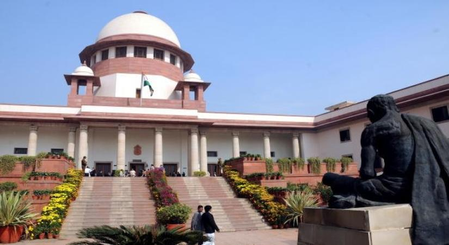
New Delhi: The Supreme Court on Thursday reserved its decision on the reference made by the President under Article 143 of the Constitution, seeking the top court’s opinion on whether timelines can be imposed on Governors to act on Bills passed by state legislatures in the absence of a constitutionally-prescribed time limit.
A Constitution Bench headed by Chief Justice of India B.R. Gavai dealt with oral arguments spread over 10 days from Attorney General R. Venkataramani and Solicitor General Tushar Mehta for the Centre, as well as from Opposition-ruled states including Tamil Nadu, West Bengal, Kerala, Karnataka, Telangana, Punjab, and Himachal Pradesh, opposing the Presidential reference.
On July 22, a five-judge Bench, comprising Justices Surya Kant, Vikram Nath, P.S. Narasimha, and Atul S. Chandurkar, issued notices to the Centre and all state governments in the matter titled “In Re: Assent, Withholding or Reservation of Bills by the Governor and the President of India” and called for the assistance of AG Venkataramani, the highest law officer of the Union of India.
In the aftermath of the apex court verdict in the Tamil Nadu Bills case, President Droupadi Murmu, in May this year, had asked the apex court to report its opinion on options available to a Governor when a Bill is presented to him under Article 200 of the Constitution.
Earlier, in April 2025, a two-judge Bench of the Supreme Court, using its inherent powers under Article 142 of the Constitution, resolved a standoff between the Tamil Nadu government and Governor R.N. Ravi over the delay in granting assent to Bills passed by the Assembly.
It ruled that Governor Ravi’s refusal to approve 10 Bills in Tamil Nadu was both “illegal and arbitrary” and set a three-month deadline for Presidential and gubernatorial approval of Bills passed by the legislature for a second time.
“The President is required to take a decision on the Bills reserved for his consideration by the Governor within a period of three months from the date on which such reference is received,” said a Bench of Justices J.B. Pardiwala and R. Mahadevan.
If there is no decision within this time frame, states are entitled to file writ petitions seeking a writ of mandamus against the President, the Justice Pardiwala-led Bench clarified.
The apex court used its extraordinary powers for the purpose of declaring the 10 withheld Bills as deemed to have been assented to on the date when they were presented to the Governor after being reconsidered by the state legislature.
The top court held that once a Bill is returned, re-passed by the legislature, and presented again to the Governor, it is not open for the Governor to reserve it for the President’s consideration.
The judgment, apparently, brought Presidential actions under judicial review by favouring a three-month deadline for granting assent to Bills, promoting the President to make a reference under Article 143 of the Constitution.
Article 143 provides that the President may invoke the advisory jurisdiction of the Supreme Court on matters of public importance or constitutional interpretation.
In the reference, President Murmu asked the apex court, “Is the Governor bound by the aid and advice tendered by the Council of Ministers while exercising all the options available with him when a Bill is presented before him under Article 200 of the Constitution of India?”
Further, the Presidential reference questioned if the exercise of constitutional discretion by the Governor on Bills is justiciable when Article 361 of the Constitution puts an absolute bar to judicial review in relation to gubernatorial actions.
“In the absence of a constitutionally-prescribed timeline and the manner of exercise of powers by the President, can timelines be imposed and the manner of exercise be prescribed through judicial orders for the exercise of discretion by the President under Article 201 of the Constitution of India?” the President asked the top court to consider and report its opinion thereon.
IANS

Delhi High Court rejects plea seeking reopening of CBSE revaluation portal
New Delhi: The Delhi High Court on Friday refused to issue any urgent directions to reopen the CBSE's digital portal for the revaluation of answer sheets of aggrieved Class 12...

Twisha Sharma case: Father seeks probe into role of legal aid lawyers, files complaint in MP HC
Bhopal: As the CBI probe continues into the death of actress Twisha Sharma, her father has filed a complaint in the Madhya Pradesh High Court demanding an inquiry into the...
SC to hear Meenakshi Natarajan’s plea against Rajya Sabha nomination rejection tomorrow
New Delhi: The Supreme Court agreed to hear tomorrow a plea filed by Congress leader Meenakshi Natarajan challenging the rejection of her nomination papers for the Rajya Sabha election from...

Patna court stays arrest of Khan Sir in coaching centre firing case
Patna: A Patna court on Tuesday granted interim relief to popular educator Faisal Khan, widely known as Khan Sir, by staying his arrest in connection with the recent coaching centre...
SC invokes extraordinary powers to acquit POCSO convict after victim marries him, seeks case closure
New Delhi: Invoking its extraordinary powers under Article 142 of the Constitution to ensure "complete justice", the Supreme Court has set aside the conviction of a man sentenced under the...

Setback for Jharkhand CM as court dismisses his discharge plea in PMLA case
Ranchi:Jharkhand Chief Minister Hemant Soren suffered a major legal setback on Monday after a special court hearing cases under the Prevention of Money Laundering Act (PMLA) rejected his discharge...

SC closes WFI plea against Vinesh Phogat’s Asian Games trials participation
New Delhi: The Supreme Court on Thursday disposed of as infructuous the Wrestling Federation of India's (WFI) plea challenging a Delhi High Court order that had allowed wrestler Vinesh Phogat...
Centre appoints five new Supreme Court judges
New Delhi: Acting on the recommendation of the Supreme Court Collegium, the Centre on Monday cleared the elevation of four High Court Chief Justices and senior advocate V. Mohana as...
Assam Assembly passes UCC Bill; CM Sarma says law to come into effect in 6 months
Guwahati: The Assam Assembly on Wednesday passed the Uniform Civil Code (UCC) Bill, with Chief Minister Himanta Biswa Sarma stating that the legislation would now be sent to Governor Lakshman...
Centre urges SC to transfer to itself pleas against Transgender Amendment Act, 2026
New Delhi: The Centre on Wednesday urged the Supreme Court to transfer to itself petitions pending before various High Courts challenging the constitutional validity of the Transgender Persons (Protection of...
‘We are satisfied’: SC says SIR within constitutional powers of ECI; advances free and fair elections
New Delhi: The Supreme Court on Wednesday upheld the Election Commission of India’s decision to undertake a Special Intensive Revision (SIR) of electoral rolls, holding that the revision exercise was...

Life term for 12 in lynching case; Kerala HC raises sentence, awards Rs 30 lakh to mother
Thiruvananthapuram: In a landmark verdict in the Attappadi Madhu lynching case that once shook the conscience of the country, the Kerala High Court on Monday enhanced the punishment of 12...


