
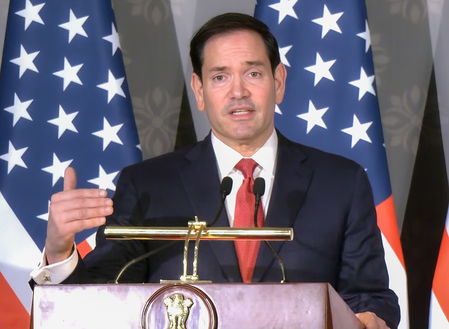
Washington: Secretary of State Marco Rubio criticised the International Criminal Court, arguing that international institutions were using legal claims to constrain American power and challenge decisions made by the United States.
Addressing the Federalist Society’s National Lawyers Convention in Washington on Friday (local time), Rubio said Americans had not agreed to submit to the court’s authority. He also warned against efforts to enforce its decisions against US citizens.
His remarks were part of a broader defence of national sovereignty and the Trump administration’s approach to foreign policy and immigration. He did not announce a new sanctions measure or a change in the US legal relationship with the court.
Rubio accused international officials and advocacy organisations of invoking legal principles selectively to oppose American military actions, border enforcement and domestic decisions.
He extended his criticism to the American judiciary, accusing some judges of using injunctions to advance their preferences. He argued that lasting political change required influence beyond elected office, including in universities, the media and other institutions that shape public debate.
Rubio praised the Federalist Society’s role in developing lawyers and legal ideas over several decades. He said winning elections alone was not sufficient to change the institutions that influence American life.
In response to a question, the Secretary defended engagement overseas while insisting that US interests should guide it. He said events abroad affected American security, markets and migration.
He also discussed immigration and citizenship, drawing a distinction between coming to the United States for work and embracing an American identity. He said the country would continue welcoming people from elsewhere while maintaining controls over admission.
Asked about the conflict with Iran, Rubio said the objective was to prevent Tehran from acquiring a nuclear weapon. He argued that economic pressure had weakened Iran enough to make military action unnecessary at present.
The United States is not a party to the Rome Statute, the treaty establishing the International Criminal Court. The statute nevertheless provides routes for jurisdiction involving nationals of non-member countries, including in certain cases concerning alleged crimes on the territory of a state that accepts the court’s jurisdiction.
IANS