



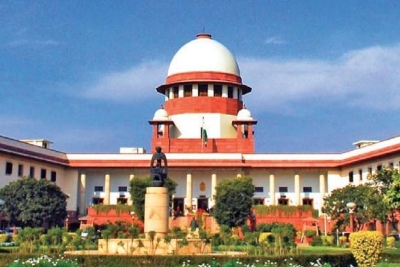
Supreme Court.
New Delhi, Sep 29 (IANS) The Supreme Court on Thursday said that all women, including the unmarried, are entitled to safe and legal abortion, and also the meaning of rape must be understood as including marital rape, solely for the purposes of the Medical Termination of Pregnancy (MTP) Act and any rules and regulations framed thereunder.
And, married women may also form part of the class of survivors of sexual assault or rape, it added.
A bench, headed by Justice D.Y. Chandrachud, said it is not inconceivable that married women become pregnant as a result of their husbands having “raped” them and the nature of sexual violence and the contours of consent do not undergo a transformation when one decides to marry.
“The institution of marriage does not influence the answer to the question of whether a woman has consented to sexual relations. If the woman is in an abusive relationship, she may face great difficulty in accessing medical resources or consulting doctors,” it added.
The bench, also comprising Justices A.S. Bopanna and J.B. Pardiwala, said the state has a positive obligation under Article 21 of the Constitution to protect the right to health, and particularly reproductive health of individuals.
“Married women may also form part of the class of survivors of sexual assault or rapea… A woman may become pregnant as a result of non-consensual sexual intercourse performed upon her by her husband. We would be remiss in not recognising that intimate partner violence is a reality and can take the form of rape,” said Justice Chandrachud, who authored the judgment on behalf of the bench.
It added that the misconception that strangers are exclusively or almost exclusively responsible for sex- and gender-based violence is a deeply regrettable one.
The bench said that there is no requirement that an FIR must be registered or the allegation of rape must be proved in a court of law or some other forum before it can be considered true for the purposes of the MTP Act.
Emphasising that the right to dignity encapsulates the right of every individual to be treated as a self-governing entity having intrinsic value, it added that in the context of abortion, the right to dignity entails recognising the competence and authority of every woman to take reproductive decisions, including the decision to terminate the pregnancy.
“The right of every woman to make reproductive choices without undue interference from the state is central to the idea of human dignity. Deprivation of access to reproductive healthcare or emotional and physical wellbeing also injures the dignity of women,” it added.
Justice Chandrachud said if women with unwanted pregnancies are forced to carry their pregnancies to term, the state would be stripping them of the right to determine the immediate and long-term path their lives would take.
“Depriving women of autonomy not only over their bodies but also over their lives would be an affront to their dignity. The right to choose for oneself – be it as significant as choosing the course of one’s life or as mundane as one’s day-to-day activities – forms a part of the right to dignity,” he added, in the 75-page verdict.
The bench said the law should not decide the beneficiaries of a statute based on narrow patriarchal principles about what constitutes “permissible sex”, which create invidious classifications and excludes groups based on their personal circumstances.
“The rights of reproductive autonomy, dignity, and privacy under Article 21 give an unmarried woman the right of choice on whether or not to bear a child, on a similar footing of a married woman, “it added.
The object of Section 3(2)(b) of the MTP Act read with Rule 3B is to provide for abortions between 20 and 24 weeks, rendered unwanted due to a change in the material circumstances of women.
“In view of the object, there is no rationale for excluding unmarried or single women (who face a change in their material circumstances) from the ambit of Rule 3B. A narrow interpretation of Rule 3B, limited only to married women, would render the provision discriminatory towards unmarried women and violative of Article 14 of the Constitution,” said Justice Chandrachud.
The bench said importantly, it is the woman alone who has the right over her body and is the ultimate decisionmaker on the question of whether she wants to undergo an abortion. “In order to avail the benefit of Rule 3B(a), the woman need not necessarily seek recourse to formal legal proceedings to prove the factum of sexual assault, rape or incest,” said the bench.
On July 21, the top court had allowed a 25-year-old to abort her 24-week pregnancy arising out of a consensual relationship. In the judgment, the top court dealt with various aspects of the issue, including forced pregnancy. The woman had moved challenged the Delhi High Court, which refused to entertain her request to terminate her 24-week foetus, under Rule 3B, dealing with categories of women entitled to abortion, of the MTP Rules, 2003. – IANS

No nuclear arms for Iran ‘non-negotiable’ condition: US
Washington: The United States has made clear that Iran will never be allowed to possess nuclear weapons, with Secretary of War Pete Hegseth calling it a “non-negotiable” condition under the...
RBI holds repo rate at 5.25 pc, maintains neutral instance amid global uncertainty
New Delhi: The Reserve Bank of India (RBI) on Wednesday kept the repo rate unchanged at 5.25 per cent, and maintaining the status quo in its latest Monetary Policy Committee...
Arrest warrant issued against former Nepal PM Deuba, his wife: Reports
Kathmandu: The Kathmandu District Court has reportedly issued an arrest warrant against former Nepali Prime Minister Sher Bahadur Deuba and his wife, former Foreign Minister Arzu Rana Deuba, in connection...

Trump claims Iran reset, orders nuclear dust cleanup
Washington: US President Donald Trump on Wednesday announced what he called a “very productive regime change” in Iran, saying the US would eliminate uranium enrichment and work to dig up...

Israel backs US pause on Iran strikes, says ceasefire deal ‘does not include’ Lebanon
Tel Aviv: Israel on Wednesday expressed support for the United States decision to suspend military action against Iran, while clarifying that the proposed two-week ceasefire arrangement does not extend to...

Iran’s 10-point proposal in negotiations with US
Tehran: Iran's Supreme National Security Council said on Wednesday that the two-week ceasefire with the United States does not signal an end to the war, pending negotiations over the details...

Bangladesh Foreign Minister begins India visit, to hold key meetings on Wednesday
New Delhi/Dhaka: Bangladesh Foreign Minister Khalilur Rahman arrived in New Delhi on Tuesday evening on a "goodwill visit" that Dhaka emphasised is expected to lay an "important foundation" for elevating...
Over to voters as curtain falls on high decibel Kerala Assembly poll campaign
Thiruvananthapuram: At the stroke of 6 PM on Tuesday, the curtains came down on more than three weeks of relentless, high voltage campaigning for the April 9 Kerala Assembly elections,...

Manipur hands bomb attack probe to NIA, protests leave two dead, curfew and internet shutdown imposed
Imphal: Manipur Chief Minister Yumnam Khemchand Singh on Tuesday announced that the state government has decided to hand over the investigation into the deadly bomb attack in Bishnupur district, which...

Manipur suspends internet in 5 districts after bomb attack, CM reviews security situation
Imphal: To prevent further escalation of violence, the Manipur government on Tuesday suspended internet and mobile data services, including broadband, for three days across five Imphal valley districts. The government...

Trump threatens legal action against media organisations over Iran leak
Washington: US President Donald Trump threatened legal action against journalists and media organisations over a leak related to a high-risk US rescue mission in Iran, saying reporters could face jail...
SC directs NIA to probe Bengal’s Malda incident involving judicial officers
New Delhi: The Supreme Court on Monday directed the National Investigation Agency (NIA) to take over the probe into the incident in West Bengal’s Malda district, where seven judicial officers...


