



 by ASAD MIRZA
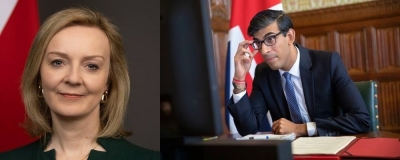
During the last four months, the British public has witnessed a lot, with change of three Prime Ministers, four Chancellors and a new monarch, it definitely is taking a toll on the political scene of the country.
Liz Truss resigned as the Prime Minister and leader of the Conservative Party on Thursday after reading out a statement outside 10, Downing Street. She said she was doing so because she could not deliver the mandate on which she was elected as the Tory leader, just 46 days before.
This brings the curtains down on her 44 day-tenure, the shortest ever for any British Prime Minister. The final act was preceded by a period of immature and unviable decisions, taking the British public for granted and backstabbing and infighting amongst Conservative Party members.
The story more or less unfolded on the same lines as it happened during the last days of the previous Prime Minister Boris Johnson. In BoJo’s case the crisis was precipitated by the resignation of his Chancellor Rishi Sunak and in Truss’s case it snowballed after the resignation of her Home Secretary Suella Braverman.
The stormy days
Truss, who assumed office on September 6, assured the electorate that her government will “ride out the storm” together and she will do everything to bring the living costs down by imposing a cap on energy prices for the next two years.
But her Chancellor Kwasi Kwarteng who presented a mini-budget on September 23, completely rattled the markets. His suggestions included abolishing the 45 per cent rate on earnings over 150,000 pounds, and government plans to borrow around 2 billion pounds annually.
The not so mini fiscal plan that was intended to boost UK growth, spooked the investors, and sent the pound to a record low against the dollar. Sterling’s fall produced higher import prices, and concerns about skyrocketing borrowing costs.
It also forced the Bank of England to take emergency measures, committing to buy 65 billion pounds in bonds to calm gilt markets after a sell-off which is due to end on October 14.
Truss’s mini-budget was seen as overly aggressive, with her tax proposals and spending initiatives viewed as unsustainable, moreover these cuts were unfunded and affected the investors and market’s confidence in the UK economy.
To undo the damage Truss in an unprofessional manner fired her Chancellor and she has been reported as saying that she was forced to do so to save her own skin.
She further pulled another rabbit out her the hat on October 14 when she unexpectedly sacked her Chancellor Kwasi Kwarteng who was summoned to return early from the annual IMF summit in Washington.
She replaced Kwarteng with Jeremy Hunt, who made a complete U-turn and abolished majorly all proposals of his predecessor. Thus with this, her humiliation was complete. Her public standing and political savvy took a severe hit.
Another blow was served when her Home Secretary Suella Braverman resigned on October 19, after backpedalling furiously on her statement calling Indians the biggest visa overstayers in the UK.
This coupled with other related issues also casted doubts on the finalisation of the Free Trade Agreement (FTA) with India before Diwali, a promise much touted by both BoJo and Truss.
But the failure of her fleeting leadership was really written by financial markets. Investors immediately protested her disastrous “growth plan” when it was revealed in September.
Now who?
The contest to find the next Tory leader and PM has been kick started; the most important man to play a major role in this is Graham Brady, chairman of the Conservative Party’s 1922 Committee, who says that that a shorter contest may give a result by next Friday. Current Chancellor Jeremy Hunt has refused to run but Rishi Sunak, Boris Johnson and Penny Mordaunt are all seen as contenders.
Though Rishi seems to a current favourite of the bookies, yet his policies seem to more in tune with the market forces and no sympathy could be expected from him to overhaul the crumbling social care, health and public housing sectors in Britain. Other names being floated are Defence Secretary Ben Wallace, International Trade Secretary Kemi Badenoch, Foreign Secretary James Cleverly and Braverman.
Meanwhile, there have been unconfirmed reports that veteran Tory, Michael Gove, one of Truss’s fiercest critics, and Tom Tugendhat, who have both run in previous contests – have ruled out standing this time.
On the other hand the opposition Labour Party smelling blood has called for a general election. In a statement on Twitter on October 20, UK Labour Party’s leader Keir Starmer said the British people deserve “so much better” than this “revolving door of chaos, each one of these crises was made in Downing Street but paid for by the British public. Each one has left our country weaker and worse off, the Tories cannot respond to their latest shambles by yet again simply clicking their fingers and shuffling the people at the top without the consent of the British people”.
To a certain extent Starmer seems right. But if we peep a little bit more deeply in history, then these chaos in the UK unfolded with the onset of the Brexit saga. The public was fed falsified accounts of how the country would benefit from the economic boom and clutches of EU’s red tape, if the UK left the EU.
We saw an unwelcome ear of Theresa May’s rule, followed by Boris Johnson’s quirky style of leadership and then a nervous and uninspiring leadership by Truss. These all point to a lack of courage or clear principled politicking by the Conservatives.
The Conservatives seems to have taken the electorate for granted and in fact they have elected two Prime Ministers without going back to the public and both have been shown the door unceremoniously. And now they are ready to thrust a third unelected Prime Minister on the British public and God forbid if that person also ends up to be a non-performer then the Conservatives would have written their own epitaph.
(Asad Mirza is a political commentator based in New Delhi. He writes on Indian Muslims, educational, international affairs, interfaith and current affairs)

India rejects China’s attempt to rename places, reaffirms Arunachal Pradesh an ‘integral and inalienable part’
New Delhi: India on Sunday rejected China's "mischievous attempts" to assign "fictitious names" to places which are part of the country, reiterating that territories, including Arunachal Pradesh, remain an "integral...
US intel sees China weighing Iran support
Washington: US intelligence assessments cited by American media suggest China may be weighing a more active role in Iran’s conflict, even as Beijing seeks to avoid a wider war. A...

American security structure over Gulf shattered but Iran’s grip over Strait of Hormuz still intact: Report
New Delhi: Iran's dominance over the Strait of Hormuz remains evident, with surveillance through the chokepoint waters now extending from the tiny Iranian Larak island, while the US security structure...

I don’t see any competition with Pak: Tharoor dismisses Oppn’s concerns on West Asia, backs India’s policy
New Delhi: Congress MP Shashi Tharoor on Saturday defended India's approach to the ongoing West Asia conflict, stating that New Delhi is playing a "very good" role by actively engaging...

Iran struggles to reopen Strait of Hormuz as missing sea mines complicate navigation: Report
Washington: A fresh complication has emerged in the already tense geopolitical landscape, with Iran reportedly facing difficulties in reopening the strategically crucial Strait of Hormuz after laying sea mines during...

Stirrings for CM’s chair begin as Kerala awaits verdict
Thiruvananthapuram: Even before the election results are announced, a quiet but unmistakable race for the Chief Minister’s chair has begun within the Congress-led UDF in Kerala, which is spoiled for...

Political slugfest: Oppn targets BJP, Owaisi after AIMIM snaps ties with AJUP; NDA dismisses charges
New Delhi: The political row over the All India Majlis-e-Ittehadul Muslimeen (AIMIM) withdrawing its alliance with the Aam Janata Unnayan Party (AJUP) intensified on Friday, with leaders across party lines...

Sea temperatures near record in March as El Nino odds rise: Climate agency
Brussels: Global sea surface temperatures rose to their second-highest level on record in March and edged closer to the peaks seen during the last El Nino episode, the European Union's...
Bangladesh: Awami League condemns parliamentary bill banning party as ‘disgraceful act’
Dhaka: Bangladesh’s Awami League has strongly denounced a parliamentary bill that effectively bans the party, terming the move a “disgraceful act” and a direct attack on democratic norms. The remarks...

Oil shock to drag growth, raise inflation: IMF
Washington: A global oil shock linked to the Middle East conflict is set to hit growth and stoke inflation across energy-importing economies, the International Monetary Fund (IMF) Managing Director Kristalina...

India, Bangladesh discuss ways to strengthen defence ties
Dhaka: India's High Commissioner to Bangladesh Pranay Verma held a meeting with Defence Adviser to Bangladesh's Prime Minister, Brigadier General (Retd) AKM Shamsul Islam and underlined the importance of sustained...

‘Situation ambiguous’, ‘Iran came out stronger’: Former Ambassador to China on US-Iran ceasefire
New Delhi: India's former Ambassador to China Ashok K. Kantha on Wednesday termed the two-week ceasefire agreement by the US and Iran as "ambiguous", though he also expressed optimism by...


