



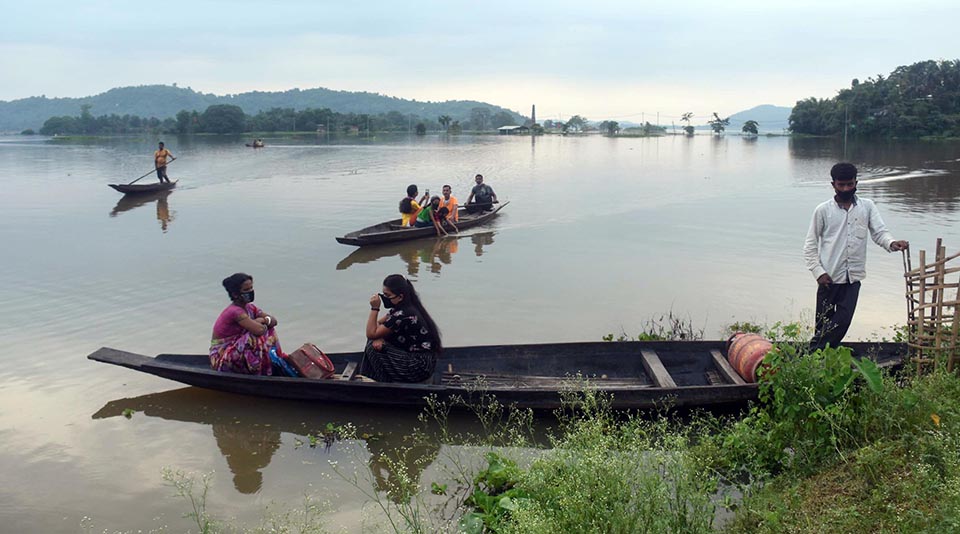
Assam, June 28 (ANI): People use boats to move to safer places from a flood-affected village in Kamrup District on Sunday. (ANI Photo)
July 14, 2020
Guwahati: Amidst spiralling cases of Coronavirus infection, flood fury is creating havoc across Assam having affected a polulation of more than 2 million and killed 50 people in a span of a week, as swelling waters of mighty Brahmaputra and its tributaries are engulfing human habitation, wildlife habitat with an alarming pace.
The flood is like an annual event in Assam where every year millions of people lose their lives and devastation continues unabated. There has been a long pending from respective state governments in the state to declare Assam flood and erosion problem as a national calamity but New Delhi has not paid heed to the demand.
Assam loses almost 8,000 hectares of farmland annually to flooding and erosion, according to government data. The state’s disaster management agency said 32 people died because of flooding in 2012, 44 in 2014,64 in 2015 and 140 in 2016. Analysts say successive governments failed to tackle the annual problem of flooding and erosion in the ecologically fragile region of eastern India. “This year’s flood is possibly the worst in the last three years. The government needs to chalk out a long-term plan to tackle the swelling waters of the Brahmaputra River during the monsoon season,” Bibhan Talukdar of Aaranyak,a Guwahati-based environmental NGO,said.
c
According to the daily flood report of the Assam State Disaster Management Authority (ASDMA), more than 12.63 lakh people have been affected by floods in 23 districts of the state. Barpeta is the worst-hit district with over 5.44 lakh people affected, followed by 1.92 lakh in South Salmara and 1.30 lakh in Dhemaji.
At present, 2,763 villages are underwater and 1,03,806.15 hectares of crop area have been damaged across Assam, the ASDMA said. It further said authorities are running 480 relief camps and distribution centres across 20districts, where 60,696 people are currently taking shelter.
In several areas the swelling waters have breached dykes, damaged roads and the release of additional dam water due to incessant rains in last 72 hours have worsened the situation. Assam Chief Minister Sarbananda Sonowal has directed his council of ministers and legislators to take stock of the loss incurred due to the flood and help in relief and rehabilitation works in their respective constituencies.
The wildlife habitat has been badly hit. The famed Kazirnaga National Park which is known for one horned rhino is completely submerged under water forcing animals to stray in open areas and highways. As per official sources, 166 forest camps have been affected and seven have been vacated due to the floods till last evening. There are altogether 233 forest camps in the Park. As many as 47 animals have died in floods, including those hit by vehicles while trying to cross the national highway 37 that runs through the KNP. Speed restrictions are clamped in the stretch in the Park area to ensure safety of the vehicles.
Besides KNP, other wildlife habitats of the state, including the Rajiv Gandhi Orang National Park and the Pobitora Wildlife Sanctuary, have also been affected by floods.
In the second round of flood this year, which started nearly a week ago, the Brahmaputra is flowing above the dangermark in Guwahati, Dhubri and Goalpara cities in Lower Assam, besides at Nimatighat in Jorhat district and Tezpur in Sonitpur district in Upper and Central Assam. Its tributaries such as Subansiri at Badatighat in Lakhimpur, Burhidihing at Chenimari in Dibrugarh, Dhansiri at Numaligarh in Golaghat, Jia Bharali in Sonitpur, Kopili at Kampur and Dharamtul in Nagaon, Puthimari at NH Road Crossing at Kamrup and Pagladiya at NT Road Crossing in Nalbari are also flowing above the danger mark.
–India News Stream

Mumbai Crime Branch takes over IIT Bombay student’s suicide case, to examine digital evidence
Mumbai: The Mumbai Crime Branch has taken over the investigation into the suicide by IIT Bombay student Sahil Wakode, with investigators focussing on examining his mobile phone for any suicide...

Two top TMC leaders arrested in Bengal after 6 years for attack on Nadda’s convoy, arms seized
Kolkata: The West Bengal Police arrested two influential Trinamool Congress (TMC) leaders from the South 24 Parganas district for their involvement in the December 2020 attack on the convoy of...

Priyanka Gandhi raises women’s safety concerns after Delhi teen’s gang rape and murder
New Delhi: Congress MP Priyanka Gandhi on Saturday raised concerns over women’s safety in Delhi following the alleged gang rape and murder of a teenage girl, questioning the lack of...

Nithari case accused Surendra Koli commits suicide in Haridwar
Haridwar: Surendra Koli, the accused in the sensational Nithari killings case, has committed suicide by hanging himself in Uttarakhand's Haridwar, police said on Friday. His body was found at a...

16-year-old girl gang-raped and killed in Delhi, body found in field
New Delhi: A 16-year-old girl was allegedly gang-raped and murdered by four persons, including three juveniles, in Delhi, with police saying the accused subsequently abandoned her body in an open...

Gurugram biker hit-and-run accused Kalyan Bainsla arrested in Rajasthan’s Dausa
New Delhi: Kalyan Bainsla, the accused in the Gurugram hit-and-run, has been arrested in Rajasthan's Dausa. He will be brought to Gurugram soon, officials said. Earlier in the day, the...

Have solid evidence against them: Disha Salian’s father on naming bigwigs in CBI FIR
New Delhi: Disha Salian’s father Satish Salian on Monday doubled down on his charge that his daughter’s death was not a mere accident but a premeditated murder and the city’s...

‘Op Safed Sagar’ veteran attacked with iron rod over parking dispute in Gurugram
Gurugram: A retired Indian Air Force officer and Kargil War veteran has alleged that he was attacked with an iron rod by a parking attendant at Magnum Global Park in...

Man who killed wife, 3 daughters in Jaipur visited three temples after murders
Jaipur: Rajasthan Police apprehended Rahul Jha (45), accused of murdering his wife and three daughters in Jaipur, from a hotel in Reengus, said police on Monday. He was arrested on...

‘Is it illegal to invest abroad…let ED prove money trail’: Karnataka HM questions agency over Jarkiholi raids
Bengaluru: Karnataka Home, IT and BT Minister, Priyank Kharge, on Saturday questioned the Enforcement Directorate’s (ED) allegations against Public Works Department (PWD) Minister, Satish Jarkiholi, asking whether investing in a...

Satish Jarkiholi has 40 pc stake in Congo gold mining firm, bribe money allegedly used to buy foreign assets: ED
Bengaluru: Karnataka Public Works Department (PWD) Minister Satish Jarkiholi holds nearly a 40 per cent stake in a gold mining company in Congo, while the Enforcement Directorate (ED) on Friday...

Women attack raiding police team in Bihar’s Begusarai, free two wanted men
Patna: In an incident that has raised questions over police authority, dozens of women allegedly surrounded a police team and freed two wanted men who had been arrested during a...


