



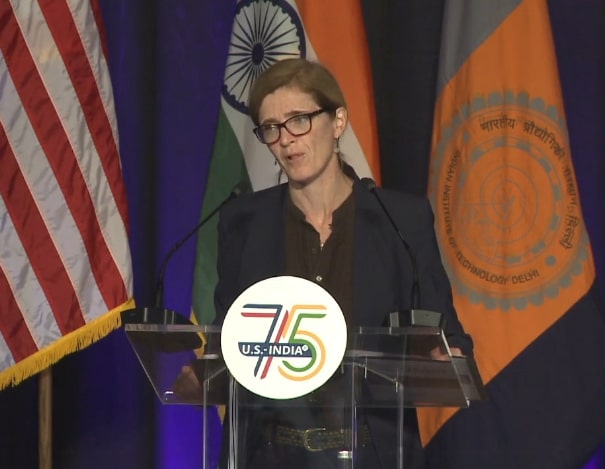
USAID Chief visit to India
On her recent visit to India USAID Administrator, Samantha Power observed that “headwinds” against democratic rule are “strong” across the world currently, and that there are forces in India and the United States “who seek to sow division, pit ethnicities and religions against one another, bend laws and abuse institutions”.
During her three-day visit to India last week USAID Administrator Samantha Power met with civil society representatives in Delhi besides External Affairs Minister S. Jaishankar, Principal Secretary to the PM, P.K. Mishra, and Foreign Secretary Vinay Kwatra.
In meetings with civil society representatives, she stressed the need to discuss freedom of expression, speech, identity, and the importance of protecting the rights of minority groups. Commenting on the meetings, the acting spokesperson of USAID Shejal Pulivarti said that Ms. Power underscored the United States continued commitment to work with civil society organizations around the globe to advance human rights and fundamental freedoms.
Ms. Power addressing an event at IIT-Delhi opined that the headwinds against democratic rule are growing strong the world over. She further said that within the United States and India, there are forces who seek to sow division, who seek to pit ethnicities and religions against one another, who wish to bend laws, abuse institutions, and wield violence against those who stand in their way; we saw this, of course, on January 6 in the United States last year… How the United States and India rise to meet these injustices, how fiercely we protect our hard-won pluralism, and how insistently we defend our democracy and individual rights will determine not just our trajectory, but also that of the world that we inhabit.
US-India Development Model
She also said that USA and India together can offer the emerging countries, the emerging economies of the future a new development model, one rooted not in debt traps and dependence but in economic trade and integration, one that supports and celebrates individual and national agency, and one that aspires to see all countries move beyond the need for assistance.
Elaborating on the model she described it as a model predicated on engaging with a country’s citizens and civil society, just as willingly as it does with its government. One that treats others as equals and collaborates on solutions without preconceptions or stereotypes, which recognizes that democracy, inclusivity, and pluralism offer the surest path to sustainable progress, where dignity is not reserved for the few but endowed to us all, one that is rooted in cooperation, not small-minded but big-hearted, which at its core, believes that we are all one family.
In a reference to highlight the growing importance of India to the US, particularly in the Indo-Pacific region, she said that the US sees India not just as a leader in the Indo-Pacific but as a leader throughout the world. She further said that India, with its talent, resources, and technological expertise, could contribute massively to the development trajectory of many countries. Also, what has positioned India, as a future development leader has not been its assets but its values. It has been India’s multi-ethnic, multi-party democracy that has allowed it to withstand the challenges it has faced and come out ahead stronger and more resilient. It has been its support for free expression over decades that has allowed injustices to come to light. It has been its tolerance for diversity and dissent that has allowed reforms to take hold and institutions to progress. India’s trajectory has been so strong because of its democracy.
India as a regional leader
Power also lauded India’s help to Sri Lanka, and contrasted it with China. She mentioned how India wrote off the debts of poor countries like Ghana, Mozambique, Tanzania, Uganda, and Zambia in 2003. Perhaps nowhere is India’s commitment to those in peril more on display than right now in Sri Lanka. India has reacted swiftly with a critical set of measures, facilitating $3.5 billion in lines of credit to the government of Sri Lanka, in its hour of abject need.
Contrasting the Indian approach with China, she said that China has been an increasingly eager creditor of the Sri Lankan government since the mid-2000s, offering often opaque loan deals at higher interest rates than other lenders and financing a raft of headline-grabbing infrastructure projects with often questionable practical use for Sri Lankans, such as a massive port that generated little income and was barely used by ships, an equally massive airport, dubbed the emptiest in the world because it attracted so few passengers, and the country’s tallest tower that was built as a tourist attraction but has never, unfortunately, been opened to the public.
Sri Lanka’s economic crisis and pressing global challenges such as food security and climate change figured prominently in Power’s talks with her Indian interlocutors.
Ms. Pulivarti said the meetings aimed to reinforce the U.S. and India’s long history as strategic partners and collaborators across development issues, including food security, climate change, and adaptation through mechanisms such as the Coalition for Disaster Resilient Infrastructure and digital development.
Ms. Power also joined Indian agricultural experts and private sector leaders to learn how the U.S. and India can apply climate-smart and sustainable solutions to address the global food security crisis, which is further “exacerbated” by Russia’s invasion of Ukraine.
All countries including India and the U.S. need to hold Russia to the terms of the grain exports deal, she said. The grain agreement, brokered by the U.N. and Turkey and aimed at averting a global food crisis, was signed on 22 July to primarily facilitate the export of around 20 million tonnes of wheat, maize, and other grains from Ukraine.
In toto, Ms. Power’s visit touched upon all those issues which India wants to engage on with the U.S. administration, in addition to issues like human and minority, to which continuing U.S. administrations have attached great importance and kept an eye on. However, most important is the action to get these details reflected in the talks between political leaders of the two countries and if they are reflected and acted upon even halfway through the U.S.-India ties can be transformed, with both countries benefitting from each other’s support and efforts. – INDIA NEWS STREAM

PM Modi embarks on France, Slovakia visit, bilateral talks, G7 Summit on agenda
New Delhi: Prime Minister Narendra Modi on Saturday departed on a visit to France and Slovakia, where he has a packed diplomatic itinerary that includes bilateral talks, multilateral engagements, and...
‘Not justified’: EAM Jaishankar speaks to Rubio, lodges protest over killing of 3 Indian sailors in US Naval attack
New Delhi: India's External Affairs Minister (EAM) S. Jaishankar spoke to the US Secretary of State Marco Rubio and lodged a strong diplomatic protest with the United States after the...

‘Unacceptable’: India lodges strong protest with US over attacks on vessels carrying Indian mariners
New Delhi: The Ministry of External Affairs (MEA) on Friday summoned US Charge d'Affaires Jason Meeks to lodge India's strong protest against the continuing attacks by US naval forces on...
Annamalai floats new youth-centric movement after BJP exit, to contest next TN polls
Chennai: Former Tamil Nadu BJP chief K. Annamalai on Friday announced his departure from the Bharatiya Janata Party (BJP) and launched a new youth-focused movement, ‘We the Leaders’. He said...
US can secure Hormuz alone; we’re most powerful military in the world: Trump
Washington: US President Donald Trump has said the United States does not require military assistance from European allies to safeguard navigation through the Strait of Hormuz, while stressing that the...
Malviya Nagar inferno: 15 admitted in Max Hospital, 6 on ventilator yet stable
New Delhi: A day after 21 people died in a massive fire at the multi-storied Flourish Stay B&B in Delhi's Malviya Nagar area, 15 others injured are undergoing treatment at...
‘No amount of censorship can erase the past’, Rubio criticises CCP ahead of Tiananmen anniversary
Washington: US Secretary of State Marco Rubio on Wednesday commemorated the 37th anniversary of the Tiananmen Square crackdown, saying the world continues to remember those killed while demanding democratic reforms...
India’s global standing weakened amid strategic ambiguity, security challenges: Shiv Sena(UBT) in ‘Saamana’
Mumbai: The Shiv Sena Uddhav Balasaheb Thackeray (UBT) on Thursday said the geopolitical landscape appeared increasingly challenging for India, and after incidents like the Pahalgam attack, the country has found...

India-US trade deal 99 pc finalised, remaining issues being resolved: Sergio Gor
Mumbai: The proposed India-US trade agreement is “99 per cent there”, with only a few remaining issues left to be resolved, US Ambassador to India Sergio Gor said on Wednesday,...
China’s Belt and Road Initiative faces new US pushback
Washington: Two Republican lawmakers have introduced legislation aimed at countering China's Belt and Road Initiative (BRI), arguing that Beijing is using infrastructure financing and investment deals to expand its economic...

Germany announces visa free transit for Indian travellers
Berlin/New Delhi:The German Embassy in New Delhi on Tuesday announced that Indian nationals will no longer require a transit visa when travelling to another country with a layover at a...
India rejects ‘unwarranted references’ to J&K in the Pak-EU statement
New Delhi: India on Tuesday outrightly rejected "unwarranted references" to the Indian Union Territory of Jammu and Kashmir in the joint statement issued by Pakistan and the European Union (EU),...


