

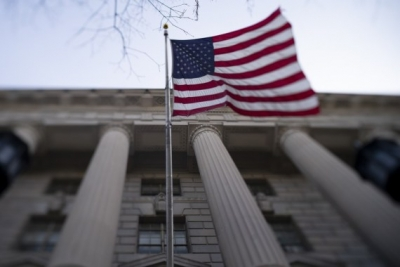
Washington: The 2026 US defence bill intensifies Washington’s pushback against China, tightening restrictions on Chinese military-linked companies and expanding political, economic, and military support for Taiwan.
Congressional leaders on Sunday released the compromise National Defence Authorisation Act (NDAA), which frames Beijing as America’s primary strategic challenge across military, industrial, diplomatic, and global economic domains. The bill moves to the House floor later this week.
A major section of the NDAA strengthens prohibitions against “Chinese military companies in third-party countries,” expanding the legal definition of entities tied “directly or indirectly” to the People’s Liberation Army, Chinese security forces, the Ministry of State Security, the People’s Armed Police, and organizations subordinate to the Central Military Commission. These restrictions apply to such companies whether operating “inside or outside of China,” reflecting congressional concern that Beijing increasingly uses foreign subsidiaries and joint ventures to evade US controls and gain access to sensitive technologies.
Taiwan receives some of the most robust support in years.
The NDAA creates the Taiwan Non-Discrimination Act of 2025, directing the United States to “vigorously support” Taiwan’s admission to the International Monetary Fund should Taipei seek membership.
The bill underscores Taiwan’s economic strength as the world’s 21st-largest economy and asserts that US law should not be interpreted to support Taiwan’s exclusion from international organizations.
The legislation also requires Washington to support Taiwan’s participation in IMF surveillance activities and to ensure employment opportunities for Taiwanese nationals at the Fund, challenging decades of Chinese pressure to limit Taiwan’s presence in global financial institutions.
On the security front, the NDAA expands the Taiwan Security Cooperation Initiative, adding support for medical contingency care, combat casualty capabilities, and other defence-related equipment. For fiscal year 2026, Congress authorizes up to $1 billion specifically for Taiwan’s security needs. In addition, the bill directs the Pentagon to launch a joint program with Taiwan “to enable the fielding of uncrewed systems and counter-uncrewed systems capabilities,” including co-development of new platforms suited for asymmetric defence.
These provisions signal the US intent to harden Taiwan’s ability to deter or withstand a potential PLA offensive through dispersed, resilient, high-volume capabilities, which are seen as central to a modern island-defence strategy.
The NDAA’s Indo-Pacific posture sections reaffirm Congress’s view of China as the central strategic competitor. The bill directs the Pentagon to develop a detailed five-year strategy to strengthen multilateral defence across the region, expand joint exercises, and increase combined maritime operations “through the Taiwan Strait and in the South China Sea.” Congress also extends the Pacific Deterrence Initiative, sustaining investments in forward posture, integrated air defences, prepositioned munitions, and logistics networks designed to counter PLA power projection.
Industrial competition with China is another major pillar. The NDAA establishes the Partnership for Indo-Pacific Industrial Resilience, empowering the Pentagon to build a hardened defence industrial network, coordinate with allied industry, mitigate supply-chain vulnerabilities, expand production capacity, and accelerate development of advanced systems. These steps address concerns about China’s dominance in critical materials, manufacturing infrastructure, and defence-relevant technologies.
Diplomatically, the bill creates a new Ambassador-at-Large for the Indian Ocean Region, tasked with identifying US strategic priorities and directly countering “malign People’s Republic of China influence activities in the Indian Ocean region.” Congress views the Indian Ocean as a rising area of Chinese naval and political activity, including dual-use port development and expanded PLA Navy logistics.
Other provisions address maritime awareness, cyber cooperation in Southeast Asia, restrictions on PRC-linked entertainment partnerships, and reporting requirements for Chinese influence operations worldwide.
Taken together, the NDAA 2026 marks one of Washington’s most comprehensive legislative efforts to confront China’s expanding reach and reinforce Taiwan’s political, economic, and military resilience. As US–China competition deepens across the Taiwan Strait, the South China Sea, and the Indian Ocean, the bill lays out a blueprint for long-term strategic pressure on Beijing and sustained support for Taipei across every major domain.
IANS

Official figure misses 90 pc of farm fires in Haryana, Punjab; need to focus on emerging hotspots of UP, MP too: Report
Chandigarh: Saying that official figures miss over 90 per cent of large farm fires in Haryana and Punjab as farmers shift burning timings, a new report on Monday revealed a...

Vande Mataram 150: ‘They have objections to everything’, Mamata Banerjee on PM Modi’s LS speech
Kolkata: West Bengal Chief Minister Mamata Banerjee criticised Prime Minister Narendra Modi's remarks in the Lok Sabha on Monday regarding the inclusion of only a section of the famous Bengali...
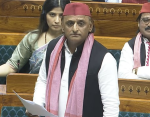
‘BJP wants to own everything’: Akhilesh Yadav in LS during Vande Mataram debate
New Delhi: Samajwadi Party chief Akhilesh Yadav on Monday accused the BJP of trying to “own everything and claiming exclusive nationalism", which was in fact “Rashtra-vivadi (anti-national).” In his address...

US outlines China deterrence strategy built on ‘strength, not confrontation’
Washington: The United States will anchor its China strategy on deterrence “through strength, not confrontation,” US Secretary of War Pete Hegseth said, declaring that Washington intends to maintain an unambiguous...

US warns of China’s ‘historic’ military buildup, signals implications for India
Washington: The United States has issued a sharp warning about China's accelerating military expansion, calling Beijing's defence buildup "historic" and underscoring the need to urgently strengthen America's defence industrial base...
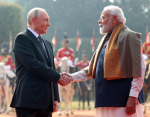
Modi-Putin summit underscores India’s tightrope between Washington and Moscow: US media
Washington: Powerful US media outlets framed the New Delhi summit between Prime Minister Narendra Modi and Russian President Vladimir Putin as a high-stakes display of India's strategic balancing act. Reporting...
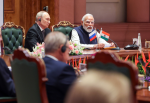
Russia opens up its Far East & Arctic region for trade, investment to India
New Delhi: India and Russia have confirmed their readiness to intensify trade and investment cooperation in the latter's Far East and the Arctic zone, according to a joint statement issued...

RBI’s 25 bps rate cut to boost growth as inflation stays low: Economists
Mumbai: The Reserve Bank of India’s decision to cut the repo rate by 25 basis points on Friday received a strong positive response from economists, who believe the move will...
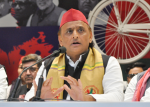
Akhilesh Yadav alleges irregularities in UP’s SIR exercise, demands release of data
New Delhi: Samajwadi Party chief Akhilesh Yadav on Friday demanded greater transparency and accountability in the ongoing Special Summary Revision (SIR) of voter lists in Uttar Pradesh, raising concerns over...
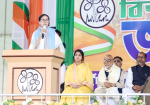
‘Politics of riots’ won’t be accepted, CM Mamata’s reaction after Trinamool suspends MLA over ‘Babri Masjid’ plan
Kolkata: West Bengal Chief Minister Mamata Banerjee on Thursday asserted that the people of Murshidabad will never accept "politics of riots". Her remarks came hours after her party, the Trinamool...

‘Govt breaking protocols’: Congress backs Rahul Gandhi over no Oppn-Putin meeting
New Delhi: The Congress on Thursday backed Leader of the Opposition in the Lok Sabha (LoP), Rahul Gandhi, after he alleged that the Centre has been advising foreign delegations against...
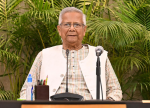
Bangladesh elections just for appearance, power decided in advance: Awami League
Dhaka: Bangladesh's Awami League said that the interim government's Chief Advisor Muhammad Yunus effectively blocked nearly 40 per cent of the country's voters from taking part in the February 2026...