



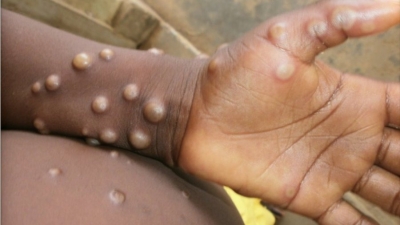
With cases of monkey pox being reported in India, experts have said that government should be proactive, and not wait for the situation to escalate. People should also be more vigilant and report if they exhibit any symptom. So far four confirmed cases of the disease have been reported in the country.
Monkeypox, a disease caused by the monkeypox virus, is associated with symptoms similar to smallpox, but these are milder. The World Health Organisation says that the disease must be distinguished from other illnesses such as chickenpox, measles, bacterial skin infections, scabies, syphilis, and drug allergies.
Patients develop fever, rash and swollen lymph nodes. Symptoms such as fever, intense headache, swollen lymph nodes, back pain, muscle ache, and lack of energy may last for one to three days. This is followed by skin eruption stage which lasts for two to four weeks. Lesions initially are flat and then become raised and painful. These later become vesicles filled with clear fluid, and then filled with pus. These finally become scabs or crusts.
“Though symptoms are milder, but scars and disfiguring may happen like small pox. And if organs such as eyes and lungs get involved, it may have serious consequences,” Dr Jugal Kishore, head of the department of community medicine, Vardhman Mahavir Medical College and Safdarjung Hospital said.
A person can transmit the disease from one-two days before the rash to until all the scabs fall off.
According to WHO, most human monkeypox cases result from a primary animal-to-human transmission. It may occur by bite or scratch of infected animals like small mammals including rodents – rats, squirrels – and non-human primates such as monkeys, and apes. Contact with sick or dead animals should be avoided, and all foods containing animal meat or parts need to be properly cooked.
Human-to-human transmission occurs through close contact with infected people. Contact with lesions, body fluids, respiratory droplets and contaminated materials such as bedding is likely to lead to infection. Therefore, close contact with infected people or contaminated materials should be avoided. Gloves and other personal protective clothing and equipment should be worn while taking care of the sick, whether in a health facility or in the home.
So far, the country has recorded four confirmed cases. Three of the cases have had a travel history. However, the case in Delhi has had no travel history. A fifth suspected case is in Telangana.
Dr Shahid Jameel, a fellow at Green Templeton College, University of Oxford, who has been earlier chief executive officer of Wellcome Trust DBT India Alliance, and head of Virology at the International Centre for Genetic Engineering and Biotechnology (ICGEB), cautioned: “We should not repeat the mistakes of Covid pandemic. We have to look for cases. People and government both should be vigilant. People should come forward to report, and government should develop adequate facilities to handle these. It should also be ensured that there is no stigma associated with the disease.”
Since the Delhi case does not show history of travel, it needs to be looked into whether transmission is happening, Jameel said. The country needs to be proactive and increase surveillance. Contact tracing should be strictly followed to prevent spread. Expertise in PCR testing developed during covid spread should be utilised for monkey pox testing.
“One must be cautious so that cases do not increase. In Covid, mortality was only one per cent, but since it had spread in the community, it caused havoc. For monkey pox, mortality is even higher,” Kishore said.
The proportion of patients who die varies between zero and 11 per cent in documented cases. Mortality has been higher among young children. In recent times, the case fatality ratio has been around three-six per cent, according to WHO. The incubation period – the time between getting infected and appearance of symptoms – for monkeypox is usually five to 21 days. The monkeypox virus is part of the same family of viruses as Variola virus, the virus that causes smallpox. Monkeypox is not related to chickenpox.
“One important thing noticed is that infection is largely happening in younger people, mostly below 40. Age profile suggests people above 40-45 years of age are protected. But, it has not been shown experimentally,” Jameel said. Small pox vaccine may be giving protection.
The vaccination against smallpox had stopped after WHO declared smallpox eradicated in 1980.
Experts say India has problems of low hygiene and overcrowding which can lead to spread. “One must be careful about close contact with infected people, though the disease is little harder to transmit than flu and covid. Since droplets can also transmit, hand hygiene and masks may be helpful especially in crowded settings such as buses and trains,” Jameel suggested.
The Union health ministry has issued guidelines for management of monkeypox disease. It has recommended a combination of standard, contact, and droplet precautions in healthcare settings when a patient presents with fever and rash. In addition, because of the theoretical risk of airborne transmission of monkeypox virus, airborne precautions should be applied as per risk assessment, it says. Patients should be separated from others. “All individuals, including family members, visitors and health care workers should apply standard, contact and droplet precautions.”
Kishore said the government has asked hospitals to gear up and develop detection and management capacity. “In our hospital, there have been seminars to orient doctors. More programmes are planned to educate other hospital staff.”
Currently, a smallpox vaccine Imvanex produced by Bavarian Nordic, a Denmark-based company, is being used against monkeypox. Recently, the European Commission (EC) has extended the marketing authorisation for this vaccine to include protection from monkeypox. Imvanex is a non-replicating live attenuated third-generation vaccine.
“Indian companies may look at producing the available 3rd generation vaccine under license. This can then even be used by other countries,” Jameel said.
WHO has declared monkeypox outbreak a “public health emergency of international concern”. Director General Tedros Adhanom Ghebreyesus said the outbreak had spread around the world rapidly, through new modes of transmission, “about which we understand too little.” More than 16,000 cases have been reported from 75 countries, with five deaths. Natural reservoir of the virus is yet unknown.
The first human case of monkeypox was recorded in 1970 in Congo. Prior to the current outbreak, the disease has been reported in several central and western African countries. Though cases were reported outside these endemic areas, almost all were linked to international travel to countries where the disease commonly occurs or through imported animals. This is the first time transmission is reported in Europe without known epidemiological links to West or Central Africa. – INDIA NEWS STREAM

FSSAI suspends licences of VKC Nuts, Chheda Specialities over food safety violations
New Delhi:The Food Safety and Standards Authority of India (FSSAI) on Saturday said that it suspended the licences of VKC Nuts Private Ltd in Uttar Pradesh and Chheda Specialities Foods...
Bhopal Gas victim groups allege BMHRC curtailing key services at mini units, write to ICMR
Bhopal: Four organisations working with survivors of the 1984 Bhopal Gas tragedy on Thursday alleged that the Bhopal Memorial Hospital and Research Centre (BMHRC) has discontinued pathology services at all...

Drug trade part of hostile nations’ terror agenda: PM Modi cautions youth against addiction
New Delhi: Prime Minister Narendra Modi on Sunday asserted that hostile nations are attempting to weaken India by pushing drugs into the country and targeting its youth, describing the illegal...

FSSAI suspends Switz Foods’ licence over major food safety violations
New Delhi: The Food Safety and Standards Authority of India (FSSAI) on Saturday said that it suspended the food business licence of Switz Foods Private Limited after an inspection of...
Sonam Wangchuk shifted to Medanta Hospital following HC order
New Delhi: Educator, innovator and climate activist Sonam Wangchuk, who is on an hunger strike for the last 24 days, was on Tuesday evening shifted to Medanta from Safdarjung Hospital,...
Gujarat reports 63 suspected Chandipura virus cases, confirms eight deaths
Gandhinagar: Gujarat has confirmed 12 cases of Chandipura virus (CHPV) out of 63 suspected infections reported this year, with the state government intensifying surveillance, treatment, and vector control measures as...

Sonam Wangchuk shifted to hospital after 20-day hunger strike; Delhi Police cite HC order
New Delhi: Climate activist Sonam Wangchuk, who has been on a hunger strike for the past 20 days at Delhi’s Jantar Mantar, was shifted to a hospital early on Saturday...

Sonam Wangchuk stable but weak after prolonged fasting, says Safdarjung Hospital
New Delhi: Innovator and climate activist Sonam Wangchuk, who has been admitted to Delhi's Safdarjung Hospital after completing 21 days of his hunger strike, is weak due to prolonged fasting...
Vegetarian food a healthier alternative: KGMU VC defends ban on non-veg dishes in hostel messes
Lucknow: King George's Medical University (KGMU) Vice Chancellor, Prof. Soniya Nityanand, on Wednesday endorsed KGMU's decision to prohibit the cooking and serving of non-vegetarian food in all hostel messes and...

Expired bread served on Delhi-Bhopal Shatabdi, IRCTC penalises caterer, orders inquiry
New Delhi: The Indian Railway Catering and Tourism Corporation (IRCTC) has imposed a penalty on a catering service provider after passengers travelling on the New Delhi-Rani Kamalapati Shatabdi Express were...
Six women die after C-sections in Bhilwara, two in Banswara; Gehlot seeks central probe
Jaipur: Six maternal deaths within five days at Rajasthan's Mahatma Gandhi Government Hospital in Bhilwara, and two in Banswara reportedly following Caesarean-section deliveries, have raised serious concerns over infection control...

FSSAI issues notices to Lotte India, Kubera Foods, FNP over misleading claims
New Delhi: The Food Safety and Standards Authority of India (FSSAI) has issued notices to Lotte India Corporation Private Limited, Kubera Foods and Ferns N Petals Private Limited (FNP) over...


