



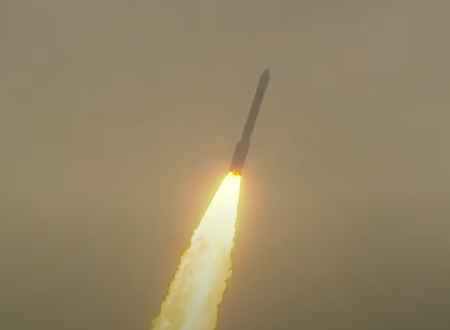
Sriharikota (Andhra Pradesh),: The Indian Space Research Organisation (ISRO) on Sunday suffered a setback as its 101st mission, PSLV-C61 carrying the EOS-09 satellite, faced a technical malfunction in the launch vehicle.
The malfunction led to the mission failure, and the satellite could not be successfully deployed.
The indigenous PSLV, or Polar Satellite Launch Vehicle — PSLV-C61 — lifted off from the Satish Dhawan Space Centre in Sriharikota with the aim of placing EOS-09 into a Sun Synchronous Polar Orbit (SSPO).
While the first and second stages of the launch vehicle performed normally, ISRO Chairman Dr V. Narayanan said that an unexpected issue arose during the third stage, preventing the successful deployment of the satellite.
The ISRO Chief said, “Today, we attempted the 101st launch from Sriharikota, the PSLV-C61 carrying the EOS-09 mission. The PSLV is a four-stage launch vehicle, and its performance was normal up to the second stage. The third stage motor ignited perfectly; however, during its operation, an anomaly was observed, and the mission could not be completed successfully…”
“We will come back after analysis,” he further said.
ISRO also posted an update on X, stating: “Today 101st launch was attempted, PSLV-C61 performance was normal till 2nd stage. Due to an observation in 3rd stage, the mission could not be accomplished.”
The third stage of the PSLV is a solid rocket motor designed to provide high thrust during the upper atmosphere phase of the flight, delivering a maximum thrust of 240 kilonewtons. It plays a crucial role in placing the satellite into its intended orbit.
The EOS-09 was designed to provide continuous and reliable remote sensing data for operational applications across various sectors, ranging from border surveillance and national security to agriculture, forestry, flood monitoring, and disaster management. For the mission, PSLV carried a 1,710 kg satellite into a sun-synchronous orbit to ensure consistent lighting for Earth observation.
The mission was also meant to promote sustainability and carry out responsible space operations. EOS-09 was a repeat satellite similar to EOS-04, launched in 2022, that was designed with the mission objective to ensure remote sensing data for the user community engaged in operational applications and to improve the frequency of observation.
–IANS
Vikram-1 success showcases India’s innovation strength: TDB-DST
New Delhi: The Technology Development Board (TDB) under the Department of Science and Technology (DST) on Sunday congratulated Skyroot Aerospace on the successful Vikram-1 mission, describing it as a watershed...
Skyroot launches India’s 1st private orbital rocket Vikram-1
New Delhi: India scripted a historic chapter in its space journey on Saturday as Hyderabad-based Skyroot Aerospace successfully launched Vikram-1, the country's first privately developed orbital rocket, under Mission Aagaman,...
Indian-origin NASA astronaut Anil Menon reaches space station
Washington: Indian-origin NASA astronaut Anil Menon arrived safely at the International Space Station (ISS) after launching aboard Russia's Soyuz MS-29 spacecraft, beginning his first spaceflight on an eight-month mission focused...
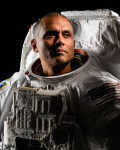
First astronaut of Kerala descent Dr Anil Menon gears up for NASA mission
Thiruvananthapuram: Kerala will have another moment of pride on Tuesday evening when NASA astronaut Dr Anil Menon, whose family traces its roots to Ottapalam in Palakkad district, blasts off to...
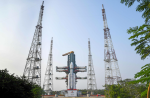
ISRO successfully conducts hot test of 175 tonne semi-cryogenic engine
Chennai: The Indian Space Research Organisation (ISRO) has successfully completed a crucial hot test of its semi-cryogenic engine power head test article (PHTA) at a thrust level of 175 tonnes,...

OpenAI limits new GPT-5.6 models for select partners over US govt request
New Delhi: US-based AI company OpenAI has announced that new GPT‑5.6 models, such as Sol, Terra and Luna, will be rolled out with a limited preview for trusted partners, with...
AI will not replace IT firms, it will amplify them: Infosys Chairman Nilekani
Bengaluru: Infosys Chairman Nandan Nilekani said on Tuesday that artificial intelligence (AI) will not replace IT software companies but, instead, will help in the expansion of firms that adapt quickly...
Microsoft CEO Satya Nadella warns against AI concentration
Washington: Microsoft Chief Executive Satya Nadella has issued a sharp warning against the growing concentration of power in the artificial intelligence industry, arguing that a handful of companies should not...

AI can help India leapfrog without building its own models: Rubrik executive
Washington: Artificial intelligence can help India emerge as a global leader in the next phase of technological innovation even without developing frontier AI models of its own, according to Dev...
NASA outlines vision for lunar ‘city’ amid renewed moon race
Washington: NASA’s vision for returning humans to the Moon no longer resembles the brief Apollo-era visits of flags, footprints and hurried science experiments. Instead, the US space agency now talks...

Tharoor defends ‘Cockroach Janta Party’ satire, warns against suppressing youth dissent
New Delhi: Senior Congress leader Shashi Tharoor on Friday defended the controversial “Cockroach Janta Party” (CJP), asserting that claims portraying the movement as a Pakistani-manufactured conspiracy were “too simplistic”...

AI firms invest 4 times more in core capabilities, leaders see 39 pc returns: Report
New Delhi: Technology companies with successful artificial intelligence (AI) initiatives invest up to four times more in core capabilities such as data quality, governance, AI-ready talent and change management, even...


