




New Delhi: Israel’s Ambassador to India, Reuven Azar, has warned that Iran will face major consequences if it continues to double down and refuses to cooperate with the American and international community requirements. In an interview with IANS, Azar also asserted that Israel will continue with its operations until the Iranian threats are neutralised.
Excerpts:
IANS: How does Israel assess the risk of a full-blown war if US attacks Iranian power plants. What measure is Israel taking to protect its interests?
Reuven Azar: Well, first of all, we are concentrating at this point in degrading the capabilities of Iran because they have produced two existential threats on Israel. One is the nuclear and the other one is a ballistic threat. They are also supporting proxies around the region that are attacking Israel constantly. So, we have to deal with that militarily. Now, if the Iranians decide to continue doubling down and refusing to cooperate with the American and the international community requirements, they will have to face the consequences. We are ready. Although Israel has been attacked and the Iranian regime is firing mainly at our civilian centres, we will not hesitate to continue this until we make sure that the threats are neutralised. We give the Iranian people this opportunity to embrace their future by degrading this mechanism of oppression that has been killing so many thousands of them. So, we are staying the course.
I think the United States is doing the same and we’ve seen, fortunately, that this regime was the first to blink because they said at the beginning that they are not going to negotiate with the United States. But in reality, they got into negotiations. So, we hope that the negotiations will end in a good result and that means, from our perspective, to get all the fissile material out of Iran, to have zero enrichment of uranium on Iranian soil or any military nuclear activity and to curb this project of missiles, ballistic missiles, and to stop Iran’s assistance to proxies in the region. If we achieve these goals, I think the negotiations can end very quickly and we can stabilise the region very quickly.
IANS: US Vice President J D Vance discussed an effort to open negotiations with Iran during a phone call with Israeli PM Benjamin Netanyahu. They also apparently discussed a possible agreement to end the war. Is it true?
Reuven Azar: It is true that there are negotiations going on. We heard the President of the United States talking about that. We have seen corroboration of that by different sources and our Prime Minister was updated on that situation by the President himself.
IANS: US President Donald Trump has stated that the United States and Iran have held talks in complete and total resolution of hostileness in the Middle East. Is Israel likely to be optimistic about such developments?
Reuven Azar: Yes, we are optimistic, because as I told you, the Iranians in the past weren’t agreeing to negotiate as a result of the launching of our operation. So, the fact that now they have agreed to negotiate, it means that they are under pressure. We are also seeing a lot of disconcert among the Iranian ranks. From time to time, you see different statements from different people. I think it shows that there are cracks within the system. I think that they have a very high degree of insecurity and therefore they are denying some of the things that they are doing and this is a good thing. It means that there is a lot of pressure put on them. And this gives me hope that the negotiations will succeed. If they don’t succeed, we will continue the operation until we reach our goals, which I stated at the outset.
IANS: How does Israel assess the implication of Saudi Arabia and UAE’s recent step to support US-led operation in Iran? And what potential benefits or risks do you see in the shift of regional alliance?
Reuven Azar: I think there is no shift, whatsoever. I think that the countries of the Gulf were supportive of this operation. They weren’t stating this openly. But, now that the Iranian regime has decided to attack them, they said publicly what they weren’t saying before. So the alignment is pretty clear. I think that everybody in the region wants to see this regime changing its policy. They want to see these threats removed from the scene, so we can enjoy stability in our region.
IANS: How does Israel see the role of Pakistan in facilitating indirect talks between US and Iran and what implication does this have for Israel’s own diplomatic efforts?
Reuven Azar: Well, it’s up to the United States to decide who they want to choose as facilitator for the negotiations. As long as the result serves the common interest of the US and Israel, there’s not much difference where the negotiations will be held.
IANS: Can Pakistan be even trusted as they are involved so much in terrorism?
Reuven Azar: Well, we are not going to engage in trusting a country that doesn’t have diplomatic relations with us. What we trust is our judgment and the judgment of the President of the United States.
IANS: If you can tell us that what specific factor contributed to Iron Dome’s failure to intercept the Iranian ballistic missiles in Dimona and Arad? How does Israel plan to enhance its air defence system in future?
Reuven Azar: Well, first of all, we have a very high rate of success in interceptions. We are talking about more than 90 per cent success and it’s not just Iron Dome. We have different systems like Arrow 3, David’s Link, Iron Beam, Iron Dome and we also have the Air Force of Israel and the United States that are engaged in intercepting missiles that are incoming from Iran. So, from time to time, these missiles penetrate, and the damage is quite substantive. We have unfortunately lost already 20 lives in Israel, and have hundreds of wounded civilians. What we are trying to do in order to minimise the toll is to get citizens to be disciplined, to enter into safe zones when these missiles are being shot. From the outset of the war, most of the missiles that the Iranian regime has been firing are cluster missiles that have small bombs between two to 10 kilos and are dispersed in a large area.
So, when we don’t manage to intercept it on time, then a number of bombs fall. Fortunately, these bombs are not capable of penetrating safe buildings. You can reduce the number of casualties if people keep in safe zones and they adhere to the recommendations of our home front command. We hope that people will continue cooperating. The downside is that we haven’t been able to open our school system yet in Israel, and that people have to wake up at night and run to shelters. But all in all, the devastation in Iran is much larger because we are hitting… We control the skies of Iran. We’re capable of continuously hitting military targets, their military industry, command and control centres, the top tier of the command and control. So, we’ll continue doing that and inflicting that kind of pressure. I think that it’s working. At the end of the day, as I told you before, the Iranians have blinked first and we hope we’ll be able to get into a diplomatic outcome.
IANS

Indian economy’s fundamentals strong: PM Modi says efforts on to minimise West Asia impact
New Delhi:Prime Minister Narendra Modi on Tuesday said that the Indian economy's fundamentals are "strong" and the Centre is making "continuous efforts" to ensure the West Asia conflict has minimal...
West Asia conflict has created unforeseen challenges for India: PM Modi in LS
New Delhi:Prime Minister Narendra Modi stated on Monday that India is facing significant challenges due to the ongoing conflict in West Asia, highlighting the impact on Indians living in Gulf...
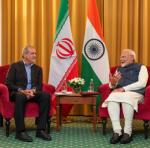
PM Modi has another phone call with Iran’s Pezeshkian, condemns attacks on critical infrastructure
New Delhi:Prime Minister Narendra Modi on Saturday spoke with Iran's President Masoud Pezeshkian conveying to him Eid and Nowruz greetings and also discussing the current security situation in the West...

India dismisses UN rapporteur’s report on Waqf law as false, displaying ‘hostility’
United Nations: India has dismissed a report by the expert on minority issues as “factually incorrect” and displaying “hostility” to the country. Gaurav Kumar Thakur, a counsellor at India’s UN...

EAM Jaishankar, Bangladesh envoy Hamidullah discuss advancing bilateral ties
New Delhi:External Affairs Minister (EAM) S Jaishankar met Riaz Hamidullah, the High Commissioner of Bangladesh to India, in New Delhi on Friday with discussions focusing on advancing bilateral ties. ...
Spokesman of Iran’s Islamic Revolutionary Guard Corps killed in Israeli strike
Jerusalem: The Israel Defence Forces (IDF) on Friday announced that spokesperson and head of the Public Relations Array of the Islamic Revolutionary Guard Corps (IRGC) Ali Mohammad Naini has been...
Safe passage to Indian vessels through Strait of Hormuz demonstrates Tehran’s friendship: Iranian diplomat
Mumbai: The Consul General of Iran in Mumbai, Saeid Reza Mosayeb Motlagh, said on Friday that Tehran's decision to provide safe passage to Indian vessels through the Strait of Hormuz...

PM Modi and Jordan’s King Abdullah II express concern over West Asia situation, call for dialogue
New Delhi: Prime Minister Narendra Modi and Jordan's King Abdullah II held a telephonic conversation on Thursday, their second this month, expressing concern over the evolving situation in West Asia....

Vikram Doraiswami appointed as India’s next Ambassador to China
New Delhi: Vikram K Doraiswami, presently High Commissioner of India to the United Kingdom, has been appointed as the next Ambassador of India to the People's Republic of China, the...

Tharoor’s ‘responsible statecraft’ remark on West Asia draws mixed political reactions
New Delhi: Congress MP Shashi Tharoor’s remarks defending India’s diplomatic restraint over the ongoing West Asia conflict have sparked sharp reactions from leaders across the political spectrum, with some supporting...

Not surrender, responsible statecraft: Days after Sonia Gandhi, Tharoor writes, citing Nehru on India’s ‘silence’ on West Asia
New Delhi: Congress MP Shashi Tharoor has weighed in on the ongoing West Asia crisis, offering a nuanced defence of India’s diplomatic restraint and pushing back against critics who have...
UAE condemns Iran’s attack on Habshan gas facility, suspends operations
Abu Dhabi: The United Arab Emirates (UAE) authorities said on Thursday that operations at the Habshan gas facilities have been temporarily suspended due to falling debris from interceptions of missiles...


