

 by Nilova Roy Chaudhury
Representational Image
Schools have been closed and offices are not functioning in Sri Lanka because of the acute fuel crisis the country is facing, a fallout of what Prime Minister Ranil Wickremesinghe said was the country’s complete economic collapse.
“Our economy has faced a complete collapse,” said Wickremesinghe, appointed just last month by President Gotabaya Rajapaksa as Premier to tackle the country’s unprecedented economic crisis, caused by a combination of political mismanagement and Covid-19 pandemic-related fall in revenues and foreign exchange. The resultant severe crisis in the energy sector has forced closure of all regular services.
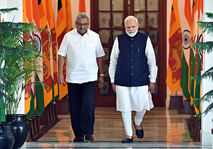
Yet, in the midst of this acute crisis, hundreds of Sri Lankans are protesting in Colombo against “cronyism” of a supposedly “dubious” deal between Rajapaksa and Indian Prime Minister Narendra Modi, to award a 500 MW wind energy project in Mannar to the Adani group.
Protests erupted in Colombo against the Sri Lankan government’s decision to give Adani Enterprises the Mannar renewable energy project. Citizens protested what they alleged was a “dubious” deal between Modi and Rajapaksa, conducted in a non-transparent and illegal way, so that Adani did not have to go through a competitive bidding process. Apparently, the Sri Lanka Parliament passed an amendment to the Electricity Act to facilitate the Adani deal without any bidding for the Mannar project.
Ceylon Electricity Board (CEB) chairman MMC Ferdinando, in a deposition earlier this month explaining recent alterations to the country’s Electricity laws before the Sri Lankan Committee on Public Enterprises, made the claim about the “pressure” from Modi to Rajapaksa to accommodate Adani. He resigned from his post shortly after a tweet from President Rajapaksa refuted the claim of “undue” favouritism in awarding the project “to any specific person or entity”.
A besieged Rajapaksa, under immense political and social pressure for his acute mismanagement of Sri Lanka’s economy leading to its collapse, and desperate to remain in power, vehemently denied the allegations but, despite the official’s resignation, the damage has been done and is being sought to be controlled. Indian government again finds itself in an unsavoury foreign policy controversy, with no explanations forthcoming. Even the Ministry of External Affairs, quick to thwart any negative commentary, has remained scrupulously silent on the matter.
An Indian delegation led by Foreign Secretary Vinay Kwatra was in Colombo last week to see how India could further assist Sri Lanka in this crisis. India has, already in 2022, extended US$ 3.5 billion in support to Sri Lanka, through currency swap arrangements, deferral of a US$ 0.5 billion loan and as liberal lines of credit for the island nation as part of its financial assistance to help the Indian Ocean nation deal with its economic crisis and finance essential imports. A further $500 million in fuel aid has been assured, making India, despite China’s deep pockets, emerge as Sri Lanka’s largest donor during this extreme crisis.
A grateful Rajapaksa government, once considered close to Beijing, had opted to award a power project in March to the Gujarat-headquartered Gautam Adani-headed company. However, an undercurrent of anger against India harboured by a section of the Sri Lankan polity, including leading opposition figure Sajith Premadasa, erupted when Ferdinando claimed that Modi had ”pressurised” Rajapaksa to award a renewable energy (wind power) project in northern Mannar district to Adani, seen as very close to the ruling Indian BJP establishment.
Last year, too, the Sri Lankan cabinet awarded the West Coast Terminal development project to India and Japan, for which India had “nominated” Adani Ports to jointly develop the Colombo West International Container Terminal (CWICT) at Colombo Port, strategically located on one of the busiest shipping routes in the world. The deal was reportedly a “compromise,” agreed upon to keep India invested in the island nation in need of funds. It remains unclear how the Adani group was nominated for the project, without due process, but it improved the tenor of bilateral tensions between Colombo and New Delhi, slightly tilting the scales from China in India’s favour.
The Adani Group, Sri Lankan Ministers have said, was the Indian government’s “nominee” in both cases, indicating there was no competitive bidding process.
Soon after the controversy over Ferdinando’s claims erupted, interestingly, the Chinese and American Ambassadors in Colombo met to work out how best they could help Sri Lanka emerge from its financial crisis. Chinese Ambassador Qi Zhenhong met his US counterpart Julie Chung to discuss how they could regain their relevance in the public discourse there.
India’s immediate and almost unconditional grants of aid to Sri Lanka when it faced its worst financial crisis ever has been a wise policy decision to help it regain some of the primacy it had lost out to China in the region. However, with the controversy over the award of the Mannar project to the Adani group, China will be looking to see how it can get back into favour again in the corridors of Sri Lanka’s government even though most of the financially ruinous infrastructure projects undertaken by the Mahinda Rajapaksa government between 2009 and 2014 were of Chinese origin, significantly contributing to Sri Lanka’s current financial and debt crisis.
India has been lauded by both the government and large sections of the Sri Lankan public for being the “only” friend which has stood by them. Hopefully, the unsavoury protests against the government’s “cronyism” should not harm India’s reputation or hinder the recent upswing in India’s ties with strategically vital neighbour Sri Lanka. – INDIA NEWS STREAM

Path to normalize relations with Taliban regime of Afghanistan fraught with unseen challenges
New Delhi: The newfound bonhomie between India’s Modi regime and the Islamic Emirate of Afghanistan, ruled by the Taliban, has come after four years of severing ties when the...

Will the neighbourhood upheavals impact India?
New Delhi: Countries across South Asia have been riven by what appear to be spontaneous, popular upheavals which have forced members of the elected ruling polity to flee their countries....

India must back successor chosen by Dalai Lama
New Delhi: China’s long held hope it would choose the next Dalai Lama and thus strengthen its stranglehold over Tibet has been dashed after the Buddhist spiritual leader’s recent announcement...

Redefining Corporate Responsibility for a Sustainable Future
New Delhi: In today’s world, the role of corporations extends far beyond profitability. They are seen as stewards of sustainability, agents of social change, and drivers of governance reform. The...
Worrisome Pak-China Initiative
A recent event in the region has set alarm bells ringing in the Indian Ministries of Defence and External Affairs. There are reports that during the 3rd virtual meeting of...

Europe scorched
By Asad Mirza The extreme temperatures witnessed in Europe during the last fortnight, are the results of our own making, and maybe this is a wake-up call for the humans...
Is China a threat or an opportunity to Russia?
That was just another political talk show on Russian TV, and, to make things lively, the editors rolled out a question list to all the attendees: Is China a sincere...

Hooch tragedy in BJP-ruled Gujarat comes to rescue of ally JD(U) in Bihar
When a dozen people died after consuming spurious liquor in the Saran district of Bihar on August 4-5 the response of the ruling Bharatiya Janata Party was somewhat muted. This...
Nitish playing BJP game on RCP
The unceremonious exit of former Union Steel minister, Ram Chandra Prasad Singh, from his own party, Janata Dal (United), on August 6 reminded one of the developments which took place...
New revelations about the nullification of Article 370
Friday the 5th was the third anniversary of the nullification of Article 370. It’s also the date on which ‘Hamin Ast: A Biography of Article 370’ was published by the...

The saga of Bi Amma, whom Gandhi addressed as ‘meri maa’
Among the few Muslim women who had actively participated in the Indian Independence movement, Abadi Bano Begum (Bi Amma) was a prominent face. Her active participation in the struggle to...

Nitish sounds optimistic as Bihar is no Uttar Pradesh
Immediately after becoming the chief minister of Bihar once again on August 10, Nitish Kumar sounded quite optimistic about the performance of the opposition in the 2024 Lok Sabha election....