



April 10, 2020
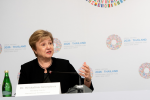
New Delhi:As the world deals with the coronavirus crisis, the Managing Director of International Monetary Fund (IMF), Kristalina Georgieva has said that the world may face the worst economic fallout since the Great Depression of the 1930s.
In her latest address on Thursday, she said that the global growth will turn sharply negative in 2020, and over 170 countries will experience negative per capita income growth this year.
“It is already clear, however, that global growth will turn sharply negative in 2020, as you will see in our World Economic Outlook next week. In fact, we anticipate the worst economic fallout since the Great Depression,” said the IMF Chief.
She said that the bleak outlook applies to advanced and developing economies alike. “This crisis knows no boundaries. Everybody hurts,” she said.
Given the necessary containment measures to slow the spread of the virus, the world economy is taking a substantial hit, Georgieva said, adding that this is especially true for retail, hospitality, transport, and tourism.
In most countries, the majority of workers are either self-employed or employed by small and medium-sized enterprises and these businesses and workers are especially exposed, she said.
She also noted that the economic crisis is expected to hit vulnerable countries hardest. Emerging markets and low-income nations, across Africa, Latin America, and much of Asia, are at high risk.
With weaker health systems to begin with, many face the dreadful challenge of fighting the virus in densely populated cities and poverty-stricken slums, where social distancing is hardly an option, said the IMF Chief.
“With fewer resources to begin with, they are dangerously exposed to the ongoing demand and supply shocks, drastic tightening in financial conditions, and some may face an unsustainable debt burden.”
She also noted that the emerging and low-income countries also are exposed to massive external pressure.
In the last two months, portfolio outflows from emerging markets were about $100 billion, more than three times larger than for the same period of the global financial crisis, she said. Commodity exporters are taking a double blow from the collapse in commodity prices, and remittances are expected to dwindle.
“We estimate the gross external financing needs for emerging market and developing countries to be in the trillions of dollars, and they can cover only a portion of that on their own, leaving residual gaps in the hundreds of billions of dollars. They urgently need help,” Georgieva added.IANS

No major impact on India due to rise in global oil price: FM Sitharaman
New Delhi: The impact of the rise in global crude oil prices on the rate of inflation in India is not estimated to be substantial at this point, as the...
US launches $20 billion Gulf shipping insurance pla
Washington: The United States unveiled a $20 billion maritime reinsurance plan aimed at protecting shipping and stabilising trade through the Gulf region amid tensions linked to the conflict with...

India has 250 million barrels of crude, petro products; 7-8 weeks of buffer across supply chain
New Delhi: Top government sources on Saturday allayed fears that current global energy situation can become a crisis for India, saying that the country currently holds over 250 million...
Oil prices surge to $91.84 per barrel amid rising Middle East tensions
New Delhi: Crude oil prices surged further on Saturday to reach $91.84 per barrel amid the escalating US-Israel and Iran war. Brent crude reached $91.84 while West Texas Intermediate...
Asia must stay agile and prepared as global shocks become more frequent: IMF Chief
New Delhi: Policymakers and businesses in Asia must remain agile and financially strong as the world faces more frequent and unpredictable shocks, Kristalina Georgieva, Managing Director of the International Monetary...

Sensex, Nifty bounce back strongly as global tensions ease
Mumbai: Indian stock markets ended sharply higher on Thursday, with benchmark indices logging their best session in over a month as easing geopolitical tensions between the United States and Iran...

Safe-haven assets likely to rally as Middle East tension deepens
New Delhi: Safe‑haven currencies, from the dollar to the yen and gold, are expected to rally and equity sentiment could worsen due to supply chain disruption amid escalation of...
India, Canada sign $2.6 bn uranium deal, aim to finalise trade pact in 2026
New Delhi: India and Canada took a major step forward in their relationship on Monday by signing a landmark uranium supply agreement worth $2.6 billion. The agreement was signed during...
India, EU agree to grant each other MFN status for 5 years under trade deal
Mumbai: India and the European Union have agreed to give each other Most-Favoured-Nation (MFN) treatment for five years after their proposed free trade agreement (FTA) comes into force. The move...

Pentagon shuns Anthropic, picks OpenAI models in its classified network
New Delhi: The United States Department of Defense has decided to deploy OpenAI’s artificial intelligence models on its classified network, even as it distances itself from Anthropic over disagreements on...

AI will reshape jobs, not destroy them: Morgan Stanley
New Delhi: Fears that artificial intelligence will wipe out millions of jobs have unsettled workers and investors alike, but a new research note from Morgan Stanley suggests the long-term impact...

Rahul Gandhi urges Sitharaman to address ECHS fund crunch, scrap tax on disability pensions
New Delhi: Leader of Opposition (LoP) in the Lok Sabha, Rahul Gandhi, on Saturday wrote to Finance Minister Nirmala Sitharaman, raising concerns over what he described as serious funding gaps...


