



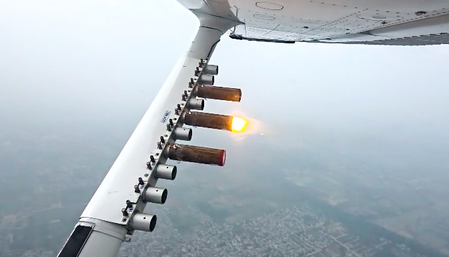
New Delhi: The much-anticipated attempt to induce artificial rain through cloud seeding over parts of Delhi turned out to be “not completely successful.” According to IIT Kanpur Director Manindra Agrawal, the failure was largely due to insufficient moisture in the clouds, emphasising that cloud seeding is not a magic bullet for Delhi’s pollution crisis but rather an emergency, last-resort measure. He also stated that the team plans to make fresh attempts on Wednesday
Speaking exclusively to NDTV on Tuesday, Agrawal, whose institute is collaborating with the Delhi government for this experimental project said that the team plans to make fresh attempts on Wednesday, expressing hope for improved results.
“There hasn’t been any rain so far. So, in that sense, it was not completely successful. Unfortunately, the clouds present today did not have very high moisture content. I am told it was only around 15–20 per cent. The possibility of inducing rain with such low moisture levels is not very high. But this trial has given more confidence to our team to continue conducting them,” Agrawal told NDTV.
The IIT Kanpur-led team used a mixture comprising 20 per cent silver iodide and the rest made up of rock salt and common salt to seed the clouds. On Tuesday, 14 flares were fired in total.
“There were conflicting reports about the likelihood of rain today. Some forecasts predicted rain, while others did not. But our own observation was that the cloud cover had very low moisture content — and this could well be true for the entire region we flew over. So, we do not expect rain today,” Agrawal added.
Two additional flights, he said, are scheduled for Wednesday, and the operations will continue whenever suitable cloud cover is available.
When asked whether cloud seeding could serve as a long-term remedy for Delhi’s persistent air pollution, Agrawal was clear in his response.
“It is an SOS solution, something to attempt only in a crisis when pollution levels are extremely high. It is not a permanent solution. The permanent solution, of course, is to control the sources of pollution. Ideally, we should reach a stage where there’s no need for cloud seeding because pollution itself has been eliminated. Until then, this is one of the tools available to provide temporary relief,” he said.
Agrawal acknowledged that the current cost of the operations is high because the flights are being conducted from Uttar Pradesh. However, he added that these costs could be reduced substantially in future attempts.
“Any effort that leads to even a partial reduction in pollution benefits everyone. Even if rain comes after a few days, it can still provide some relief,” he added.
According to a preliminary report by the Delhi government, the cloud seeding experiment did help reduce particulate matter levels in some of the targeted areas. Two minor precipitation events were recorded 0.1 mm of rain in Noida and 0.2 mm in Greater Noida around 4 p.m. on Tuesday.
Before seeding, the PM 2.5 levels were recorded at 221 (Mayur Vihar), 230 (Karol Bagh), and 229 (Burari). After seeding, they dropped to 207, 206, and 203 respectively.
Similarly, PM 10 levels fell from 207, 206, and 209 to 177, 163, and 177 in the same areas.
Delhi’s Forest and Environment Minister Manjinder Singh Sirsa had confirmed that two cloud seeding attempts were made on Tuesday — one in the morning and another in the evening — with assistance from IIT Kanpur.
“Today, one attempt was made in the morning and another in the evening. The results are still being collated,” Sirsa told IANS, emphasising that the Delhi government is committed to exploring scientific solutions to combat the city’s toxic air.
The experiment comes at a time when Delhi’s air quality has sharply deteriorated in the days following Diwali celebrations. The Air Quality Index (AQI) across Delhi and the National Capital Region (NCR) has remained in the “poor” to “very poor” category, with smog blanketing large parts of the city.
Cloud seeding involves dispersing substances like silver iodide nanoparticles, iodized salt, and dry ice into the atmosphere to stimulate cloud condensation and trigger rainfall. It is often used in regions suffering from water scarcity, or to reduce hail and fog.
On Tuesday, IIT Kanpur’s aircraft seeded a corridor approximately 25 nautical miles (46.3 km) long and four nautical miles (7.4 km) wide, covering areas between Khekra and Burari colonies.
The first flight released six flares at an altitude of around 4,000 feet, while the second, which took off at 3:55 p.m., deployed eight flares at a slightly higher altitude of 5,000 feet.
Despite the lack of rainfall, experts consider the trial a significant technical success, marking one of India’s most advanced urban cloud seeding operations to date.
IANS

Senior members like Tharoor should counsel Cong leaders: HM Shah’s swipe at Opposition
New Delhi: Union Home Minister Amit Shah on Wednesday slammed the Opposition for bringing a notice seeking the removal of Lok Sabha Speaker Om Birla and also took a swipe...
Ilyas Husain appointed as Jamia’s Pro Vice-Chancellor
Jan 1, 2020 New Delhi: Jamia Millia Islamia Vice-Chancellor Najma Akhtar on Wednesday appointed professor Ilyas Husain as the Pro Vice-Chancellor (PVC) of the institute. Husain holds an expertise in...
AMU winter vacations extended for indefinite period, students condemn the VC move
Jan 1, 2020 Aligarh: With the discontent over the CAA-NRC refusing to subside and anger among students simmering over the recent police action, the Aligarh Muslin University(AMU) authorities on Wednesday...
AAP, BJP spar over violence during anti-CAA protests
Dec 1, 2019 New Delhi: The political slugfest between the Aam Aadmi Party (AAP) and the Bharatiya Janata Party (BJP) over the violence and arson during the anti-Citizenship (Amendment) Act...
This drug holds promise for arthritis treatment
Jan 1, 2020 London: Researchers have identified a drug that can significantly reduce bone and cartilage progression in osteoarthritis. In a study, published in the journal Annals of Internal Medicine,...
Delhi Metro launches free Wi-Fi on Airport Express Line
Jan 2, 2020 New Delhi: Delhi Metro Rail Corporation (DMRC), on Thursday, launched free Wi-Fi facility at all the six metro stations of the Airport Express Line. Passengers on this...
New Delhi World Book Fair from Jan 4-12
Jan 2, 2019 New Delhi, Jan 2 (IANS) The 28th edition of the much-attended New Delhi World Book Fair (NDWBF) will open at the Pragati Maidan here on Saturday. Marking...
Man commits suicide by jumping before Delhi Metro
Jan 3, 2020 New Delhi: Services on the Delhi Metro's Yellow line were affected on Friday after a 42-year-old man allegedly committed suicide at Ghitorni Metro Station here. According to...
US attack kills Iranian General, Khamenei vows revenge
Jan 3, 2019 Tehran, Jan 3 (IANS) A US attack ordered by President Donald Trump has killed Gen Qasem Soleimani, the head of the Iran's Islamic Revolutionary Guard Corps' (IRGC)...
Kota children’s deaths: Pilot criticises own government
Jaipur, Jan 4 (IANS) Rajasthan Deputy Chief Minister Sachin Pilot on Saturday took an apparent dig at his own government on the 'number game politics' over the death of children...
Senior JD-U leader wants Nitish to oppose CAA-NPR-NRC
Jan 5, 2020 New Delhi:Pavan Varma, former Rajya Sabha member and JD-U General Secretary, has written a letter to Bihar Chief Minister Nitish Kumar opposing the National Population Register after...
JNU students recall fearful moments of campus violence
Jan 5, 2020 New Delhi: Sunday evening saw tensions ratcheting up yet again on JNU's volatile campus when masked intruders barged into the university compund, targeting Sabarmati hostel inmates. Those...


