


By Yajuvendar Singh
Feb 22, 2020
New Delhi:The word ‘imperial’ has that touch of legacy that one associates so strongly with the British empire of yore. The game of cricket was the domain of that empire and the ICC then was known as the Imperial Cricket Conference, the body that governed cricket around the globe.
The game of cricket when played correctly was defined as the imperial way of playing it. Australia, apparently, through some shrewd field placements, made the first move against the conventional and imperial way of playing the game. South Africa too made their mark by their bowlers mastering the googly.
But the man who played the magical “Indian rope trick” by inventing the leg glance was the first cricket poster boy of the world, Prince Ranjit Sinhji from the Indian state of Nawanagar/Jamnagar. He advertised products in the UK and was the blue eyed cricketer whom people came to watch because of his mystical way of batsmanship.
“Ranji”, as he was popular called, had mastered the art of leg glance and could play it with such grace and precision that it left the spectators as well as the bowlers awestruck.
The imperial way of playing the ball was in front of the wicket, with fielders placed in front to stop the ball. However, the innovative Indian prince, so like his royal lineage of not utilizing undue force, used the bowlers speed and effort to direct the ball finely to the leg side boundary. The imperial way of batting, thereafter, changed forever.
In 1965, the world cricket body finally changed its name to the International Cricket Council (ICC) and the aura of imperialism was finally buried once and for all. The game of cricket was, however, still being governed and controlled from the Lords cricket ground by the powerful English and Australian boards. India and the other nations were at times mere bystanders to the rules and regulations being enforced and implemented.
Although India was a significant part of the cricket world, winning a few series and matches occasionally, they were never given the pride of place or status. India, is now the hub of the cricket world with 80 per cent of the ICC’s revenue coming from them. The reason for this rise is not a lucky dice but many years of effort from the BCCI administrators to popularise and commercialize the game on and off the field.
The change in Indian cricket emanated from the 1983 World Cup win and the shabby treatment that was given to the Indian cricket representatives during the final. N.K.P Salve, the then President of the BCCI, made a promise to change the tidings and India was the venue of the next cup final held in 1987.
The ICC, as one understands, had gradually dwindled to become a cricket body with just Pound 30K in their kitty when the astute Indian administrator, Jagmohan Dalmiya, took over the reins. At the end of his term, he left the ICC a
few millions richer and put in place a structure that finally paid dividend.
Indian cricket both administratively and financially brought the riches to the table. Thereafter, under the ICC leadership of another good Indian administrator N. Srinivasan, Indian cricket along with England and Australia were justifiably given a revenue package that recognized their contribution.
One now gets a feeling that a battle royal is brewing between the ICC and the Board of Control for Cricket in India (BCCI). The body that governs cricket, has two Indians at its helm, in Shashank Manohar as its chairman and Manu Sawhney as its CEO.
Indian history is garnished with tales of Indians playing a part against a fellow Indian to bring the country down. This is precisely how the Afghans, Mughals and finally the British captured and ruled India.
Shashank Manohar, the former President of the BCCI, the man who fought to enrich the coffers of the BCCI during his term seems to be a man on a mission to bring the very cricket body he headed down to its knees. The internal court issues of the BCCI was an ideal platform for him to strike, knowing very well that the BCCI is helpless till the Supreme Courts hearings are completed.
The ICC once again is showing the imperialistic attitude of old. Unfortunately, the person heading it is an Indian. Recently, a report said that the ICC has hired the well-known consulting company Mckinsey to strategize their operations. This was done without any knowledge to either the Indian, Australian or the England board.
The situation looks to be heading towards a battle between the top playing cricket countries and the ICC who wants to govern with an iron fist. The popularity of cricket is growing by leaps and bound and one hopes that an amicable solution is reached before it escalates into a grim situation. Or else, the existing battle may just lead to a war. Cricket unfortunately will then be the loser.

India backs Bangladesh’s call for justice over 1971 genocide by Pakistan: MEA
New Delhi: India on Friday extended support to Bangladesh's pursuit of justice over the genocide carried out by Pakistan during 'Operation Searchlight' in March 1971. Addressing a weekly media...
India in touch with concerned countries for safe transit of ships through Strait of Hormuz: MEA
New Delhi: The Ministry of External Affairs (MEA) said on Friday that four ships laden with LPG have arrived in India after crossing the Strait of Hormuz and assured that...
Delegation of Muslim scholars led by Mirwaiz Umar Farooq calls on Iran ambassador
Srinagar: A delegation of Mutahida Majlis-e-Ulema (MMU) of Kashmir, led by Mirwaiz Umar Farooq, called on the Iranian ambassador in New Delhi on Friday and offered condolences on the “martyrdom”...

Israel staying on course until Iranian threats are neutralised: Ambassador Azar
New Delhi: Israel's Ambassador to India, Reuven Azar, has warned that Iran will face major consequences if it continues to double down and refuses to cooperate with the American and...
Indian economy’s fundamentals strong: PM Modi says efforts on to minimise West Asia impact
New Delhi:Prime Minister Narendra Modi on Tuesday said that the Indian economy's fundamentals are "strong" and the Centre is making "continuous efforts" to ensure the West Asia conflict has minimal...
West Asia conflict has created unforeseen challenges for India: PM Modi in LS
New Delhi:Prime Minister Narendra Modi stated on Monday that India is facing significant challenges due to the ongoing conflict in West Asia, highlighting the impact on Indians living in Gulf...
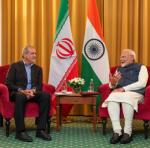
PM Modi has another phone call with Iran’s Pezeshkian, condemns attacks on critical infrastructure
New Delhi:Prime Minister Narendra Modi on Saturday spoke with Iran's President Masoud Pezeshkian conveying to him Eid and Nowruz greetings and also discussing the current security situation in the West...

India dismisses UN rapporteur’s report on Waqf law as false, displaying ‘hostility’
United Nations: India has dismissed a report by the expert on minority issues as “factually incorrect” and displaying “hostility” to the country. Gaurav Kumar Thakur, a counsellor at India’s UN...
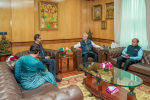
EAM Jaishankar, Bangladesh envoy Hamidullah discuss advancing bilateral ties
New Delhi:External Affairs Minister (EAM) S Jaishankar met Riaz Hamidullah, the High Commissioner of Bangladesh to India, in New Delhi on Friday with discussions focusing on advancing bilateral ties. ...
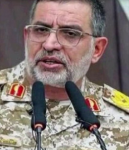
Spokesman of Iran’s Islamic Revolutionary Guard Corps killed in Israeli strike
Jerusalem: The Israel Defence Forces (IDF) on Friday announced that spokesperson and head of the Public Relations Array of the Islamic Revolutionary Guard Corps (IRGC) Ali Mohammad Naini has been...
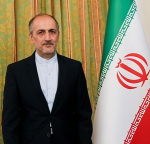
Safe passage to Indian vessels through Strait of Hormuz demonstrates Tehran’s friendship: Iranian diplomat
Mumbai: The Consul General of Iran in Mumbai, Saeid Reza Mosayeb Motlagh, said on Friday that Tehran's decision to provide safe passage to Indian vessels through the Strait of Hormuz...
PM Modi and Jordan’s King Abdullah II express concern over West Asia situation, call for dialogue
New Delhi: Prime Minister Narendra Modi and Jordan's King Abdullah II held a telephonic conversation on Thursday, their second this month, expressing concern over the evolving situation in West Asia....