



 by Nilova Roy Chaudhury
Multiple forums focusing on the criticality of the Indo-Pacific region reiterate the importance of this region, called the “confluence of the two seas” by former Japanese Prime Minister Shinzo Abe, in the global security and strategic dialogue.
For India, the Indo-Pacific, a vast, predominantly maritime expanse from the eastern shore of Africa to the western shore of the Americas, is becoming increasingly the focus of its geo-strategic and geo-economic policies as a more assertive, even aggressive China threatens to disrupt the global flow of commerce and supply chains with its non-adherence to global laws and norms.
Focus on the Indo-Pacific, a term coined by the late Japanese prime minister and endorsed as part of the United States’ strategic construct, has rapidly increased in a clear indication that the global economic centre of gravity has shifted eastward, to this region. This has substantially raised geo-economic opportunities along with daunting security challenges, not only for India and the rest of Asia, but also the Western, developed world.
In New Delhi, a three-day apex-level regional strategic dialogue of the Indian Navy, the “Indo-Pacific Regional Dialogue 2022” (IPRD-2022), an annual international conference that aims to foster an exchange of ideas and promote deliberations on maritime issues relevant to the Indo-Pacific, began with calls for adherence to the rule of law in the region.
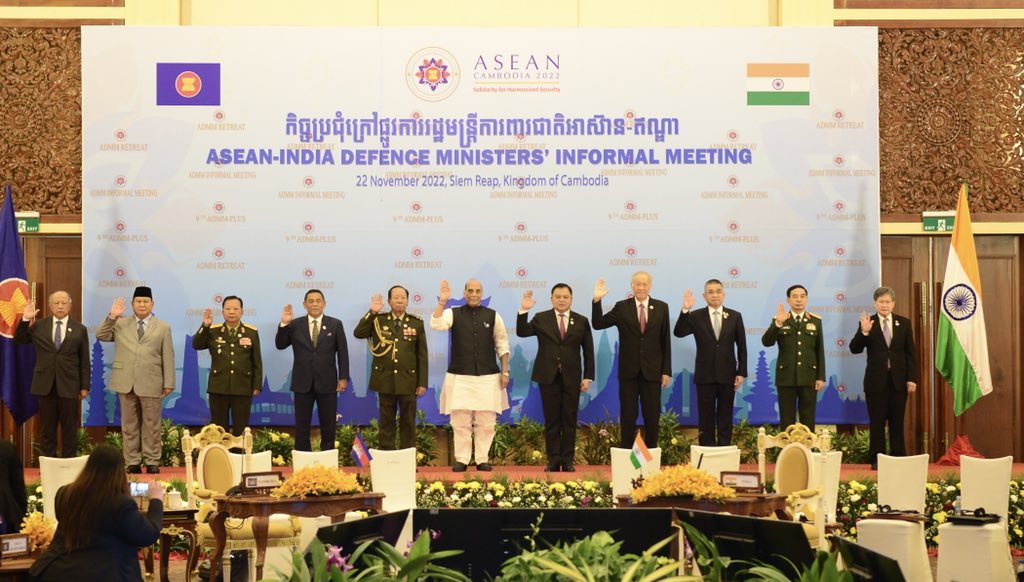
In Siem Reap in Cambodia, speaking at the 9th ASEAN Defence Ministers’ Meeting (ADMM), Defence Minister Rajnath Singh reaffirmed India’s position on the region, stating, “India advocates a free, open and inclusive Indo-Pacific region and calls for peaceful resolution of disputes while respecting the sovereignty and territorial integrity of all nations.”
“India stands for the freedom of navigation and overflight, unimpeded lawful commerce, peaceful settlement of maritime disputes and adherence to international law, particularly, the United Nations Convention on the Law of the Sea (UNCLOS) 1982,” he said, adding, “A peaceful Indo-Pacific, with ASEAN at its centre, becomes vital more than ever for the security and prosperity of the world.”
Singh emphasised India’s commitment to ensuring “practical, forward-looking and result-oriented cooperation” between India and ADMM Plus countries to enhance maritime security in the region and ensure safety of the global commons. The ADMM Plus is an annual meeting of defence ministers of ten ASEAN countries and their eight dialogue partner countries: India, USA, Russia, China, Australia, Japan, New Zealand and South Korea.
Since he assumed his unprecedented third term in office recently, Chinese President Xi Jinping has urged the Chinese armed and maritime forces to be more aggressive and use force if necessary.
While not naming China, Singh expressed hope that ongoing negotiations on the Code of Conduct in the South China Sea would be consistent with international law, particularly UNCLOS, and not prejudice the legitimate rights and interests of nations that are not a party to these discussions.
Meanwhile, Bangladesh on Thursday hosted the 22nd Council of Ministers’ (COM) meeting of the Indian Ocean Rim Association (IORA), the largest and pre-eminent organization in the Indian Ocean Region with 23 Members and 10 Dialogue Partners. India is strongly committed to strengthening IORA to promote peace, security and prosperity in the region and the wider Indo-Pacific.
The QUAD, or quadrilateral of democracies, Australia, India, Japan and the US, was also born of the need to more unitedly focus on the Indo-Pacific region where China has tried to play the spoiler. At the Quad summit in May this year, though the leaders were at pains to state that the group was not aimed at any one country, some areas of focus and some of the emphases in the joint statement left little room for doubt that China is the country Quad aims to keep in check particularly in the Indo-Pacific region. The summit happened when relations between China and Quad members, including India, remained tense with Beijing increasingly challenging the international law of the seas and resorting to coercive trade practices.
The emphasis on building infrastructure in the region and addressing debt servicing and sustainability issues was clearly intended to highlight the major failures of China’s Belt and Road Initiative, most dramatically in Sri Lanka.
The unequivocal reiteration that Quad seeks to uphold international law and security interests in the Indo-Pacific, indicates how crucial this region has become for the world at large as it aims to provide countries in the region, including those in the Association of South East Asian Nations (ASEAN) with an alternative to Chinese belligerence and dominance.
-INDIA NEWS STREAM

US Fed keeps interest rates unchanged, flags oil shock risks
Washington: Federal Reserve Chair Jerome Powell said the US central bank was keeping interest rates unchanged as it monitored the fallout from higher oil prices and broader uncertainty linked to...

Rupee hits record low of 92.63 amid firm dollar, import pressures
Mumbai: The rupee on Wednesday touched a fresh record low of 92.63 against the US dollar, amid a firming greenback and continued foreign fund outflows. At the interbank foreign exchange,...

Gold, silver fall up to 2 pc amid fading Fed rate cut hopes, geopolitical tensions
New Delhi: Gold and silver prices declined on Monday amid fading hopes of a near-term interest rate cut by the US Federal Reserve, while escalating tensions in West Asia kept...
Cyrus Mistry says won’t take up chairmanship of Tata Sons
Jan 5, 2019 New Delhi: In a major turn in the Tata-Mistry saga, Cyrus Mistry on Sunday said that he would not take up the chairmanship of Tata Sons or...
Tata Motors produced zero Nanos in 2019, sold just one
Jan 7, 2020 Mumbai:Tata Motors did not even produce a single unit of its entry-level offering, Nano, during 2019, while it managed to sell just one unit during the year....
Growth estimate subdued, can force fiscal stimulus in Budget
Jan 7, 2020 New Delhi: The government on Tuesday forecast 5 per cent growth for the current financial year, which is the slowest pace in 11 years, and may force...
‘Lack of credit, lower consumption led India’s growthrate to 5%’
by Arul Louis Jan 9, 2020 United Nations: The World Bank says that a lack of credit and drop in private consumption have led to a gloomy growth outlook for...
December auto sales decline by over 13%
10, 2020 New Delhi: The domestic automobile sales continued to decline in December with the overall sectoral off-take plunging 13.08 per cent on a year-on-year basis, data showed on Friday....
Amazon CEO Bezos’s India visit crucial as ecommerce space gets fierce
Jan 10, 2020 New Delhi: As the Indian ecommerce market enters into an interesting phase with Reliance firming up its mega plans with launching JioMart, Amazon Founder and CEO Jeff...
Star unicorn Oyo shuts door on employees in India, China
Jan 13, 2020 New Delhi: Ritesh Agarwal-led Indian hospitality unicorn Oyo, currently the second top unicorn after Paytm and valued at nearly $10 billion in the country, has acted tough...
US ends China’s designation as currency manipulator
Washington: The US has dropped its designation of China as a "currency manipulator", just two days before the two countries were scheduled to sign an agreement at the White House...
Amazon to invest $1 bn to digitise Indian SMBs: Bezos
Jan 15, 2020 New Delhi: In a major announcement showing Amazon's support for Indian MSMEs, CEO Jeff Bezos on Wednesday said that the company would invest $1 billion in digitising...


