




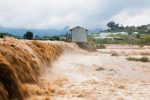
New Delhi: Yesterday’s flash floods in Nepal that have caused massive death and destruction, sweeping away whole communities, bridges and damaging hydropower plants, raise once again the fear of an ecological disaster in the making for India owning to large scale construction of massive dams by China, especially the new mega dam project being built in Tibet’s Yarlung Zangbo river.
Yarlung Zangbo river when it reaches Asssam after entering Arunachal Pradesh in India becomes the Brahmaputra. The dam is located in China-occupied Tibet Autonomous Region’s (TAR’s) Medog or Medong which is located in seismically active zone. That is why construction of a massive dam by China in this region has such a potentially disasterous consequences for India.
Though Nepal disaster was caused by ” glacial collapse”, according to the US Geological Survey (USGS), similar kind of disaster in a dam can happen because of an earthquake, and the strong possibility of such a disaster happening anytime can be gauged from the fact that the Himalayas are very young and seismically active mountain range.
” Already we have had two earthquakes of over 8 on the Richter scale during the last 150 years in the region where China is constructing the dam. Then there was no such dam but now if an earthquake of this scale, occurs, its impact could well be imagined, ” says noted water expert Himanshu Thakkar, one of the country’s leading water expert. He is currently coordinator of South Asia Network on Dams, Rivers and People( SANDROP).
“There are very few places on this earth where earthquake of this scale has occurred,” and the scale of destruction in case of any major seismic event would be in proportion to the scale on which the dam has been constructed,” he added.
The Medog Dam is the world’s largest hydropower project, with a proposed capacity of 60,000 MW, and costing some 1 trillion Yen, or around $148 billion.
Several international studies have already cautioned against the outcomes, saying that the risks posed the Medog Dam may outweigh promised benefits. Ever since the dam has been completed in 2012, it has remained controversial for its social and environmental costs.
The dam spans more than 2 km and rises 185 metres high. If any earthquake hits the region, the resulting destruction would not remained confined to Tibet. Its impact would be strongly felt downstream regions in India and Bangladesh, say the experts.
_-India News Stream
China’s aggressive dam-building programme adding to disaster woes in South Asian region: Reports
New Delhi: Widespread death and destruction were reported from Nepal on Wednesday as flash floods in the Bhote Koshi river, originating from Tibet, inundated many areas in districts north of...

‘Complained was unable to achieve anything’: Mother of IIT Delhi student recalls emotional conversation before his suicide
New Delhi: The mother of Rishikesh Kumar, the 31-year-old MSc Physics student at IIT Delhi who died by suicide on the institute's campus, has recalled an emotional conversation with him...

K’taka govt to declare drought in 102 taluks: Dy CM
Bengaluru: Karnataka Deputy Chief Minister and Revenue Minister G. Parameshwara said on Wednesday that the state government is conducting a comprehensive assessment of the drought situation and is likely to...

Strong national evidence base for land restoration must in fight against degradation
New Delhi: India is facing a serious land degradation threat as can be realised by the Desertification and Land Degradation Atlas of India figures, according to which 97.85 million...

‘People are the masters of the movement’: Achuthanandan’s son drops veiled message for CPI-M
Thiruvananathapuram: At a time when the CPI-M is battling perhaps its most difficult political phase in decades, a social media post by V.A. Arunkumar, son of veteran Communist leader and...

COP17 meet: India highlights its innovative, diversified financing architecture for land restoration
Ulaanbaatar: Minister for Environment, Forest and Climate Change, Bhupender Yadav, on Monday stressed the need for diversified, adequate, predictable and sustained international finance for land restoration and drought resilience at...

Heavy rain batters Delhi-NCR, flights disrupted, Gurugram issues WFH advisory
New Delhi: Heavy rain lashed Delhi-NCR on Monday, causing widespread waterlogging, traffic snarls, and flight disruptions, while authorities in Gurugram issued advisories asking offices to allow employees to work from...
Amarnath Yatra suspended indefinitely as tracks damaged in adverse weather conditions
Srinagar: Due to damaged tracks on both the North Kashmir Baltal route and the South Kashmir Pahalgam route and following adverse weather advisory, the Amarnath Yatra has been suspended indefinitely....

Kerala rain fury: Eight dead, search for missing continues; CM assures assistance
Thiruvananthapuram: Kerala Chief Minister V.D. Satheesan on Sunday confirmed that so far eight people have lost their lives in rain-related disasters in the state, 13 have sustained injuries, and eight...

Expert warns Western Europe warming faster than global average as wildfire risk escalates
Barcelona:Western Europe is warming faster than many other parts of the world, fueling more frequent heatwaves and creating conditions for increasingly severe wildfires, a Spanish climate expert said. As...

Bengaluru has water reserves for only 5-6 months if rain fails: BWSSB chief
Bengaluru: The state capital could face a drinking water shortage within the next five to six months if Karnataka does not receive adequate rainfall, Bengaluru Water Supply and Sewerage...

China wants African nations to switch from USD to yuan in debt repayments
New Delhi: Beijing has started asking African countries to shift their debt repayments to China from the US dollar to the yuan as part of its strategy to strengthen its...


