


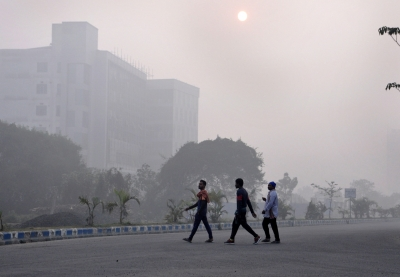
Kolkata: Environmentalist Somendra Mohan Ghosh has raised concerns over the rising air pollution level in Kolkata, especially in heritage site Victoria Memorial and eco-sensitive areas like the Maidan.
In the letter to the Union Environment, Forest, and Climate Change Ministry and West Bengal Environment Department, Ghosh pointed out that the city’s Maidan, often referred to as Kolkata’s lung, is indeed facing severe air pollution issues, exacerbated by the ongoing Metro Rail project near Victoria Memorial. Recently, the air quality in this heritage site has deteriorated to alarming levels, surpassing Delhi’s pollution levels, with the Air Quality Index (AQI) reaching 342, which falls into the “very poor” to “hazardous” range.
According to the environmentalist, the main contributors to this pollution spike include biomass burning in and around Maidan areas, ongoing metro construction without eco-friendly practices, vehicle emissions, and the use of coal and firewood by roadside food stalls near the Esplanade bus stand.
“Regular water sprinkling around Victoria Memorial to trap dust, adopting eco-friendly practices in metro construction, and restricting old diesel vehicles on Maa flyover near Victoria are some of the steps required to reduce the spike in the air pollution level. It’s crucial for authorities to take immediate action to mitigate this pollution and protect public health,” Ghosh wrote in his letter.
On Friday night, the AQI level continued to remain over 300 in several places in Kolkata. At Victoria Memorial, the AQI was 355 at 10 p.m., while in the Javadpur area, it was 311 (“very poor” to “hazardous” level). During the day, the AQI also crossed the 300 mark in the Ballygunge and Fort William areas as well.
The Air Quality Index (AQI) recorded as high as 385 on December 11 and 378 on December 12.
Speaking to IANS on Saturday, Ghosh said: “Kolkata’s metro projects significantly contribute to air pollution during construction due to excavation dust, uncovered soil transport in open trucks, traffic diversions causing congestion, and general construction debris, leading to spikes in PM2.5/PM10 and impacting local air quality.”
“General construction activities, combined with existing issues like trash burning, worsen air quality. High levels of PM2.5 and PM10 pose severe respiratory and cancer risks, with doctors noting increased lung issues,” he said.
IANS
Delhi slips into ‘severe’ air category, stage-III GRAP curbs enforced across NCR
New Delhi: With air quality in the national capital deteriorating sharply, the Commission for Air Quality Management (CAQM) on Saturday invoked Stage-III restrictions under the Graded Response Action Plan (GRAP)...
Heavy smog engulfs Delhi-NCR as air quality slips to ‘very poor’ category
New Delhi: A thick blanket of smog enveloped the National Capital Region (NCR) on Saturday, pushing air quality to alarming levels and raising serious public health concerns. The overall Air...
Smog blankets Delhi as AQI turns very poor again, Jahangirpuri crosses 400-mark
New Delhi: Delhi woke up to a dense blanket of smog on Friday, with the overall Air Quality Index (AQI) reaching 331 at 7 a.m., placing the city once again...
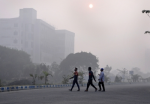
Kolkata’s air turns more hazardous than Delhi, AQI shoots up to 342
Kolkata: In a rare and worrying development, Kolkata has overtaken Delhi in air pollution levels, with the city recording hazardous air quality on Tuesday night. The Air Quality Index (AQI)...
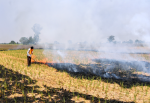
Official figure misses 90 pc of farm fires in Haryana, Punjab; need to focus on emerging hotspots of UP, MP too: Report
Chandigarh: Saying that official figures miss over 90 per cent of large farm fires in Haryana and Punjab as farmers shift burning timings, a new report on Monday revealed a...

Nation’s food bowl Punjab faces water crisis of survival’: Raghav Chadha warns in RS
' New Delhi: "Guru Nanak Dev Ji taught us that wind is the Guru, water is the father, and the earth is the mother. I come from Punjab, also known...

WMO warns of deadly Asia floods as extreme rains batter region
Geneva: Devastating monsoon rains and tropical cyclones have unleashed catastrophic flooding across parts of South and Southeast Asia, killing hundreds of people, displacing communities and causing major economic disruption,...

Rahul Gandhi rakes up rising pollution in Delhi-NCR
New Delhi; As Delhi-NCR's air quality continues to deteriorate, Leader of the Opposition (LoP) in Lok Sabha, Rahul Gandhi, on Friday said that India’s children are choking due to...

PM Modi moots IBSA Fund for climate resilient agriculture at Johannesburg meet
Johannesburg: Prime Minister Narendra Modi on Sunday proposed the setting up of an IBSA (India, Brazil, South Africa) Fund for Climate Resilient Agriculture to further advance South-South cooperation. In his...

CPCB tightens pollution restrictions in Delhi as air quality stays toxic
New Delhi: With Delhi’s air quality turning toxic, the Central Pollution Control Board (CPCB) on Saturday tightened pollution-control measures, directing that several restrictions currently reserved for the ‘Severe’ category under...

Toxic air: CAQM wants NCR govts, pvt offices to switch half of staff to work-from-home
New Delhi: As the air quality dipped in Delhi-NCR, new rules bringing some stringent restrictions from the GRAP-IV stage under GRAP-III were notified by the CAQM, suggesting work-from-home for half...

India-born ‘Mukhi’ gives birth to 5 cubs in Kuno; MP CM calls it ‘unprecedented breakthrough’
Bhopal/Sheopur: In a major achievement for India's ambitious 'Cheetah Reintroduction (translocation) Project', an India-born female cheetah named 'Mukhi' has given birth to five healthy cubs at Kuno National Park, marking...