



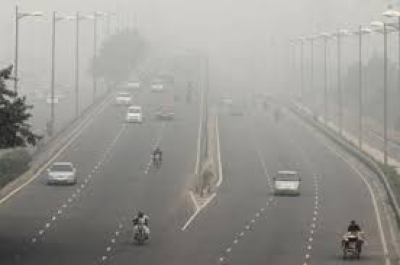
For representational purpose. (File photo)
New Delhi, Nov 4 (IANS) Diwali is the start of the air pollution season in the Indo-Gangetic Plain states, and the worst of the season may be ahead of us, as per data from the Central Pollution Control Board’s (CPCB) Continuous Ambient Air Quality Monitoring Station.
Local emissions, coupled with winter meteorology and increased stubble burning in the region, are some of the leading causes of the high pollution levels during this season.
According to the analysis by NCAP Tracker, average PM 2.5 levels in October this year were higher as compared to 2021 in capital cities of Delhi, Chandigarh, Lucknow and Patna.
The PM 2.5 levels in October 2022 have surpassed those in October 2021, despite delayed withdrawal of monsoon and a cleaner Diwali in comparison across the last five years. The rains also delayed the stubble burning season this year. The only exception was Kolkata which saw a decrease in levels in comparison to last year.
The five capital cities were selected for the analysis as representatives of the IGP.
Jharkhand’s capital Ranchi couldn’t be included due to the unavailability of a Continuous Ambient Air Quality Monitoring Station (CAAQMS) in the city. Data for the months of October to February was considered representative of the winter season.
The average PM 2.5 levels for October 2022 in Delhi, Patna, Lucknow and Chandigarh were higher despite the meteorological conditions and cleaner Diwali indicating that the last few days of October 2022 saw higher pollution levels in comparison to those in the same month in 2021, thereby increasing the monthly average in.
The PM 2.5 levels for October 2022 in Delhi and Patna remained above CPCB’s daily safe limits of 60 ug/m3. Delhi recorded an average PM 2.5 of 105 ug/m3 in October 2022 as opposed to 74.88 ug/m3 in the previous year.
The rains also meant a delayed stubble burning season which meant its share in the PM 2.5 levels in Delhi was around seven per cent until October 28. Similarly, Patna’s PM 2.5 concentration breached the safe limits to 67 ug/m3 from 2021 when it was 45.25 ug/m3.
It was only Kolkata which saw its PM 2.5 levels dip in comparison with 2021.
Responding to the data, Aarti Khosla, Director, Climate Trends, said, “In October 2021, there was a slump in the economy and Covid restrictions in place too. However, this year a lot more activity resumed which could be a reason for higher PM levels.
“For years, the action against air pollution have included ad-hoc measures during the winter season. The government’s have also resorted to a blame game as air pollution levels spike in the national capital and around.
“What we need are long-term solutions like switching to clean energy, managing vehicular pollution and strengthening monitoring to tackle emissions all year round so we can avoid such hazardous levels of pollutions during winter. The extremely high PM 2.5 levels for nearly four months over the years are causing long-term adverse impacts on health of the citizens in these cities.”
It is important to note that both Delhi and Patna have reported an increase of over 40 per cent in their PM 2.5 levels of October 2022 as compared to the same time last year, while Kolkata has recorded a reduction of 34 per cent.
These are cities with a reasonably dense city-wide monitoring. Some cities improving and others getting worse point to a combination of metrological conditions and ground policies which need to be understood better to know what improvements to make to clean our air.
The analysis clearly indicates that enough has not been done and it might get worse in the next two-three months.
“While the measurements and science is giving us better insights in the problem, we still need very close monitoring of the situation to make large-scale improvements at the city-level,” said Ronak Sutaria, Founder and CEO, Respirer Living Sciences.
It also showed that the months of November and December in Delhi over the past three years have the highest concentration of PM 2.5.
The levels of 205.58 ug/m3 in December 2019 were over three times more than the CPCB daily average safe limit of 60 ug/m3 for PM2.5 levels.
November 2020 and 2021 were even higher in comparison, despite the complete lockdown in 2020 and reduced economic activity over the last two years. – IANS

NGT directs action on plea alleging unauthorised groundwater extraction by builders in Noida region
New Delhi: The National Green Tribunal (NGT) has directed the Uttar Pradesh Ground Water Department to examine allegations of illegal groundwater extraction by private builders, industries, and other entities in...

Delhi-NCR to swelter at 44 degrees as monsoon advances across India; rain likely later this week
New Delhi: Delhi-NCR is set for a scorching Tuesday, with temperatures expected to touch 44 degrees Celsius even as the southwest monsoon continues its advance across different parts of the...

UN warns AI could double electricity use by 2030, deplete water level
New Delhi: Contrary to popular beliefs, artificial intelligence could double its electricity consumption by 2030 to about 3 per cent of the world’s power use and produce greenhouse gas emissions...

Monsoon arrives in Kerala after three-day delay, bringing relief and cheers
Thiruvananthapuram, June 4 (IANS) The much-awaited southwest monsoon has officially arrived in Kerala, marking the beginning of India’s most important rainy season and bringing relief to farmers, markets, and policymakers...
Rain, gusty winds to keep Delhi-NCR cool till June 4; AQI in satisfactory category
New Delhi: The residents of Delhi-NCR are likely to experience continued relief from the summer heat as the India Meteorological Department (IMD) has forecast rain accompanied by gusty winds across...

NGT takes suo motu cognisance of rising heatwave crisis across India
New Delh: The National Green Tribunal (NGT) has taken suo motu cognisance of a news report highlighting the growing threat posed by intensifying heatwave conditions across large parts of...

Below-normal southwest monsoon likely; IMD forecasts deficient rainfall across India
New Delhi: The India Meteorological Department (IMD) has released its updated long-range forecast for the 2026 southwest monsoon, indicating a higher probability of below-normal rainfall across the country. According...

UN report warns of more global temperature records
Geneva: Global average temperatures are likely to continue at or near record levels in the next five years, with Arctic temperature anomalies expected to continue to be higher than the...

Heatwave grips North India, temperatures cross 45 degrees Celsius, IMD issues red, orange alerts
New Delhi: Severe heatwave conditions continued to intensify across Delhi and several parts of North India on Wednesday, with temperatures crossing 45 degrees Celsius in many areas of Rajasthan, Haryana,...

Decarbonisation of buildings, construction sector slowed, says UN report on climate impact
New Delhi: Decarbonisation of the buildings and construction sector has slowed, leaving it both a major emissions source and increasingly vulnerable to climate impacts and energy price shocks, a new...

IMD issues yellow alert for heatwave in Delhi-NCR for next three days
New Delhi: The spell of intense heat across Delhi-NCR is steadily worsening, with the India Meteorological Department (IMD) issuing a yellow alert for severe heatwave conditions over the next three...

Jairam Ramesh writes to Defence Minister on Great Nicobar project; flags ecological, tribal concerns
New Delhi: Congress leader Jairam Ramesh has written to Defence Minister Rajnath Singh regarding the Great Nicobar Island Project, raising concerns over environmental clearance, tribal rights, and the justification offered...


