




New Delhi: Price wars are taking a heavy toll on China’s corporate sector as profits are being sharply eroded in the fierce competition to grab a share of the dwindling market pie amid excess production capacity. This is also resulting in the dumping of cheap Chinese goods in overseas markets.
Intense, cutthroat competition is forcing companies to slash prices relentlessly, even when they can’t cover their costs, according to an article published in The Wire China Podcast.
In many sectors, including electric vehicles, solar panels and batteries, Chinese firms engage in endless price wars. A growing number of these companies cannot earn enough revenue to even service their debt, let alone other costs. These “zombie” companies survive only because banks roll over loans and local governments provide subsidies to avoid job losses and keep tax revenues flowing, the article states.
“Recent estimates show this problem is spreading. The share of non-financial corporate assets held by zombies climbed from about 5 per cent in 2018 to 16 per cent in 2024. In newer, high-priority sectors like green tech, the share of zombie companies has hit 30 percent of total listed companies,” the article states.
The more productive Chinese companies manage to survive through improved efficiency and cutting costs through better technology or scale, and can afford to lower prices without immediately running into losses amid shrinking margins.
But this is only a small share of Chinese corporates. Most firms lack those efficiency improvements. Without real productivity advances, they still resort to cutting prices to stay in the market as they get external support from banks or local governments. This is leading to collapsing profit margins across the board, even for the better companies, whose productivity is increasing. In sum, unproductive companies are hurting the productive ones, which is clearly not good for the Chinese economy, the article observes.
The article also highlights that the overcapacity in the Chinese economy is also leading to ultra-cheap exports flooding markets abroad with EVs, solar panels, and batteries. Trade partners respond with tariffs and defences, turning domestic distortions in the Chinese economy into global friction, the article laments.
IANS

US-Iran war could push Brent above $100 per barrel
New Delhi: Brent crude could climb above $90 per barrel with Strait of Hormuz disruption or exceed $100 per barrel in a broader regional conflict, a report said on Sunday....

AI will reshape jobs, not destroy them: Morgan Stanley
New Delhi: Fears that artificial intelligence will wipe out millions of jobs have unsettled workers and investors alike, but a new research note from Morgan Stanley suggests the long-term impact...

4,000 employees sacked in a jiffy at Jack Dorsey’s firm Block in AI era
New Delhi: Twitter (now called X) co-founder Jack Dorsey has announced that Block, the financial services company he founded, will cut its workforce by 40 per cent due to AI-led...
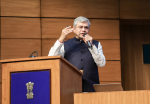
Social media platforms must share revenue fairly with content creators: Ashwini Vaishnaw
New Delhi: Union Information and Broadcasting Minister Ashwini Vaishnaw on Thursday said that social media platforms must share revenue in a fair manner with those who create content, including journalists,...

PM Modi invites Israeli firms to explore investment, manufacturing opportunities in India
Tel Aviv: Prime Minister Narendra Modi has invited Israeli companies to explore opportunities in India to invest, manufacture and build technology partnerships, it was announced on Thursday. PM Modi, accompanied...

SpiceJet shares crash 10 pc to 11-year low as 8.4 pc equity changes hands in block deals
Mumbai: Shares of SpiceJet crashed 10 per cent on Wednesday, hitting the lower circuit after heavy block deals on the BSE triggered massive selling in the counter. Nearly 8.4 per...

Sensex, Nifty end higher as PSU banks, healthcare stocks lead gains
Mumbai: Indian stock markets extended their gains for the second straight session on Monday, supported by buying in PSU banks and healthcare stocks. Positive global cues also boosted investor sentiment...

Bharti Airtel to invest Rs 20,000 crore to expand digital lending biz via NBFC arm
Mumbai: Bharti Airtel on Monday announced plans to invest Rs 20,000 crore over the next few years to expand its digital lending business through its Non-Banking Financial Company (NBFC) subsidiary,...
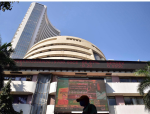
Nifty-500 clocks highest earnings growth in 8 quarters
Mumbai: India Inc delivered its strongest earnings performance in the past eight quarters in the third quarter of FY26, driven by broad-based sectoral growth and improving demand trends, a new...

Market cap of six top-10 firms jump Rs 63,478 crore
Mumbai: The combined market valuation of six of India’s top-10 most valued companies rose by Rs 63,478.46 crore last week, with Larsen & Toubro and State Bank of India emerging...

India’s UPI proves public digital model can surpass private networks: Report
New Delhi: India’s Unified Payments Interface (UPI), the world’s largest real‑time payments system, has proved that inclusion and scale can go together and that a "public, interoperable model can surpass...

125 overseas companies exit Pakistan by Jan 2026: SECP data
New Delhi: Pakistan’s top corporate regulator, the Securities and Exchange Commission of Pakistan (SECP), has released a list of 125 foreign companies that have stopped operating in the country as...


