



New Delhi: Atmospheric carbon dioxide (CO2) levels today are higher than at any point in the past 800,000 years. As a result of global warming caused by greenhouse gas emissions, many countries have seen record extreme temperatures, more frequent wildfires, and destructive floods. This has resulted in devastating impacts upon the people and the nature.
The ocean is experiencing increased temperature, acidification, and oxygen depletion. Marine ecosystems have experienced significant, and increasing disruption as the impacts of climate change, multiplied by other human impacts � notably industrial fishing � have applied huge pressure on life below water.
When coastal wetlands are damaged or degraded they capture less carbon and release significant amounts of greenhouse gases � carbon dioxide, methane and nitrous oxide that might have been stored for thousands of years.
Blue carbon ecosystems are some of the world’s most efficient absorbers of CO2 and long-term carbon sinks. The carbon sequestered by the world’s oceans and coastal wetlands is termed as blue carbon.
To date, research has focused on the blue carbon capacity of three coastal wetland habitats: mangroves, seagrasses and tidal marshes. These habitats are currently the only marine habitats that the Intergovernmental Panel on Climate Change (IPCC) provides guidance to countries for inclusion in their national greenhouse gas inventories.
Other emerging blue carbon components of interest include seaweed, especially kelp and Sargassum, phytoplankton, shellfish beds, seabed sediments and marine vertebrates, like sharks, whales and deepwater �mesopelagic’ fish. For want of detailed research, these are yet to be included in international climate policies or carbon financing mechanisms, but are known to be important components of carbon sequestration to seabed sediments and the deep ocean.
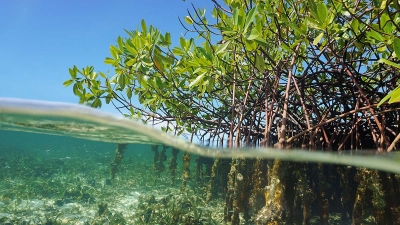
Mangrove forests are highly productive and sequester more carbon per unit area than any other tropical ecosystem, land or sea.
Mangroves protect a global carbon stock of 2.6 � 10.4 billion tonnes, of which 80per cent is stored in the soil.
Globally, mangroves sequester up to 34 million tonnes of carbon per annum, equivalent to one year’s CO2 emissions from 31 coal fired power plants.
More than 30 per cent of the world’s mangroves have been destroyed since 1960 and losses continue at a rate of 0.11 per cent per year, releasing greenhouse gases that account for up to 10 per cent of deforestation emissions globally.
Healthy mangroves are important defences against storms and sea level rise and sustain coastal fisheries through their nursery function to fish and shellfish.
Mangroves are salt-tolerant forests that grow at the interface between land and sea in tropical and sub-tropical latitudes across over 118 countries. In 2012, global mangrove cover was estimated at 14.5 million hectares, nearly the same size as Bangladesh, most of which was in Asia (42 per cent).
The present study collated data on the Indian blue carbon repository (mangroves, seagrasses, and salt marshes) from peer-reviewed literature on carbon stock assessment. This meta-analysis indicated that the blue carbon ecosystems of India could have a collective carbon stock of 67.35 Tg C (mangroves, seagrass, and salt marsh accounting for 67 Tg C, 0.0630 Tg C, and 0.0049 Tg C, respectively). Several studies have ubiquitously measured the spatial extent of mangroves (4991 km2) and seagrasses (517 km2) in India; however, the salt marshes (290�1398 km2) have contradictions in estimates.
The green payments against the blue carbon ecosystems of India can be as high as $9.6 billion, whereas the social cost of carbon sequestered by these ecosystems can vary between $0.47 billion and 5.43 billion.
India’s Sundarbans is among five sites that have the highest blue carbon stocks globally, according to a new assessment of greenhouse gas volumes emitted from and absorbed by forests in Unesco World Heritage sites.
Blue carbon – world’s most efficient absorbers of CO2 and long-term carbon sinks – IANS

IMD forecasts below normal monsoon in 2026, rainfall to be 95-90 pc of average
New Delhi: The 2026 southwest monsoon seasonal (June to September) rainfall over the country is most likely to be below normal or around 95-90 per cent of the Long Period...

Sea temperatures near record in March as El Nino odds rise: Climate agency
Brussels: Global sea surface temperatures rose to their second-highest level on record in March and edged closer to the peaks seen during the last El Nino episode, the European Union's...

NGT says artificial embankments cannot define Yamuna floodplain limits
New Delhi:The National Green Tribunal (NGT) has directed authorities in Delhi to ensure demarcation of the Yamuna floodplain along a 22-km stretch between Wazirabad and Palla in accordance with statutory...
Earth’s climate swings increasingly out of balance: WMO
Geneva: The Earth's climate is more out of balance than at any time in observed history, as greenhouse gas concentrations drive continued warming of the atmosphere and ocean as well...
China to ban single-use plastics
Jan 20, 2020 Beijing: China, one of the world's biggest users of plastic, has unveiled a major plan to reduce single-use plastics across the country, a media report said on...
CFL, filament bulbs to be banned in Kerala
Feb 7, 2020 Thiruvananthapuram: Kerala Finance Minister Thomas Issac on Friday presented the state Budget 2020-21 in the Assembly, giving it a 'green' touch by proposing total ban on CFL...
Severe weather storm weather alert issued as ‘storm of century’s hits UK
Severe weather alert issued as 'storm of the century' hits UK (09:18) London, Feb 10 (IANS) Storm Ciara, named the "storm of the century", has slammed the UK as gale...
Sydney hit by heaviest rainfall in 30 yrs
Feb 10, 2020 Sydney: Sydney has been hit by the heaviest rains in three decades after a storm caused flooding along Australia's east coast, but in the process extinguished a...
Tough diplomatic act for Indian-origin UK minister in UN climate talks
By Vishal Gulati Feb 14, 2020 New Delhi: Indian-origin Alok Sharma, who was named the UK's new Minister to lead the crucial UN climate talks, has immense challenges and pressure...
Green tribunal pulls up Defence Ministry
Feb 14, 2020 New Delhi: The National Green Tribunal (NGT) has pulled up the Ministry of Defence after the latter failed to comply with the tribunal's earlier order relating to...
EUR 150 mn to come from EIB for green infrastructure projects in Southeast Asia
Feb 16, 2020 Luxembourg: The European Investment Bank (EIB) will invest EUR EUR 150 million to accelerate the development of green infrastructure projects in Southeast Asia. It will invest the...
Modi announces institutional research facility for conservation of migratory birds.
Feb 17, 2020 Gandhinagar; Prime Minister Narendra Modi on Monday inaugurated a convention on migratory fauna and announced the creation of an institutional facility for undertaking research and assessment for...


