




It is true that he was instrumental in elevating the country to the ranks of major global economic powers by introducing long-wanted economic reforms, but when one casts one’s eyes on the various landmark egalitarian legislations during his tenure, his achievement seems no less monumental.
One legislation that will go down in history as a great tool in the hands of citizens to hold the government accountable is the Right to Information Act, 2005.
The Act provided the common man greater and smoother access to information about decisions and acts of the government and its agencies, which is must in a democratic society.
The second significant law passed by Parliament in 2005, was the National Rural Employment Guarantee Act under which a minimum of 100 days of guaranteed wage employment every year to every household was ensured In 2009, the title of the Act was changed to Mahatma Gandhi National Rural Employment Guarantee Act.
The National Food Security Act, 2013 was another landmark legislation which said that the state shall “regard the raising of the level of nutrition and the standard of living of its people and the improvement of public health as among its primary duties”. This was in line with the Directive Principles of State Policy. Yet another law in furtherance of these directive principles was
Right of Children to Free and Compulsory Education Act, passed in 2009.
Through this Act, the government inserted a new Article, 21-A,into Part III of the constitution, mandating universal elementary education for children up to 14 years of age.
The Act also provides that private schools will reserve 25 pc seats for children from poor families and prohibits donations or capitation fees.
We thus see that along with economic reforms that created a market economy, Dr Singh was not oblivious of the need of the role of the state in ensuring welfare of its citizens.
His political journey began in 1971 when he was appointed as an Economic Advisor in the Ministry of Commerce. He later became Chief Economic Advisor (CEA) and Secretary in the Ministry of Finance.
From 1991 to 1996 he was the country’s Finance Minister, and that was the period that saw a crucial turning point in India’s economy.
During this period, Singh’s bold reforms helped transform the country’s economy in the face of an economic crisis. Among the major steps he took were devaluation of the rupee, reduction of tax burdens, and attracting foreign investment etc..
He became India’s Prime Minister in 2004 when the Congress’ won the Lok Sabha elections, And his tenure as PM saw India making major strides in economic field.

Messi’s India Tour event organiser files complaint against former Bengal minister, ex-DGP
Kolkata: Lionel Messi's 'GOAT India Tour-Kolkata edition' organiser Satadru Dutta has lodged a written complaint against former state Sports Minister Aroop Biswas at Bidhannagar South Police Station in connection with...
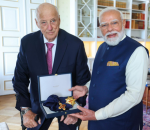
PM Modi conferred with 32nd global honour — Grand Cross of Royal Norwegian Order of Merit
Oslo: Prime Minister Narendra Modi was conferred with Norway's top honour, Grand Cross of the Royal Norwegian Order of Merit, by King Harald V in Oslo on Monday. This marks...

Mulayam Singh Yadav’s son Prateek Yadav dies at the age of 38
Lucknow: Prateek Yadav, son of late Samajwadi Party chief Mulayam Singh Yadav and husband of BJP leader Aparna Yadav, passed away at the age of 38 years in Lucknow on...

Father remembers ‘struggle for food’ after Vijay takes oath as Tamil Nadu CM
Chennai: As Tamilaga Vettri Kazhagam (TVK) President C. Joseph Vijay took the oath as Tamil Nadu Chief Minister, his father, S.A. Chandrasekhar, got emotional, remembering the struggles he once made...

Life ended the day we received news of his death: Father of Pahalgam terror attack victim Lt. Vinay Narwal
Karnal: A year into one of the worst terrorist attacks on tourists in India, life seems to have stopped there itself for families of the victims of the Pahalgam terror...
Gautam Adani becomes Asia’s richest person, surpasses Mukesh Ambani
New Delhi: Billionaire industrialist Gautam Adani, Chairman of the Adani Group, has become Asia’s richest individual, overtaking Reliance Industries Chairman Mukesh Ambani, according to the latest Bloomberg Billionaires Index. Gautam...

Sundar Pichai, Ranbir Kapoor, Vikas Khanna shine in TIME’s ‘100 Most Influential People of 2026’
New Delhi: Google CEO Sundar Pichai, Bollywood actor Ranbir Kapoor and celebrity chef Vikas Khanna have been featured in TIME magazine’s latest list of the '100 Most Influential People of...

‘Monumental loss’: EU Ambassador Delphin, Australian envoy Green pay tribute to Asha Bhosle
New Delhi: Foreign diplomats in India have also joined those paying tributes to legendary singer Asha Bhosle, who passed away in Mumbai on Sunday at the age of 92. ...

‘Touched countless hearts’: PM Modi expresses grief over passing away of Asha Bhosle
New Delhi: Prime Minister Narendra Modi on Sunday expressed grief over the passing away of legendary singer Asha Bhosle. Bhosle breathed her last in Mumbai on Sunday at the age...

Asha Bhosle passes away at 93, last rites to be held on Monday at Shivaji Park
Mumbai: Legendary playback singer Asha Bhosle passed away at the age of 93 in Mumbai on Sunday. The singer was admitted to the Breach Candy Hospital on Saturday. Ashish Shelar,...

Top Maoist leader Prashant Bose alias ‘Kishan da’ dies in custody in Ranchi
Ranchi: Banned CPI-Maoist's senior Politburo member, Prashant Bose, alias ‘Kishan Da’, died at the Rajendra Institute of Medical Sciences (RIMS) in Ranchi after his health deteriorated on Friday, officials said....

Harish Rana, first Indian allowed passive euthanasia, cremated in Delhi
New Delhi: The final rites of Harish Rana, the first person in India to be granted permission for passive euthanasia, were conducted on Wednesday at New Delhi's Green Park cremation...


