



 by Diptendra Raychaudhuri
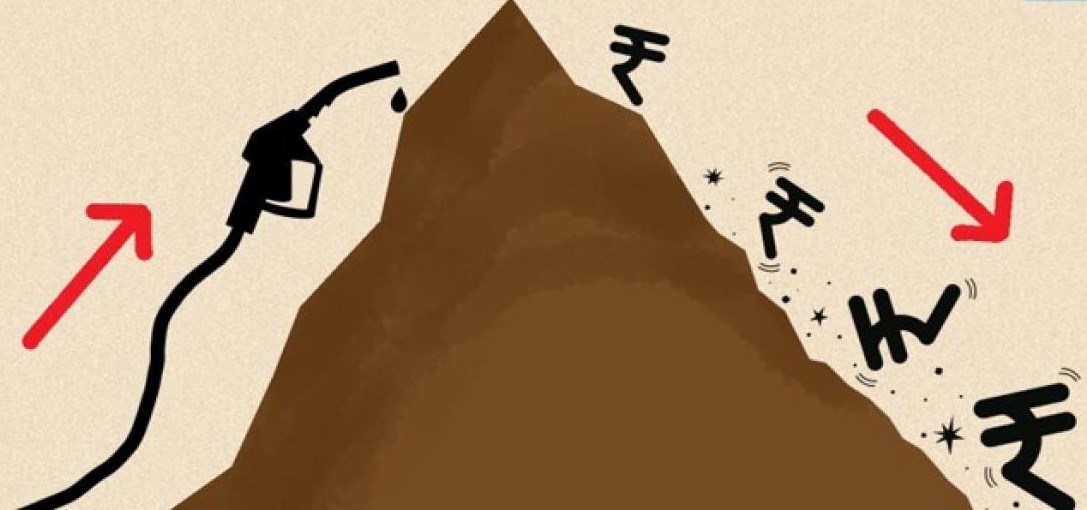
On 28 May 2013, the Rupee was quoted at Rs 55.97 for 1 USD. Three months later, the Rupee plummeted by 23% to Rs 68.83 to a dollar. Those were the dying months of the Manmohan Singh government, and the challenger was leaving no stone unturned to mock the then PM. The falling rupee gave him an apt scope to deride the union government.
Expressing serious concern over the continuous fall in the value of the rupee, on 24th August 2013, at a function at Rajkot, the challenger said, “Today our currency is on its deathbed. It is in terminal stage and urgently needs the attention of a doctor.” Further, he said, “There was a time when the Indian rupee was making lots of noise. But today it has lost its voice. And similarly, we are unable to hear the voice of our Prime Minister. Both have turned mute.”
That was when the rupee was at 68 against the dollar. Now it has breached the symbolically key level of 80. The challenger of 2013 is now the Prime Minister. He, Narendra Modi, has so many resources under his control now. But like Manmohan Singh, he too has not found the ‘doctor’ he talked of in 2013. The question that begs an answer is if at 68 vis-à-vis a dollar our rupee was on its ‘deathbed’, and ‘in the terminal stage’, is it still alive at 80 vis-à-vis a dollar? Or is it dead?
Well, the politicians do not answer uncomfortable questions. So, we will never get the answer. But we will feel the consequences. The present free fall of the value of the rupee is a pointer to the fact that we are still a vulnerable economy. The tall talks of becoming an economic giant are all pretense. Thanks to economic liberalization unleashed by Narsimha Rao in 1991, we have traveled a long, long way from a sick, controlled economy, but a much longer road is ahead before we reach a position of strength.
This time the fall of the rupee is mainly due to monetary tightening by the Federal Reserve that is being mimicked by the major central banks across the globe. It has particularly hurt the developing economies as an exodus of hot money from these countries to the US is being witnessed. While many economies have been hurt by it, India will feel the heat the most due to several reasons. First of all, it will be ravaged by record-breaking crude oil prices, which will pump up the cost of India’s imports, thereby widening our trade deficit. That brings us to the second important point, that of the current account deficit. It is the difference between a country’s imports and exports. If a country’s import value is less than the value of its exports, we have a current account deficit, and it is adversely affected by the fall of its currency. If the value of exports surpasses that of imports, it has a current account surplus and is much less vulnerable.
As per the provisional figures released by the Reserve Bank of India (RBI), In FY’22, India’s current account deficit will be around $38.7 billion, a sharp reversal from a surplus of $23.9 billion in FY’21. The figure for FY ’21 was however an aberration. India recorded a surplus after 17 years in FY’21. It was because of the low demand for fuel oil and inputs for the factories due to Covid-19. Talking about the short-term future, there is little scope for repeating the feat. So the falling rupee will stay a heavy burden for some years now unless a reversal of the exodus of hot money is witnessed.
Now comes the third point, which will probably hit us the most this time: The fuel inflation (as crude becomes costlier in rupee terms) will affect all other commodities, particularly food and fertilizer. It will give a boost to the already high rate of inflation, and in turn, will further erode the purchasing power of both the middle class (salaried and pension or fixed-deposit interest-dependent people) and the poor Manmohan Singh paid the price of his failure on the economic front and huge corruption at the highest level of his government. But Narendra Modi is luckier, for he will not face any stiff opposition even in 2024. Furthermore, he enjoys the advantage of a divided and ineffective opposition. So he has no political need to answer whether the rupee is still alive or dead.
—-INDIA NEWS STREAM
Oil PSUs’ losses on LPG sales below market price cross Rs 59,000 crore
New Delhi: The cumulative under-recoveries of the government-owned oil marketing companies -- Indian Oil, Bharat Petroleum and Hindustan Petroleum -- on the sale of domestic LPG below the market price...

No charges on UPI transactions for users, limited merchant MDR possible: Govt
New Delhi: The government on Saturday clarified that consumers will not be charged for making payments through the Unified Payments Interface (UPI), while any future merchant discount rate (MDR) will...

India faces tariff risk as US Senate passes sweeping Russia sanctions bill
Washington:The US Senate passed a sweeping Russia sanctions bill that does not name India but could expose it and other major buyers of Russian energy to tariffs of up to...
RBI projects 5 pc inflation for FY27, seen rising in near term
Mumbai: The Reserve Bank of India (RBI) on Wednesday projected consumer price inflation at 5 per cent for FY27, while expecting it to rise further in the near term. Announcing...
RBI projects GDP growth at 6.7 pc for FY27 as India remains fastest-growing economy
New Delhi: Terming India as the fastest-growing economy amid persistent global uncertainties, the Reserve Bank of India (RBI) on Wednesday projected real GDP growth at 6.7 per cent for FY27,...
RBI holds repo rate at 5.25 pc, maintains neutral instance as global tensions linger
New Delhi:The Reserve Bank of India (RBI) on Wednesday kept the repo rate unchanged at 5.25 per cent, while maintaining the status quo in its latest Monetary Policy Committee (MPC)...

‘Do what India needs’: Noel Tata on Tata Trusts’ roadmap
Bengaluru: Declaring that businesses must ultimately serve society and not merely generate wealth, Tata Trusts Chairman, Noel Tata on Sunday spoke about the roadmap for India's largest philanthropic organisation, signalling...

RBI revises deposit rules to enhance transparency, uniformity; new norms effective October 1
Mumbai:The Reserve Bank of India (RBI) has revised the regulatory framework governing deposit interest rates, introducing measures aimed at enhancing transparency and ensuring uniform treatment of depositors across banks. The...

India remains key equity bet for wealthy Gulf NRIs: Report
Mumbai: India continues to remain a key equity investment destination for wealthy non-resident Indians (NRIs) in the Gulf, even as they increasingly diversify their portfolios into global liquid assets, private...
7.7 pc growth rate despite West Asia crisis reflects India’s inherent strength, says PM Modi
New Delhi: Prime Minister Narendra Modi on Monday said that India maintaining a growth rate of 7.7 per cent despite the West Asia crisis reflects India's "inherent strength" and "offers...

AI will transform, not diminish, India’s IT services industry: Anand Mahindra
New Delhi: Tech Mahindra Chairman Anand Mahindra has dismissed concerns that artificial intelligence (AI) will undermine India's IT services industry, asserting that the sector's role will evolve and become even...

Historic cargo service between Kolkata and Nepal’s Biratnagar begins
Kathmandu: A first-ever rail cargo service between Kolkata and Biratnagar, an eastern city in Nepal, officially began on Friday, marking a major milestone in facilitating imports from third countries under...


