



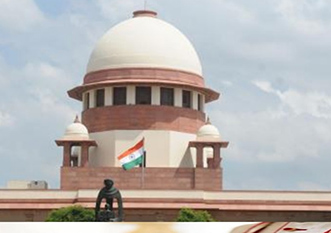
The Supreme Court on Tuesday observed that the practice of divorce in Muslims through Talaq-e-Hasan – which is pronounced once a month over a period of three months – is not akin to triple talaq – pronounced in one sitting – and the women also have an option of ‘khula’. The top court five years ago declared instant triple talaq unconstitutional.
The Supreme Court, however, said if a married couple does not want to live together, it can also grant divorce on the ground of irretrievable breakdown under Article 142 of the Constitution.
A bench of Justices S K Kaul and M M Sundresh was hearing a plea seeking to declare ‘Talaq-e-Hasan’ and all other forms of “unilateral extra-judicial talaq as void and unconstitutional”, claiming they were “arbitrary, irrational, and violated fundamental rights”.
In the religion of Islam, men have the right to divorce; the women have option to take khula. However, the processes in both the situations require attempts by family and friends to intervene for protection of the marriage as divorced is discouraged in Islam. The Prophet declares divorce to be the most disliked among the lawful things in the eyes of Allah.
What does the petitioner want?
The plea filed in the Supreme Court says that Talaq-e-Hasan and other forms of unilateral extra-judicial talaq are neither harmonious with the modern principles, nor an integral part of Islam. According to Times of India report, petitioner Benazeer Heena, who claims to be a victim of Talaq-e-Hasan, has submitted that though the apex court has declared triple talaq unconstitutional, it left the issue of Talaq-e-Hasan undecided. The petitioner submitted that her husband had allegedly divorced her by sending a Talaq-e-Hasan notice through a lawyer on April 19 after her family refused to pay dowry, even as her in-laws were harassing her for the same. She has also sought a direction to the Centre to frame guidelines for neutral and uniform grounds of divorce and procedure for all citizens, according to PTI.
What is Talaq-e-Ahsan and Triple Talaq?
Talaq-e-Ahsan is said to be the least disapproved way of dissolving a marriage. Ahsan, an Arabic word, means the best. Under this form of divorce, a husband can pronounce talaq only once when the wife is in a state of ‘purity’, that is, not menstruating. It is followed by a period of abstinence, known as iddat. The duration is ninety days or three menstrual cycles or three lunar months. If the husband and wife decide to resume cohabitation within the period of iddat, the pronouncement of divorce is treated as having been revoked. On the other hand, if there is no resumption of cohabitation or intimacy during this period, the divorce becomes final and irrevocable. Under the triple talaq process, if a man pronounces talaq three times in one sitting, divorce becomes operational. The divorce becomes irrevocable. This form of divorce is highly controversial and thus has been discouraged by ulema. It is considered talaq-e-biddat, meaning allowed but not liked.
Why do some people oppose Talaq-e-Hasan?
Since this form of divorce takes time, reports of torture and intimidation by husband often come to fore. Some Muslim women have also reported cases of physical abuse and violent threats by their in-laws. The plea is also to direct the concerned religious leaders to invalidate the talaq-e-hasan and not to force any woman to abide by the divorce practiced under the Sharia Law, according to a Times of India report. The Petitioner here has moved to the court to invalidate the first talaq notice sent by her husband as invalid and unconstitutional as it is a violation of her due rights.
The legal position
In 2017, the Supreme Court pronounced the Talaq-e-Bidat unconstitutional in the case of Shayara Bano v. Union of India. In this type of divorce, the couple’s marriage is dissolved when the man declares divorce three times in a single sitting. The Islamic divorce procedure known as Talaq-e-Hasan has been challenged in court in public interest litigation (PIL). – INDIA NEWS STREAM

Tulsi Gabbard releases declassified documents alleging Fauci influenced Covid origin assessments
Washington: Director of National Intelligence Tulsi Gabbard released a trove of newly declassified documents that she said show former top US infectious disease official Anthony Fauci influenced intelligence assessments...
G7 Summit: PM Modi ‘failed’ to stand up for India’s economic interests, says Congress
New Delhi: The Congress on Thursday criticised the takeaways from Prime Minister Narender Modi's participation at the G7 Summit in France's Evian, alleging that he "failed" to stand up for...


PM Modi finds Banaras connection in Bratislava, says ‘art, culture bring people closer’
Bratislava: Prime Minister Narendra Modi on Tuesday highlighted a unique cultural connection between India and Slovakia after witnessing an exhibition on Varanasi at the Presidential Palace in Bratislava, saying...
‘Undermines institutional neutrality’: K.C. Venugopal slams Kerala VCs who attended RSS event, demands resignation
Thiruvananthapuram: Congress General Secretary, Organisation, K.C. Venugopal, on Monday launched a strong political attack on three Kerala Vice Chancellors who attended an RSS centenary-related programme, describing their participation as contravening...

Foreign Secy Vikram Misri highlights indigenisation as key pillar for Rafale deal
Nice: Foreign Secretary Vikram Misri on Sunday highlighted indigenisation as a key pillar of the Rafale fighter jet deal with France, reaffirming India's commitment to defence self-reliance and strengthening domestic...

Trump approval slips as inflation climbs
Washington: US President Donald Trump's approval rating has fallen to its lowest level of his second term as inflation continues to weigh on voters and Democrats hold a modest advantage...

Actor Raghava Lawrence signals political entry in TN, says he has taken ‘positive decision’ after public backing
Chennai: Actor, choreographer and filmmaker Raghava Lawrence has strongly hinted at entering active politics in Tamil Nadu, stating that he has taken a “positive decision” after receiving overwhelming encouragement from...

El Nino likely to impact food prices, inflation projected to settle in 5.2–5.5 pc range in FY27
New Delhi: There is 80 per cent likelihood of an El Nino event during the June–August period and probabilities for this, to continue until at least November, are near or...

‘Hug row’ opens INDIA bloc cracks as Pinarayi Vijayan takes on Rahul Gandhi
Thiruvananthapuram: The simmering differences within the Opposition INDIA bloc have burst into the open as Leader of Opposition in Kerala, Pinarayi Vijayan, on Saturday launched a sharp attack on Congress...

‘Old method of BJP’: Trinamool’s Kirti Azad on raids against Madan Mitra, Abhishek Banerjee
New Delhi: Trinamool Congress MP Kirti Azad on Saturday launched a scathing attack on the BJP following raids conducted by the Enforcement Directorate (ED) against party leader Madan Mitra and...
‘Political vendetta’: Trinamool’s Sagarika Ghose on early morning raid at Abhishek Banerjee’s residence
Kolkata: Trinamool Rajya Sabha member Sagarika Ghose expressed scathing criticism of the early morning police raid at the residence of party General Secretary Abhishek Banerjee to track his absconding aide....


