



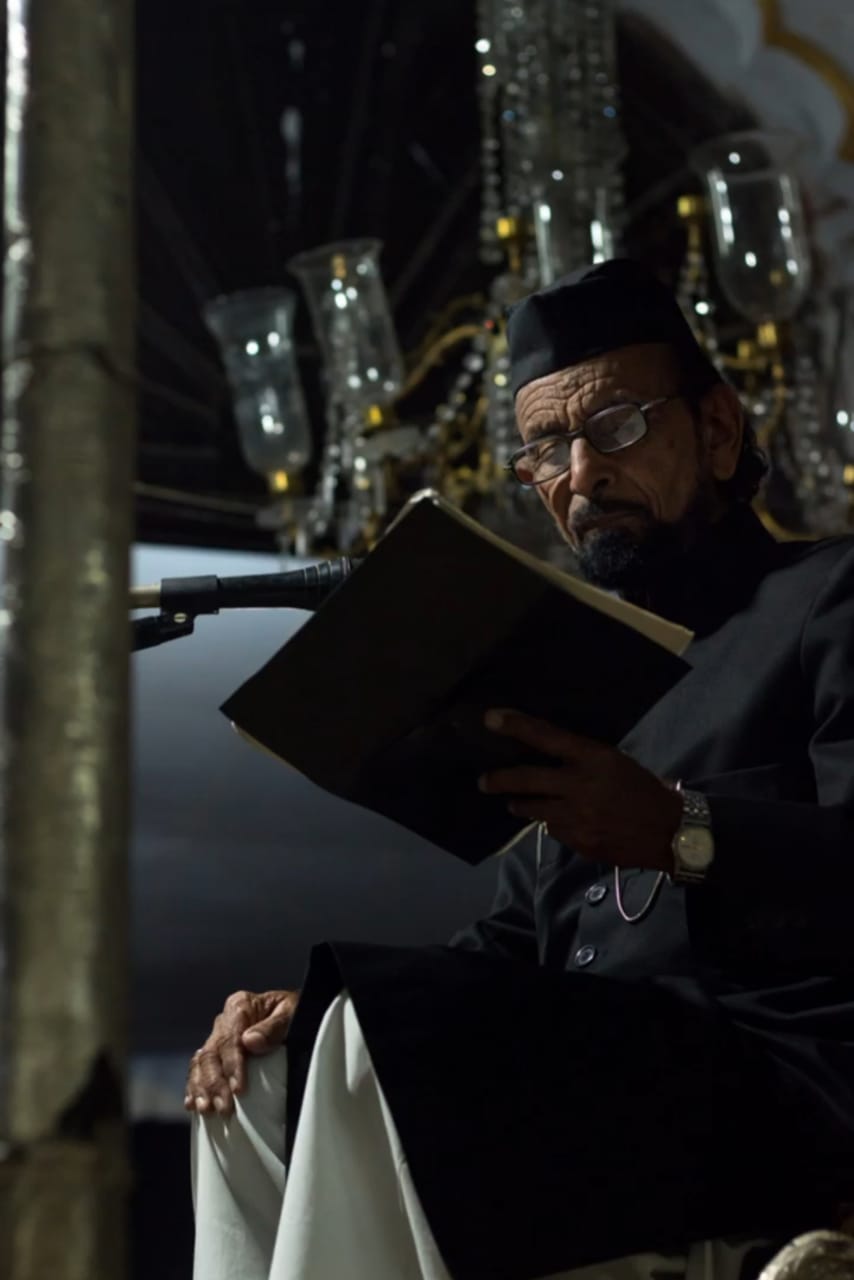
Famous Marsiyakhwan of Lucknow, Late Haider Nawab Jafri reciting Marsiya at Chota Imambada, Lucknow Image credits: Auon Hasan
India is not only a melting pot but a salad brawl, which manifests equally in grief and sorrow. The Muharram is the one that is being observed with religious-cultural ethos. Many traditions and customs that enriched India today have come from Persia during the Mughal era – some also before it – giving birth to the observations such as Taziyadari and Marsiyakhwani, making the country a synthesis of culture.
Marsiyakhwani, the meaning, and the background
The term Marsiya is a derivative of the Arabic ‘Risa’, which means praising the dead in a funeral oration, weeping and wailing over the deceased. Marsiya, generally speaking, is an elegy recited to express sorrow on the death of a person. But it has been symbolized by the commemoration of the martyrdom of Prophet Muhammad’s (PBUH) grandson, Imam Hussain. The form of Urdu Marsiya is only related to this only as it has been observed in the Indian subcontinent but now it is recited across the world. Imam Hussain and His family including his 6-month-old son were martyred in the month of Muharram, Marsiya used to be mainly recited by Shia Muslims only. Other sects of the Muslim community and even Hindu poets also adopted this form of Marsiya in their poetry.
Marsiya evolved in two different techniques; one is Tahtul Lafz means in spoken form without the use of musical notes like Sa Re Ga Ma. The legendary Marsiyakhwan who made this art famous, Mir Anees recited Tahtul Lafz Marsiya in which he used his hands to express the particular event. Another form started gaining popularity in Majalis (mourning ceremonies) which were recited by the people with good soulful voices i.e. Sozkhwani.
Marsiya was a Persian literary tradition, it molded with its uniqueness in India when many Persian poets and scholars came here. Marsiya first developed in the Deccan as a form of folk poetry. As an audience-oriented literary tradition it changed following the social environment and patronage patterns, and in this process absorbed many traits of oral epic rendition. The theatrical arts of Indian and Persian origin also influenced it considerably, and thus Marsiya represented the synthesis of multiple cultural traditions. It assimilated the traits of both classical canonized forms and folk musical varieties and developed from Khwanandagi (chanting) into a most sophisticated musical style – the Sozkhwani.
Marsiya as a well-defined literary form existed in Arabic literature in pre-Islamic days (Daur-i Jahili) and many poets such as Muhalhil Taghlabi (c. 531 AD) and Khamsa shaira (44 A.H.) contributed to the ‘Risa’ poetry. However, this tradition is much older in Iran and may be traced to the literary and musical conventions of pre-Islamic ancient Persia. Sog-i Siyawash (mourning of Siyawash, Cyrus, the father of Kai Khusrau) and Marg-i Zarir (the death of Zarir, brother of Gushtasp) figure most in the tales (asatir) of bygone days. Some stories (dastan) and poetic verses are still extant in Pahlavi, reminiscent of the legacy of the ancient Persians. Sog-i Siyawashan is a famous melody (ahang) of a sombre nature that prompts us to cry.
Marsiya in Urdu was first written in the 16th century in South India, in the kingdoms of Golconda and Bijapur which were Shiite kingdoms. This form found an especially congenial soil in Lucknow, an important Shia Muslim community in the Indian subcontinent, where it was regarded as an act of piety and religious duty to eulogize and bemoan the martyrs of the battle of Karbala. The genre was championed by Mir Babar Ali Anees.
Talking to India News Stream about this art, famous Marsiyakhwan of Lucknow and Urdu litterateur Qazi Asad said, “The Art of Tahtul Lafz Marsiya Khwani is the recitation of Urdu Epics & Elegies based on the Tragedy of Imam Hussain in Karbala in a Declaratory form with the obvious usage of voice, eyes, hands, etc. to let the audience understand and feel different emotions of every Stanza of the Elegy which is mostly comprised of six verses.”
Fundamentals of Marsiyakhwani
Marsiya generally consists of six-line units, with a rhyming quatrain, and a couplet on a different rhyme.
It is characterized by six-line verses in an AA, AA, and BB rhyme scheme. They are traditionally either recited by Marsiya-Khwans or sung by a Sozkhwan.
Historian Rana Safvi writes in her blog, “A classical Urdu Marsiya usually includes most of the following sections: a prelude (Chehrah) of poems of praise, descriptions of the morning or night before the battle, a general introduction to the hardships faced by Hussein; a description of the poem’s hero — whether Hussein or one of his companions — and his virtues; the leave-taking or departure for the battlefield (Rukhsat); the entry onto the field (Aamad); a declaration of the hero’s martial prowess (Rajaz); the battle (Jang); the martyrdom (Shahadat); and finally, the lament (Bain). To this one could add the topical focus (Maajrah) and the prayer (Dua).”
Famous marsiya writers in Urdu include Mir Babar Ali Anis, Mirza Salamat Ali Dabeer, Ali Haider Tabatabai, Najm Afandi, Josh Malihabadi, and others. Well-known Persian poets of the genre include Muhtasham Kashani, Nawab Ahmad Ali Khan Qayamat, and Samet Borujerdi. In Turkish, Bâkî composed an important Marsiya.
Mir Babar Ali Anes, a renowned Urdu poet, composed salāms, elegies, Nauhas, and quatrains. While the length of the elegy initially had no more than forty or fifty stanzas, he pushed it beyond one hundred fifty or even longer than two hundred stanzas or bands, as each unit of Marsiya in the ‘Musaddas’(six liners) format is known. Mir Anees drew upon the vocabulary of Arabic, Persian, Urdu, Hindi, and Awadhi to a great degree. He has become an essential element of Muharram among the Urdu speakers of the Indian subcontinent. The first major and still current critical articulation about Mir Anis was Muazna-e-Anis-o-Dabir (1907) written by Shibli Nomani in which he said “the poetic qualities and merits of Anis are not matched by any other poet”.
Another important Marsiya poet was Chhannu Lal Dilgeer who was born during the reign of Nawab Asaf-ud-Daulah. He was initially a ghazal poet with the ‘takhallus’ (pen name) ‘Tarab’, before focusing on Marsiya at a later stage. He converted to Islam and changed his name to Ghulam Hussain. His most popular marsiya is ‘Ghabrayegi Zainab’, which is currently being recited in houses during Ashura i.e. 10th Muharram.
For latest Marsiyakhwani watch here:
https://www.youtube.com/watch?v=zycgt8GxOm8
-INDIA NEWS STREAM

20-feet-deep well discovered after Saharanpur mosque demolition, ASI called to examine
Saharanpur: Officials from the Archaeological Survey of India (ASI) have been called to inspect a 20-foot-deep well, which was discovered following the demolition of a mosque located within the Saharanpur...
A century and a half on, the Ishavasya Upanishad returns to Oxford, this time in Acharya Prashant’s voice
Oxford (UK): In 1879, Professor Max Muller carried the Ishavasya Upanishad to the West, publishing its first English translation through Oxford University Press as the opening volume of the ‘Sacred...

Bageshwar Baba’s remark on Shivaji sparks row; Maha CM refutes claim
Mumbai: A major controversy has erupted after Dhirendra Krishna Shastri, popularly known as Bageshwar Baba, claimed that Chhatrapati Shivaji Maharaj felt tired from continuous battles and approached Samarth Ramdas Swami,...

Akashvani to air full 6-stanza Vande Mataram from tomorrow in revamped national broadcast
New Delhi:Akashvani will begin broadcasting a new and complete six-stanza version of the national song Vande Mataram from Thursday, the government announced on Wednesday, marking a significant shift from the...
Temple work may begin from Ram Navami: Nyas
Ayodhya, Feb 6 (IANS) The Ram Janambhoomi Nyas has said that with the Centre constituting the 'Shri Ram Janambhoomi Teertha Kshetra trust for temple, the construction is expected to begin...
Ram temple as per model but grander, says Mahant Nritya Gopal
Feb 19, 2020 New Delhi: Ram temple as per model but grander, says Mahant Nritya Gopal (Lead) (22:43) New Delhi, Feb 19 (IANS) Mahant Nritya Gopal Das, the newly-appointed Chairman...
Sonbhadra gold reserve: Barely known facts about Son Pahari
By R Jayan Feb 24, 2020 Sonbhadra: Sonbhadra district of Uttar Pradesh gained sudden prominence after news circulated that the area has a rich vein of gold. The Geological Survey...
Trump walks hand in hand with wife at Taj Mahal
Feb 24, 2020 Agra: US President Donald Trump, who is on a two-day visit to India, on Monday walked hand in hand with his wife Melania Trump at the Taj...
J&K seeking world heritage status for Mughal Gardens
March 5, 2020 Srinagar: The Jammu and Kashmir government is making efforts to bring the famous Mughal Gardens in Srinagar on the map of UNESCO world heritage site. This will...
JNU road named after Savarkar, JNUSU sees red
March 15, 2920 New Delhi: After last year's uproar in Delhi University over Vinayak Damodar Savarkar's bust, another educational institution might see unrest as naming of a road in JNU...
When 3 species of our human ancestor roamed the Earth
April 3, 2020 New York: In a fascinating discovery that will force scientists to rewrite our species' evolutionary history, an international team has unearthed the earliest known skull of Homo...

The Tablighi mission
By Saeed Naqvi April 5, 2020 New Delhi: In the early 70s, Indian missions in West Asia received a curt directive from South Block: do not issue visas to applicants...


