



By Vishnu Makhijani
Dec 23, 2020
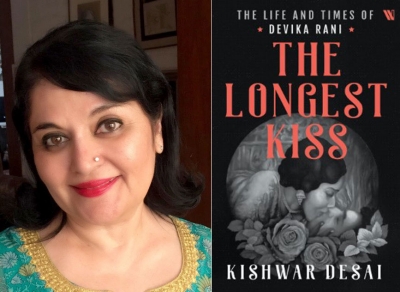
New Delhi: “I hope that I have managed to establish who Devika Rani really was. A rebellious and unusually talented and beautiful woman, a great actress and studio head who changed the course of Indian cinema in many ways, despite her intense personal suffering. A pioneer then and now,” writes author Kishwar Desai of “The Longest Kiss” (Westland), the biography of India’s first international superstar in the 1930s and 1940s.
“I hope this book will be of help to others who care to study this very important phase in Indian cinema, with its passion, idealism and entrepreneurship, in the days before it became a business like any other,” adds Desai, whose husband, Lord Meghnad Desai is a lifetime member of Britain’s House of Lords.
Astonishingly beautiful, prodigiously talented, and a great-grand-niece of Rabindranath Tagore, Devika Rani (1908-94) earned rave reviews for her first film, “Karma” (1933), a bilingual in Hindi and English. It elicited interest in England for a prolonged kissing scene featuring the real-life couple of Devika Rani and actor-producer-director Himanshu Rai, one of the pioneers of Indian cinema whom she had married in 1929, but bombed in India.
Together, Himanshu Rai and Devika Rani set up India’s first truly professional studio, Bombay Talkies in 1934. Over the next few years, the studio became the launch pad for some of India’s best-known talent, including Ashok Kumar, Leela Chitnis and Dilip Kumar.
After Himanshu’s controversial death in 1940, Devika Rani took over Bombay Talkies. She ran the studio with a steel hand, squashing all rebellion and constantly walking a tightrope when it came to the men around her. Then, in 1945, she met the handsome and reclusive Russian-born painter Svetoslav Roerich, and, just like in a Hindi film, nothing was ever the same again as the couple eventually settled down in Bangalore (now Bengaluru), where they are buried in the tranquility of the Tataguni estate on the outskirts of the city.
“Devika died as she had lived, in the middle of controversy and refuses to be forgotten. Even now, when one visits the ruins of Bombay Talkies or the chalet at Naggar, (in Himachal Pradesh that Svetoslav’s father Nicholas Roerich had built), where a rough-hewn stone spreading banyan tree in Tataguni, one can sense her spirit, wild and free, and her desire to create beauty all around her,” Desai writes.
“She wanted her ashes to kept both at Naggar and at Tataguni, where she lies next to Svetoslav, the only man to understand her and give her the freedom she needed to be herself. He was the ‘reward’ she believed she had been given for keeping faith in spite of all the abuse and humiliation she had suffered. And her restless passion seems to still hover the graves.
“In both places, the tombstones stand next to stone idols symbolising Shakti. A strange energy emanates from the idols – their sturdy, gray bodies, with their vivid red bindis and the shining zari on their dupattas”” Desai concludes.
Devika Rani was a recipient of the Padma Shri (1958) and the Dadasaheb Phalke Award (1969). In “The Longest Kiss”, for the first time, through her letters and documents, Desai pieces together the life that she kept away from the world. The romance and the abuse that characterised her marriage with Himanshu, the struggle of being a woman at the helm of a hyper-male domain, the circuitous ways in which cinema found its feet in Bombay, and the soaring happiness and tragedy of a life lived on the edge, always.
Kishwar Desai is an award-winning author and playwright who writes both fiction and non-fiction. She worked in television as an anchor and producer for over 20 years before becoming a writer. She is the chairperson of The Arts and Cultural Heritage Trust that set up the world’s first Partition Museum at Town Hall, Amritsar. She also helped her husband to install the statue of Mahatma Gandhi outside Westminster in the UK.
Desai is the author of “Darlingji: The True Love Story of Nargis and Sunil Dutt” (2007).
Her novel “Witness the Night” won the Costa First Novel Award in the UK, in 2010, and was followed by two others: “Origins of Love” (2012) and “Sea of Innocence” (2013). The trilogy featuring has since been optioned for a web series.
Desai’s first work of political non-fiction, “Jallianwala Bagh: The Real Story” (2018), won critical acclaim and inspired exhibitions on the massacre in India, the UK and New Zealand. She also wrote a play, “Manto!” which won the TAG Omega award for Best Play in 1999. Most recently, in 2019, her play, “Devika Rani: Goddess of the Silver Screen”, was successfully staged in venues across India.IANS
New Delhi World Book Fair from Jan 4-12
Jan 2, 2019 New Delhi, Jan 2 (IANS) The 28th edition of the much-attended New Delhi World Book Fair (NDWBF) will open at the Pragati Maidan here on Saturday. Marking...
At Lit Fest, actress Nandita Das opposes CAA, NRC
Jan 23, 2020 Jaipur: The controversial CAA and NRC issues reverbated at the Jaipur Literature Festival here as Bollywood actress and director Nandita Das on Thursday opposed the Citizenship (Amendment)...
’26/11 attacks were planned for 27/9; Dawood assigned to kill Kasab’
Feb 18, 2002 Mumbai, Feb 18 (IANS) The 2008 Mumbai terror strikes that took place on 26/11 were originally planned for September 27 that year and the Lashkar-e-Taiba wanted terrorist...
The name Ravi Shankar still spells magic: Sukanya Shankar
By Sugandha Rawal April 4, 2020 New Delhi: Sukanya Shankar feels her late husband and Grammy award-winner musician Pandit Ravi Shankars contribution is not limited to music, and adds that...
Begum Akhtar’s pupil Shanti Hiranand dies at 87
April 10 New Delhi: Padma Shri recipient and disciple of Begum Akhtar, noted Indian vocalist Shanti Hiranand passed away early Friday morning in Gurugram. She was 87. The classical musician...
Noted Urdu satirist Mujtaba Hussain is no more
May 27, 2020 Hyderabad: Celebrated Urdu author, humorist and satirist Mujtaba Hussain passed away here on Wednesday after a prolonged illness. He was 84. According to family sources, he breathed...

Life is so fragile; think, plan, look after each other: Author Vish Dhamija
By Vishnu Makhijanai June 16, 2020 New Delhi: Life is so fragile that even a virus could bring the world to its knees, says London-based author of Indian-origin Vish Dhamija...
Meet the Sompuras who designed Ram temple
By Anindya Banerjee Aug 4, 2020 New Delhi( IANS) Did you know that the man who designed the Ram temple decades back, took a rough measurement using his own feet...
He was, therefore we are: Theatre stars on Ebrahim Alkazi
By Sukaant Deepak Aug 5, 2020 New Delhi: "He is definitely responsible for what I am today. It was Ebrahim Alkazi who laid my creative foundation," says actor Pankaj Kapur,...
Noted poet Rahat Indori passes away
Aug 11, 2002 Indore: Noted Urdu poet Rahat Indori is no more. The 70-year-old poet, who had tested positive for COVID-19 on Monday, passed away here on Tuesday morming following ...
Film, TV production activities to resume with SOP: I&B Minister
Aug 23, 2002 New Delhi: Union Information and Broadcasting Minister Prakash Javadekar on Sunday announced the reopening of the film and TV production industry that has been shut for several...
‘Delhi Riots 2020’ gets another publisher
Aug 23, 2002 New Delhi: Following the withdrawal of the book 'Delhi Riots 2020: The Untold Story' by publisher Bloomsbury India, another publishing house Garuda Prakashan has stepped in and...


