




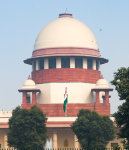
The Supreme Court of India. (File Photo: IANS)
By Sumit Saxena
Jan 10, 2020
New Delhi:The Supreme Court on Friday said the right to access the internet is a fundamental right under Article 19 of the Constitution as it directed the Jammu & Kashmir administration to immediately restore internet services connected with access to government websites, localised/limited e-banking facilities, hospital services and other essential services.
A three-judge bench, headed by Justice N.V. Ramana and also comprising Justices B.R. Gavai and R. Subhash Reddy said: “Non-recognition of technology within the sphere of law is only a disservice to the inevitable. In this light, the importance of the internet cannot be underestimated, as from morning to night we are encapsulated within the cyberspace and our most basic activities are enabled by the use of internet.”
However, the judgement did not mention any timeframe to restore internet services to other sectors and for the people in the region.
The apex court observed that it is essential to distinguish between the internet as a tool and the freedom of expression through the internet.
“There is no dispute that freedom of speech and expression includes the right to disseminate information to as wide a section of the population as possible. The wider range of circulation of information or its greater impact cannot restrict the content of the right nor can it justify its denial,” said the court.
The apex court said that the expression through the internet has gained contemporary relevance and is one of the major means of information diffusion. “Therefore, the freedom of speech and expression through the medium of internet is an integral part of Article 19(1)(a) and accordingly, any restriction on the same must be in accordance with Article 19(2) of the Constitution,” added the court.
The court identified the internet as also a very important tool for trade and commerce, and there is no doubt that there are certain trades which are completely dependent on the internet.
“Such a right of trade through internet also fosters consumerism and availability of choice. Therefore, the freedom of trade and commerce through the medium of the internet is also constitutionally protected under Article 19(1)(g), subject to the restrictions provided under Article 19(6),” observed the court.
The apex court observed that none of the counsel involved in the matter have argued for declaring the right to access the internet as a fundamental right and therefore “we are not expressing any view on the same”.
“We are confining ourselves to declaring that the right to freedom of speech and expression under Article 19(1)(a), and the right to carry on any trade or business under 19(1)(g), using the medium of internet, is constitutionally protected,” said the court. Therefore, the court has given Constitutional protection to the right to access the internet, which can be termed as a fundamental right subject to reasonable restrictions.
The apex court concluded that the suspension of broad telecom services, be it the internet or otherwise, being a drastic measure, “which must be considered by the state only if ‘necessary’ and ‘unavoidable'”.
The court also noted that the “geopolitical struggle cannot be played down or ignored” in Jammu & Kashmir.
“In this light, we may note the state’s submission that since 1990 to 2019 there has been 71,038 recorded incidents of terrorist violence, 14,038 civilians have died, 5,292 security personnel were martyred, 22,536 terrorists were killed,” said the court stating the geopolitical struggle cannot be played down or ignored.
The court observed that while the mountains of Himalayas spell tranquillity, yet blood is shed every day.
“In this land of inherent contradictions, these petitions (challenging the restrictions) add to the list, wherein two sides (petitioners and J&K administration) have shown two different pictures which are diametrically opposite and factually irreconcilable,” said the court.
The apex court observed that modern terrorism heavily relies on the internet, and the operations on the internet do not require substantial expenditure and are not traceable easily.
“The internet is being used to support fallacious proxy wars by raising money, recruiting and spreading propaganda/ideologies. The prevalence of the internet provides an easy inroad to young impressionable minds,” said the court.
The apex court also cited Susan W. Brenner, a Distinguished Professor of Law and Technology, University of Dayton School of Law, who opined the traditional approach has not worked satisfactorily on terrorism due to the proliferation of the internet.
The Solicitor General pointed out that the ‘war on terrorism’ requires imposition of such restrictions so as to nip the problem of terrorism in the bud. He submitted that in earlier times, sovereignty and integrity of a state was challenged only on occurrence of war.
The court observed the fight against terror cannot be equated to a law and order situation as well. “In this light, we observe that this confusion of characterising terrorism as a law and order situation has plagued the submission of the respondent government and we need to carefully consider such submissions,” observed the court on the government’s contentions.
However, the apex court said that there is ample merit in the contention of the government that internet could be used to propagate terrorism, which will eventually challenge the sovereignty and integrity of the country.Geopolitical struggle in Kashmir can’t be ignoredGeopolitical struggle in Kashmir can’t be ignored. IANS

Abhishek Banerjee moves SC against delay in disqualification of 20 rebel MPs
New Delhi:The Mamata Banerjee-led faction of Trinamool Congress (TMC) has moved the Supreme Court challenging the delay by Lok Sabha Speaker Om Birla in deciding the disqualification petitions filed against...
Sohrabuddin encounter case: Deceased’s brother moves SC against acquittal of 22 accused
New Delhi: The younger brother of deceased Sohrabuddin Shaikh has moved the Supreme Court challenging the recent judgment of the Bombay High Court which upheld the acquittal of all 22...

Freeze on Abhishek Banerjee’s account lifted; Calcutta HC has word of advice for bank
Kolkata: The bank, which had imposed debit restrictions on the personal bank account of Trinamool Congress general secretary and Diamond Harbour Lok Sabha member Abhishek Banerjee, informed the Calcutta High...

New J&K High Court bench to come up in Ladakh, announces HM Amit Shah
New Delhi/Leh: The Union Cabinet on Thursday approved the establishment of a bench of the High Court of Jammu and Kashmir and Ladakh in the Union Territory of Ladakh, Union...

Preacher sentenced to death for sexually assaulting four minor girls in TN’s Tirunelveli
Tirunelveli: A special court in Tamil Nadu's Tirunelveli on Thursday sentenced a 50-year-old preacher to death after convicting him of sexually assaulting four minor girls who attended classes at a...

Jharkhand: Students move HC against cancellation of recruitment exams, hearing on four petitions at 3 PM
Ranchi: The legal battle launched by affected candidates against Jharkhand government's decision to cancel 22 recruitment examinations has intensified, with four petitions challenging the move filed in the High Court...

Bengal court issues arrest warrant against Trinamool MP Mahua Moitra in hate speech case
Kolkata: A court in West Bengal’s Krishnanagar issued an arrest warrant against Trinamool Congress MP Mahua Moitra in a case of controversial comments regarding the Indian Army on Wednesday. ...
July 20 protest: SC to form panel to probe ‘police excesses’ against students
New Delhi: The Supreme Court on Tuesday announced its decision to constitute a high-powered fact-finding committee to scan CCTV footage of the students’ march from Jantar Mantar towards Parliament on...
SC refuses to ban ‘hanging till death’ as mode of execution
New Delhi: The Supreme Court on Tuesday refused to ban hanging as the mode of execution in the country, allowing the government and other stakeholders to discuss and explore other...

Parliament: 12 bills passed; 19 pc productivity in LS, 39 pc in RS, says Kiren Rijiju
New Delhi: The Monsoon Session of Parliament, which concluded on Thursday, was successful in terms of legislative business but remained unsatisfactory in terms of productivity, Union Parliamentary Affairs Minister Kiren...
Delhi court takes cognisance of CBI chargesheet in NEET-UG paper leak case
New Delhi: A Delhi court on Wednesday took cognisance of the chargesheet filed by the Central Bureau of Investigation (CBI) against 13 accused in the alleged NEET-UG 2026 question paper...
Justice Varma cash row: Panel rejects his defence, finds charges proved
New Delhi: A three-member inquiry committee constituted by Lok Sabha Speaker Om Birla has found all three charges against former Delhi High Court judge Justice Yashwant Varma proved in connection...


