




Bishkek: Prime Minister Narendra Modi delivered a strong message against terrorism at the 26th Shanghai Cooperation Organisation (SCO) Summit in Bishkek on Tuesday, calling for dismantling the entire ecosystem of terror financing, recruitment, radicalisation and safe havens, stating that it cannot be used as a “strategic asset for anyone”.
Addressing the 26th Meeting of the Council of Heads of State of the SCO in Kyrgyzstan’s Bishkek on Tuesday, PM Modi stressed that terrorism continues to pose a serious challenge to humanity and asserted that there can be no room for double standards on terrorism.
“Terrorism continues to pose a serious challenge to humanity. In our fight against it, we cannot limit ourselves to a mindset of action and reaction. We must dismantle the entire ecosystem of terrorist financing, recruitment, radicalisation, and safe havens,” the Prime Minister said.
“We must speak with one voice that there can be no room for double standards on this serious issue. Those countries which make terrorism a tool of their policy, provide shelter and support to terrorists, will have to be given a strong message that terrorism cannot be a strategic asset for anyone,” he added.
PM Modi reiterated India’s stance that all wars and conflicts should be resolved through dialogue and diplomacy and not on the battlefield. He said that the conflict in West Asia is not confined to that region and impacts the energy security, maritime trade and supply chains of the whole world.
“In today’s interconnected world, the scope of security has expanded even further. The crisis in West Asia has shown that conflict in one region is not confined to that region. It impacts the entire world’s energy security, maritime trade, and supply chains. Countries in the Global South bear the brunt of this. Therefore, India has been calling for the resolution of all tensions and wars through dialogue and diplomacy, not on the battlefield,” he said.
The Prime Minister flagged drug trafficking as a serious threat to the young generation and regional security. He welcomed the centres being established within the SCO to address challenges like security threats, organised crime, information security, and narcotics as a “positive step” and called for making them effective instruments of practical coordination and timely action.
PM Modi expressed India’s support for efforts to connect markets, facilitate trade and create new pathways for development.
“Another foundation for our shared development is strong and reliable connectivity. India supports all efforts that connect markets, facilitate trade, and open new avenues for development. However, respect for the sovereignty and territorial integrity of all countries is essential in these efforts. This is also the core spirit of the SCO Charter,” he said.
“In the coming times, the scope of connectivity will become even more extensive. Along with roads, railways, and air corridors, we will need to simplify customs processes, promote digital documentation, and make logistics networks more efficient,” he added.
He outlined three main pillars of India’s approach to SCO – Security, Connectivity and Opportunity. He said that cooperation of SCO members should be people-driven and not government-driven and highlighted India’s initiatives taken by India within the SCO.
“Our cooperation in the SCO should be people-driven, not just government-driven. I am pleased that under Kyrgyzstan’s presidency, special emphasis has been placed on youth engagement in the SCO. India has taken initiatives such as the Start-up Forum, the Young Authors’ Conclave, and the Young Scientists’ Forum within the SCO,” he added.
“Last year, India proposed the SCO Civilizational Dialogue Forum. I am pleased that its first session will be held in India this year. I am confident that with your active participation, this Forum will become a powerful platform for vibrant dialogue within the SCO,” he added.
The SCO comprises 10 member states – Belarus, India, Iran, Kazakhstan, China, Kyrgyzstan, Pakistan, Russia, Tajikistan and Uzbekistan. It has two observer states – Azerbaijan and Armenia and 15 dialogue partners – Azerbaijan, Armenia, Egypt, Cambodia, Qatar, Kuwait, Laos, Maldives, Myanmar, Nepal, UAE, Saudi Arabia, Turkey and Sri Lanka.
IANS
Must move from endless war to end of war: PM Modi during meeting with Russian President Putin
Bishkek: Reiterating that India continues to back all efforts towards achieving peace in Ukraine, Prime Minister Narendra Modi on Monday asserted during a meeting with Russian President Vladimir Putin that...
India, Uzbekistan elevate ties to comprehensive strategic partnership, deepen critical minerals cooperation
Tashkent: India and Uzbekistan on Sunday elevated their bilateral ties to a Comprehensive Strategic Partnership, with Prime Minister Narendra Modi and Uzbek President Shavkat Mirziyoyev placing a strong focus on...
‘Strengthening strategic ties’: PM Modi embarks on four-day visit to Uzbekistan, Kyrgyzstan
New Delhi: Prime Minister Narendra Modi emplaned for his two-nation tour to Uzbekistan and Kyrgyzstan on Saturday, and expressed confidence that this visit will strengthen India's strategic partnerships in Central...
India to host two-day BRICS Summit in Delhi from September 12
New Delhi: India will host the 18th BRICS Summit at Bharat Mandapam in New Delhi on September 12-13, bringing together leaders of BRICS members and partner countries as well as...
India, China for early, substantial outcome of boundary talks
New Delhi: A month ahead of likely visit by Chinese President Xi Jinping to India for the BRICS summit, the two countries significantly seem pushing for "Early and Substantial...
‘Politically motivated, highly malicious’: India denounces UN racial discrimination committee remarks
New Delhi:India on Wednesday rejected the United Nations Committee on the Elimination of Racial Discrimination's remarks about the country, terming them "politically motivated" and "highly malicious". In a statement, the...
EAM Jaishankar holds wide-ranging talks with Russian FM Lavrov on bilateral, global issues
Moscow: External Affairs Minister S Jaishankar held a wide-ranging conversation with Russian Foreign Minister Sergey Lavrov, with the two leaders discussing bilateral cooperation, regional hotspots, global challenges and multilateral issues....
NSA Doval meets Chinese V-P; discusses ways to strengthen peace at border
Beijing: National Security Advisor (NSA) Ajit Doval met Chinese Vice President Han Zheng on Tuesday and discussed ways to strengthen peace and tranquillity in the border areas and bilateral cooperation...
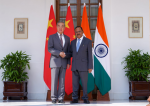
India and China will continue in-depth communication on border issue: Beijing
Beijing: India and China will continue the "in-depth communication" on the border issue in accordance with the spirit of the consensus reached by the leaders of the two countries, Chinese...
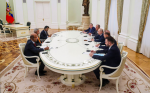
Handed over ‘personal message’ from PM Modi, says EAM Jaishankar after meeting Putin in Moscow
Moscow: External Affairs Minister (EAM) S Jaishankar called on Russian President Vladimir Putin in Moscow on Monday and handed over a "personal message" from Prime Minister Narendra Modi. ...
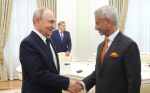
Looking forward to meet PM Modi very soon: Russian President Vladimir Putin
Moscow: External Affairs Minister (EAM) S Jaishankar called on Russian President Vladimir Putin in Moscow on Monday and conveyed greetings of Prime Minister Narendra Modi. According to a statement...
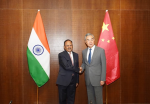
NSA Doval arrives in Beijing for Special Representatives’ Talks on India-China Boundary Question
New Delhi:National Security Advisor (NSA) Ajit Doval arrived in Beijing on Monday for a two-day visit to attend the 25th Round of Special Representatives’ Talks on the India-China Boundary Question....


