




Washington: India has mounted a broad defence of its legal, regulatory and corporate safeguards against forced labour, telling the US Trade Representative (USTR) that the country already has the institutions, laws and industry compliance systems needed to achieve the very objectives Washington is seeking through its proposed Section 301 tariff action.
Appearing before the USTR’s public hearing on Wednesday (local time), representatives of the Ministry of Commerce and Industry, the Agricultural and Processed Food Products Export Development Authority (APEDA), the Confederation of Indian Industry (CII) and the Federation of Indian Chambers of Commerce and Industry (FICCI) argued that India’s framework combines constitutional protections, labour legislation, regulatory oversight and private-sector compliance with internationally recognised standards.
The Indian delegation said Article 23 of the Constitution expressly prohibits forced and bonded labour as a fundamental right enforceable through the courts. It said these protections are reinforced by the Bonded Labour System (Abolition) Act, modern labour codes, criminal penalties under the Bharatiya Nyaya Sanhita and India’s ratification of the International Labour Organization’s core conventions on forced labour.
Industry representatives also highlighted India’s growing corporate governance framework.
CII noted that the Securities and Exchange Board of India requires the country’s top 1,000 listed companies to file Business Responsibility and Sustainability Reports covering human rights, grievance mechanisms, forced labour complaints, supply-chain assessments and corrective actions.
During questioning, CII also pointed to the BRSR Lite framework introduced for small and medium enterprises, saying Indian companies have voluntarily adopted codes of conduct, supplier compliance systems and ESG frameworks that already mirror international standards.
FICCI told the hearing that most Indian exporters supplying the US market already operate within compliance ecosystems established by American buyers and multinational corporations.
These include supplier audits, due diligence, ethical sourcing standards, worker grievance mechanisms, traceability systems and continuous monitoring.
“In many cases, compliance is driven as much by buyer requirements as by domestic regulation,” FICCI said in its written testimony.
The industry bodies also cited sector-specific examples.
According to CII, aluminium companies undertake formal human rights due diligence, textile exporters are regularly audited by US buyers and international certification bodies, foundry and forging industries comply with stringent labour legislation, while agricultural machinery manufacturers compete on engineering capability rather than labour cost advantages.
APEDA argued that Indian agricultural exports destined for the United States are subject to additional safeguards.
It said rice exports are permitted only from mills registered with the Ministry of Agriculture and Farmers Welfare and exporters must satisfy stringent labour standards required by major US retailers, including Walmart.
Throughout the hearing, Indian representatives maintained that the proposed 12.5 per cent tariff would not strengthen labour protections because those protections are already embedded in India’s legal and commercial systems.
Instead, they urged the USTR to build on existing cooperation through dialogue, technical engagement and bilateral mechanisms, arguing that evidence-based collaboration would better advance the shared objective of eliminating forced labour from global supply chains than economy-wide tariff measures.
IANS
India ready to help with Russia-Ukraine conflict: EAM Jaishankar in Kyiv
Kyiv: Spotlighting Prime Minister Narendra Modi's recent call that endless war must now give way to the end of war, External Affairs Minister (EAM) S Jaishankar on Thursday stated that...
UN chief to visit India for BRICS summit: Spokesperson
United Nations: Secretary-General Antonio Guterres will be visiting India next week for the BRICS Summit, where he will meet with leaders of emerging economies around the world, according to his...
‘Terrorism can’t be strategic asset for anyone’: PM Modi at SCO Summit
Bishkek: Prime Minister Narendra Modi delivered a strong message against terrorism at the 26th Shanghai Cooperation Organisation (SCO) Summit in Bishkek on Tuesday, calling for dismantling the entire ecosystem of...
Must move from endless war to end of war: PM Modi during meeting with Russian President Putin
Bishkek: Reiterating that India continues to back all efforts towards achieving peace in Ukraine, Prime Minister Narendra Modi on Monday asserted during a meeting with Russian President Vladimir Putin that...
India, Uzbekistan elevate ties to comprehensive strategic partnership, deepen critical minerals cooperation
Tashkent: India and Uzbekistan on Sunday elevated their bilateral ties to a Comprehensive Strategic Partnership, with Prime Minister Narendra Modi and Uzbek President Shavkat Mirziyoyev placing a strong focus on...
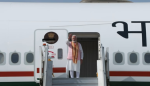
‘Strengthening strategic ties’: PM Modi embarks on four-day visit to Uzbekistan, Kyrgyzstan
New Delhi: Prime Minister Narendra Modi emplaned for his two-nation tour to Uzbekistan and Kyrgyzstan on Saturday, and expressed confidence that this visit will strengthen India's strategic partnerships in Central...
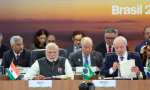
India to host two-day BRICS Summit in Delhi from September 12
New Delhi: India will host the 18th BRICS Summit at Bharat Mandapam in New Delhi on September 12-13, bringing together leaders of BRICS members and partner countries as well as...
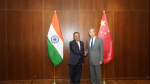
India, China for early, substantial outcome of boundary talks
New Delhi: A month ahead of likely visit by Chinese President Xi Jinping to India for the BRICS summit, the two countries significantly seem pushing for "Early and Substantial...
‘Politically motivated, highly malicious’: India denounces UN racial discrimination committee remarks
New Delhi:India on Wednesday rejected the United Nations Committee on the Elimination of Racial Discrimination's remarks about the country, terming them "politically motivated" and "highly malicious". In a statement, the...
EAM Jaishankar holds wide-ranging talks with Russian FM Lavrov on bilateral, global issues
Moscow: External Affairs Minister S Jaishankar held a wide-ranging conversation with Russian Foreign Minister Sergey Lavrov, with the two leaders discussing bilateral cooperation, regional hotspots, global challenges and multilateral issues....
NSA Doval meets Chinese V-P; discusses ways to strengthen peace at border
Beijing: National Security Advisor (NSA) Ajit Doval met Chinese Vice President Han Zheng on Tuesday and discussed ways to strengthen peace and tranquillity in the border areas and bilateral cooperation...
India and China will continue in-depth communication on border issue: Beijing
Beijing: India and China will continue the "in-depth communication" on the border issue in accordance with the spirit of the consensus reached by the leaders of the two countries, Chinese...


