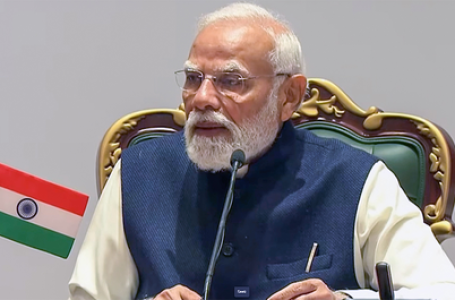



New Delhi: In yet another step to deepen its bond and engagement with global south, India has decided to raise the bilateral ties with Ethiopia to the level of strategic partnership.
The decision was taken during Prime Minister Narendra Modi’s just concluded visit to the African nation where he held talks with his counterpart Abiy Ahmad Ali.
The importance of Ethiopia for India was highlighted by the Prime Minister during his address to Parliament of the African nation when he underlined that “Ethiopia sits at a crossroads of Africa. India stands at the heart of the Indian Ocean. We are natural partners in regional peace, security, and connectivity.”
The Prime Minister said that signing of the Defence Cooperation Agreement earlier this year proves the two countries’ commitment to mutual security.
This agreement focuses on closer military cooperation. It includes collaboration in cybersecurity, in defence industries, in joint research, and in capacity building.
The Prime Minister also spoke of the significance of trade relations between the two countries. He pointed out that Indian companies were today among the largest foreign investors in Ethiopia, having invested more than five billion dollars in diverse sectors like textiles, manufacturing, agriculture, health, and more. And, they have created more than seventy-five thousand local jobs.
“But, I am sure we can all agree, our partnership has a lot more potential. That is why, Prime Minister Dr. Abiy Ahmed and I took a big step forward yesterday. We have decided to elevate our bilateral relationship to the level of a Strategic Partnership,” he said.
This will unleash the potential of the two economies, through cooperation in technology, innovation, mining, sustainability, and clean energy, and it will also help secure the future for peoples of the two countries through cooperation in food security, health security and capacity building. In addition, we will also enhance our trade and investment cooperation, as well as on defence and security matters.
Talking of robust digital infrastructure in India, he said that as Ethiopia rolls out the Digital Ethiopia 2025 Strategy, India was ready to share its expertise and experience with the country.
Going back to history, he recalled that nearly two thousand years ago, “our ancestors built connections across great waters. Across the Indian Ocean, merchants sailed with spices, cotton, coffee, and gold. But, they traded more than goods. They exchanged ideas, stories, and ways of life. Ports like अदूलिस and Dholera were not just trade centres. They were bridges between civilisations.”
In modern times,he said the relationship between the two nations entered a new era, as Indian soldiers fought alongside Ethiopians for the liberation of Ethiopia in 1941, and formal diplomatic relations with Ethiopia began soon after India became independent.
But even before embassies were set up, the people of the two countries had already started writing a new chapter together. Thousands of Indian teachers came to Ethiopia. They taught children, reached Ethiopian schools, and entered Ethiopian hearts. Even today, many Ethiopian parents speak warmly about Indian teachers who shaped the future of their children, he said.
He said Ethiopia was one of the oldest civilisations in human history, and it’s here that science has traced some of the earliest footprints of human species.
He thanked the government of Ethiopia for honouring him with the highest civilian award of the country, Nishan of Ethiopia, which he received ‘from my dear friend Prime Minister Dr. Abiy Ahmed. I accept this award with folded hands, with humility, on behalf of the people of India,’ he said.
—India News Stream

PM Modi invites Ethiopian counterpart Abiy Ahmed Ali to AI Impact Summit, BRICS meet in India
Addis Ababa: Prime Minister Narendra Modi has invited his Ethiopian counterpart, Abiy Ahmed Ali, to attend the AI Impact Summit and the BRICS Summit, both scheduled to be hosted by...
Abiy Ahmed drives PM Modi to airport, bids farewell after conclusion of landmark visit
Addis Ababa: Prime Minister Narendra Modi on Wednesday concluded his two-day visit to Ethiopia and emplaned for Oman for the third and final leg of his three-nation visit. In a...
India summons Bangladesh envoy over security situation
New Delhi: India today summoned Bangladesh High Commissioner to India Riaz Hamidullah to expresseits great concern over the deteriorating situation in Bangladesh which has raised serious security issues for its...
Grateful to people, govt for conferring ‘Great Honour Nishan of Ethiopia’, says PM Modi
New Delhi: Prime Minister Narendra Modi on Wednesday expressed gratitude to the people and the Government of Ethiopia for conferring upon him the country's highest award, ‘Great Honour Nishan of...
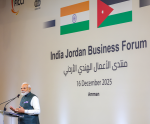
PM Modi invites Jordanian firms to partner India, create robust economic corridor
Amman: Prime Minister Narendra Modi on Tuesday invited Jordanian companies to partner India and reap the benefits of its 1.4 billion consumer market, its strong manufacturing base, and a stable,...
India and Israel reaffirm zero tolerance on terror during EAM Jaishankar’s visit
Jerusalem: External Affairs Minister (EAM) S Jaishankar on Tuesday condemned the recent terror attack at Bondi Beach in Australia's Sydney, asserting that India and Israel have a policy of zero-tolerance...
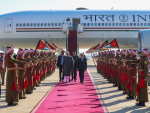
My visit will boost bilateral linkages, says PM Modi after arriving in Jordan
Amman: Prime Minister Narendra Modi on Monday expressed confidence that his visit to Jordan will boost bilateral linkages between two nations. As he began his two-day visit to the nation,...
EAM Jaishankar to co-chair India–UAE Joint Commission in Abu Dhabi, visit Israel next
Abu Dhabi: External Affairs Minister (EAM) S. Jaishankar will co-chair the 16th Joint Commission and 5th Strategic Dialogue in Abu Dhabi on Monday with Sheikh Abdullah bin Zayed Al Nahyan,...
India rejects assertions made by Bangladesh interim govt, reiterates support for free, fair elections
New Delhi: India on Sunday rejected assertions made by Bangladesh's interim government, stating that it has consistently expressed support for fair, free, inclusive and credible elections being held in the...
PM Modi, Trump review India-US Strategic Partnership progress in phone conversation
New Delhi: In a significant development, Prime Minister Narendra Modi held a telephonic conversation with US President Donald Trump on Thursday with both leaders discussing bilateral ties as well as...
Putin reaffirms India as key energy partner despite sanctions heat
New Delhi: Russian President Vladimir Putin used his December visit to New Delhi to reassure India that energy cooperation remains one of Moscow’s top priorities, a report has said. Standing...

US Consulate road in Hyderabad to be named after Donald Trump
Hyderabad: The Telangana government, on Sunday, proposes to name the road leading to US Consulate General building in Hyderabad after the US President Donald Trump, government officials said. The high-profile...