



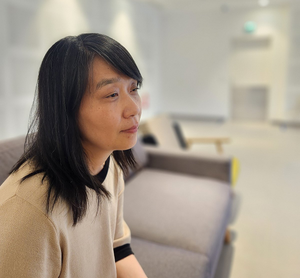
New Delhi: South Korean author and poet Han Kang, who came to global prominence with her unsettling novel “The Vegetarian” (2015), about a woman seeking to reclaim her agency through her food choices but coming to grief in an insensitive and exploitative patriarchal society, was on Thursday awarded the Nobel Prize in Literature 2024 “for her intense poetic prose that confronts historical traumas and exposes the fragility of human life”.
“In her oeuvre, Han Kang confronts historical traumas and invisible sets of rules and, in each of her works, exposes the fragility of human life. She has a unique awareness of the connections between body and soul, the living and the dead, and in her poetic and experimental style has become an innovator in contemporary prose,” the Swedish Academy said in the award citation.
The choice of Han, who is the 117th recipient overall of the top literary award, the 18th woman winner, and the second South Korean Nobel laureate after President Kim Dae-jung – who won the Peace Prize in 2000, indicates that the selection committee cast its eyes wider this year, after choosing Norwegian literateur Jon Fosse “for his innovative plays and prose which give voice to the unsayable” last year.
Born in Gwangju in 1970, Han made her literary debut in 1993 when five of her poems including “Winter of Seoul” were published by the Korean magazine “Literature and Society”, while her first short story “The Scarlet Anchor”, which came out a year later, won a literary contest.
In 1995, she published her first book, “Love in Yeosu”, a collection of stories, but it was “The Vegetarian” (originally published in Korean in 2007), about Yeong-hye, who rebels against her family and friends by eschewing meat, which brought her literary renown.
Using the media of three interrelated stories, Han sketches the struggle and inner conflict of the protagonist from different perspectives and her tribulations – her bid to make her own diet choices peremptorily and forcibly rejected by both her husband and her authoritarian father, her erotic and aesthetic exploitation by her brother-in-law, a video artist who becomes obsessed with her passive body, and her ultimate committal to a psychiatric clinic, where in her delusion and self-destruction mode, she becomes a plant.
The work won the Man Booker International Prize in 2016, making Han its first South Korean recipient.
Han also used her pen to bring sordid episodes from her country’s violent past to light.
In “Human Acts” (2016), she dwelt on the murder of hundreds of students and unarmed civilians in a massacre carried out by the South Korean army in 1980 in her hometown Gwangju, reflecting her long desire to chronicle the tragedy under the military dictatorship. How to prevent such sickening and traumatic violence from recurring was another motivation.
Singling out the work and comparing the motif to ancient Greek playwright Sophocles’ “Antigone”, the Swedish Academy said that her “style, as visionary as it is succinct, nevertheless deviates from our expectations of that genre, and it is a particular expedient of hers to permit the souls of the dead to be separated from their bodies, thus allowing them to witness their own annihilation”.
On the other hand, the autobiographical novel “The White Book”, dedicated to her older sister who died a few hours after birth, gathers fragments of text about things that are associated with the colour, and are visually supplemented by black and white photographs and wide white margins, as well as blank white pages after the last chapter. The effect is a stunning display of the imagery of human suffering yet provides a certain peace and tranquillity – and a celebration of life and human resilience, in its own way.
A 2002 novel (“Your Cold Hands”) about a sculptor who specialises in plaster casts of hands and whose source of inspiration is a student who was abused as a child and is now starving in protest, recently appeared in a German translation.
She has many other works to her credit, dealing with human pain, trauma, and fragility, both in historical as well as imaginary contexts and constructs.
A full-time writer in Seoul now, Hang was been conferred numerous awards in her country, including the Korean Novel Award, in 1999 – less than a decade after she became a published author. She has also taught creative writing for ten years at the Seoul Institute of the Arts.
IANS
‘Adam, Where Are You?’: CM Satheesan’s church speeches turn into bestseller in Kerala
Thiruvananthapuram: The English edition of Chief Minister V.D. Satheesan’s book in Malayalam, 'Adam Nee Evide Aakunnu? (Adam, Where Are You?)' is now keenly awaited, as the Malayalam version continues to...
New Delhi World Book Fair from Jan 4-12
Jan 2, 2019 New Delhi, Jan 2 (IANS) The 28th edition of the much-attended New Delhi World Book Fair (NDWBF) will open at the Pragati Maidan here on Saturday. Marking...
At Lit Fest, actress Nandita Das opposes CAA, NRC
Jan 23, 2020 Jaipur: The controversial CAA and NRC issues reverbated at the Jaipur Literature Festival here as Bollywood actress and director Nandita Das on Thursday opposed the Citizenship (Amendment)...
’26/11 attacks were planned for 27/9; Dawood assigned to kill Kasab’
Feb 18, 2002 Mumbai, Feb 18 (IANS) The 2008 Mumbai terror strikes that took place on 26/11 were originally planned for September 27 that year and the Lashkar-e-Taiba wanted terrorist...
The name Ravi Shankar still spells magic: Sukanya Shankar
By Sugandha Rawal April 4, 2020 New Delhi: Sukanya Shankar feels her late husband and Grammy award-winner musician Pandit Ravi Shankars contribution is not limited to music, and adds that...
Begum Akhtar’s pupil Shanti Hiranand dies at 87
April 10 New Delhi: Padma Shri recipient and disciple of Begum Akhtar, noted Indian vocalist Shanti Hiranand passed away early Friday morning in Gurugram. She was 87. The classical musician...
Noted Urdu satirist Mujtaba Hussain is no more
May 27, 2020 Hyderabad: Celebrated Urdu author, humorist and satirist Mujtaba Hussain passed away here on Wednesday after a prolonged illness. He was 84. According to family sources, he breathed...

Life is so fragile; think, plan, look after each other: Author Vish Dhamija
By Vishnu Makhijanai June 16, 2020 New Delhi: Life is so fragile that even a virus could bring the world to its knees, says London-based author of Indian-origin Vish Dhamija...
Meet the Sompuras who designed Ram temple
By Anindya Banerjee Aug 4, 2020 New Delhi( IANS) Did you know that the man who designed the Ram temple decades back, took a rough measurement using his own feet...
He was, therefore we are: Theatre stars on Ebrahim Alkazi
By Sukaant Deepak Aug 5, 2020 New Delhi: "He is definitely responsible for what I am today. It was Ebrahim Alkazi who laid my creative foundation," says actor Pankaj Kapur,...
Noted poet Rahat Indori passes away
Aug 11, 2002 Indore: Noted Urdu poet Rahat Indori is no more. The 70-year-old poet, who had tested positive for COVID-19 on Monday, passed away here on Tuesday morming following ...
Film, TV production activities to resume with SOP: I&B Minister
Aug 23, 2002 New Delhi: Union Information and Broadcasting Minister Prakash Javadekar on Sunday announced the reopening of the film and TV production industry that has been shut for several...


